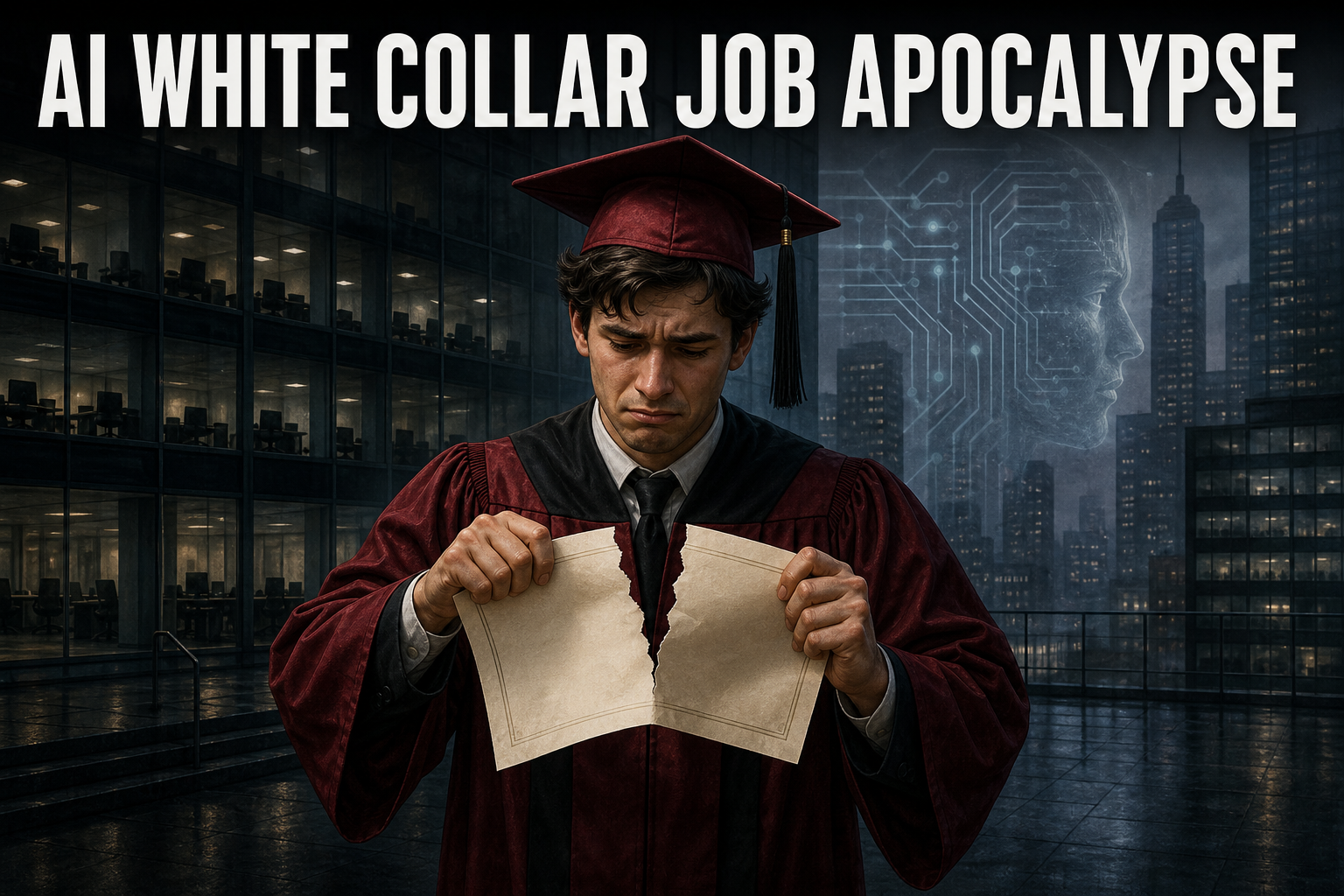
“Apocalypse” gets thrown around loosely in AI coverage, but the data on white-collar work over the next decade doesn’t need the hyperbole to be alarming. The honest picture is layered: the risk isn’t the same at every career stage, the safety net everyone points to—retraining—has a genuinely mixed track record, and the unemployment estimates from serious economists range from “manageable transition” to “the numbers people don’t want to say out loud.”
How Bad Could the White-Collar Job Apocalypse Actually Get?
The estimates span an unusually wide range for how confident the predictions sound. On the alarmed end, Anthropic CEO Dario Amodei has warned that AI could eliminate half of all entry-level white-collar jobs and push unemployment to 10-20 percent within one to five years, specifically naming technology, finance, law, and consulting. “Most of them are unaware that this is about to happen,” he said. “It sounds crazy, and people just don’t believe it.”
On the measured end, Goldman Sachs’ base-case model projects 6-7 percent of U.S. workers displaced over roughly a 10-year transition—translating to only a 0.6 percentage-point rise in the unemployment rate if the shift happens gradually, though economist Joseph Briggs cautions that “if it’s more frontloaded, the impacts on the economy are much larger.” The World Economic Forum lands somewhere in between: 92 million jobs displaced globally by 2030, offset by 170 million created—a net gain, but one that assumes the displaced and the newly employed are the same people with the same skills, which is exactly the assumption the rest of this article tests.

Must See Also: AI Jobs Shock: Why Anthropic’s “White‑Collar Bloodbath” Matches The Government’s Plan to Contain the Alien Contagion
The Youngest White-Collar Workers Are Already Losing the Front Door
This isn’t speculative for Gen Z entering the workforce—it’s already measurable. Stanford’s Digital Economy Lab found that employment among 22-to-25-year-olds in highly AI-exposed occupations now sits about 19 percent below where it would be if it had kept pace with less-exposed peers—up from a 15 percent gap just a year earlier. Critically, the mechanism is reduced hiring, not layoffs: employers simply aren’t opening as many entry-level seats. The damage concentrates in roles built on codified knowledge—the kind taught from a manual—while roles built on tacit, mentorship-based knowledge are holding steady. That’s the cruelest part of the mechanism: entry-level jobs are traditionally how workers acquire the tacit knowledge that protects them later, and AI is closing that door before they can walk through it.
Must See Also: Will Gen Z be Employable?
Mid-Career Workers Are the Ones Actually Being Automated
If entry-level workers are locked out, mid-career white-collar workers are the ones actually facing the automation itself—and the exposure numbers are steep for exactly the roles that built the modern white-collar middle class. Estimates of task exposure to AI run as high as 74.5 percent for computer programmers, 70.1 percent for customer service representatives, and 67.1 percent for data entry roles. Unlike a new graduate, a mid-career worker usually can’t simply wait the disruption out—they have a mortgage, dependents, and a narrower runway to pivot, all while being asked to learn new tools fast enough to stay useful in the same job they’re being asked to shrink.

Must See Also: AI Job Apocalypse and Alien Contagion: Why Overpopulation from AI is the Government’s Real Crisis
Older Workers Face a Different Kind of Exclusion
For workers closer to the end of their careers, the barrier isn’t automation risk so much as a closed door dressed up as a skills gap. Research from the workforce nonprofit Generation found that 90 percent of U.S. hiring managers would consider candidates under 35 for AI-related roles, compared to just 32 percent for candidates over 60—despite only 15 percent of workers over 45 currently using generative AI tools at work in the first place, largely because employers rarely offer them the training to start. Among older workers who do adopt AI, more than half report real gains in productivity and decision-making, which makes the access gap look less like a skills problem and more like a hiring-bias problem wearing a technology costume.
Must See Also: AGING BABY BOOMERS And The Coming Labor Shock The Government Won’t Talk About
Does Retraining Actually Work?
Retraining is the answer every institution reaches for, and the evidence for it is weaker than the confidence with which it gets recommended. A 2026 NBER working paper analyzing over 119,000 federal training records found that only about 45 percent of occupations are genuinely “AI-retrainable”—and the direction of a successful move matters more than the retraining itself. Workers starting in low-AI-exposure jobs benefit from upskilling into more AI-intensive roles, but workers starting in high-exposure jobs succeed by moving into different, more AI-resistant fields entirely, like nursing or transportation—not by training harder for the field that’s displacing them.
That last point cuts against a lot of retraining advice, and other data backs it up: Harvard economists found workers who retrained specifically to move into AI-exposed occupations faced a 29 percent earnings penalty compared to peers who moved into non-AI fields instead. Broader outcomes aren’t much better—a meta-analysis of 40 rigorous retraining programs found participants were only 2.6 percentage points more likely to find work afterward, with wage gains averaging roughly $1,200 a year, and corporate platforms like Salesforce’s Trailhead see fewer than 12 percent of enrollees even finish a learning path. As Brookings researcher Elisabeth Jacobs put it, after nine decades of U.S. workforce retraining programs, “the evidence base for large-scale workforce retraining as an effective response to technological displacement is, at best, weak.”
Must See Also: AI Job Losses Are Already Here — And the “Fixes” on the Table Prove the Overpopulation Problem Is Real
Put the pieces together and “apocalypse” starts to look less like a single event and more like three separate, ongoing squeezes happening at once—one at the front door, one in the middle of the workforce, and one on the way out—with a retraining safety net that catches fewer people than the policy conversation assumes. Whichever unemployment estimate turns out closest to right, the decade ahead is being shaped less by whether AI can do the work, and more by whether anyone is actually held accountable for who gets left out when it does.