What happens when a regional jobs crisis becomes a national employment emergency? The Homeland Controls Study Committee recommends a time-limited National Employment Emergency Act that sets federal minimum income continuity, expands wage insurance and health-coverage protection, and pairs transfers with rapid supply expansion—while keeping the response under statute, appropriations, and judicial review rather than executive emergency power.
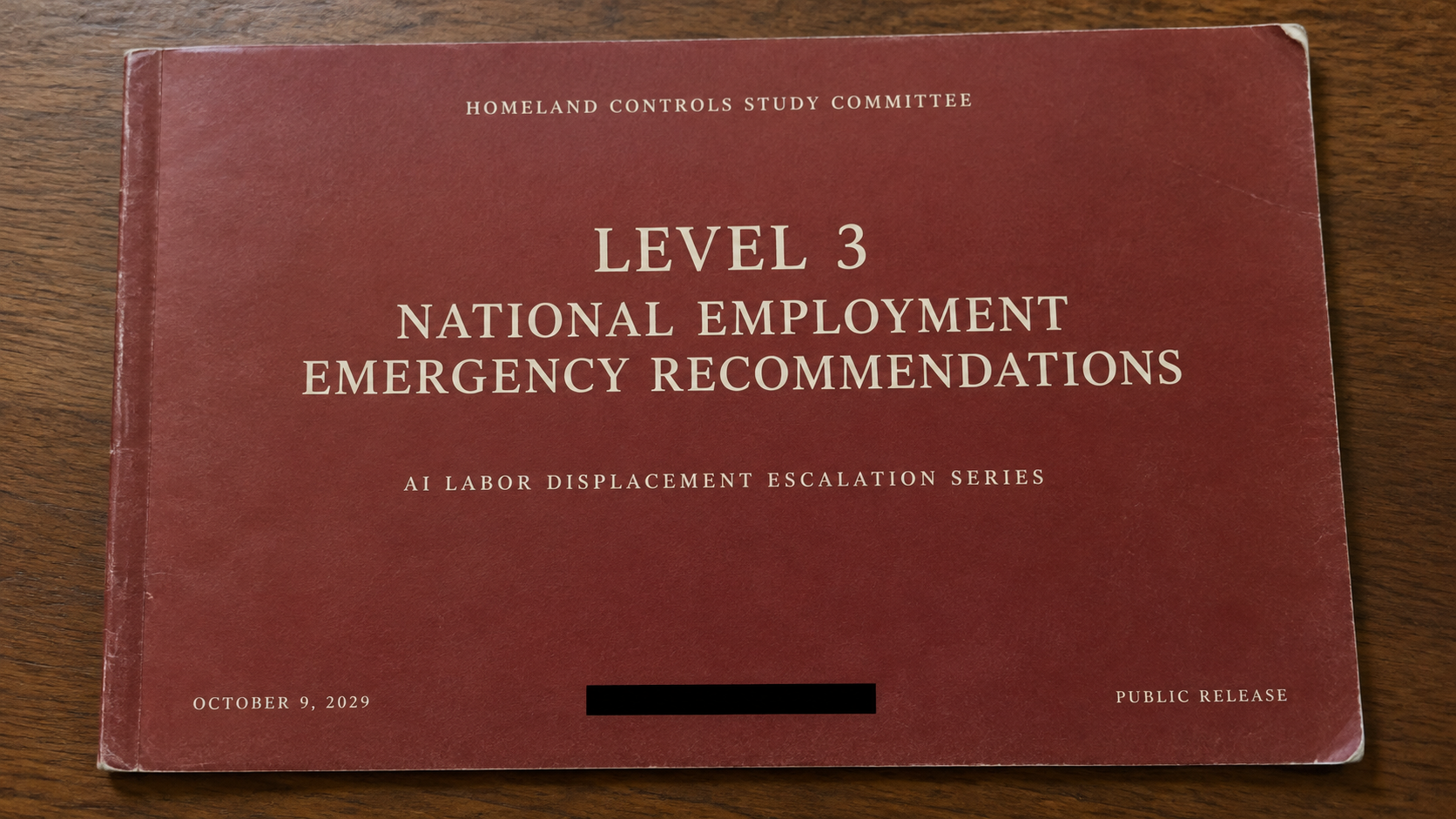
Homeland Controls Study Committee
Document: HCL-29-057
Prepared for: Homeland Controls Study Committee
Proposed operating authority: National Economic Continuity Council under congressional authorization
Activation level: Level 3 — National Employment Emergency
Status: Independent scenario-planning research prepared for Christians and Aliens. This document is not issued by, on behalf of, or under the authority of the United States Government, any state government, or any existing public agency. The institutions and authorities proposed below do not exist unless established through lawful executive, legislative, or interstate action.
Classification: Public Release — Analytical Planning Assessment
Date: October 9, 2029
Executive Summary
The official U.S. unemployment rate has reached 10 percent, equal to approximately 17 million unemployed workers under the study’s 170 million-person labor-force planning assumption. The broader economically unstable workforce is estimated at 30 million to 50 million people after accounting for underemployment, declining hours and earnings, contingent-work deterioration, contract-income collapse, labor-force exit, benefit loss, and blocked entry into stable employment. Approximately 18 million to 30 million workers require direct continuity support, and 55 million to 85 million people are exposed when dependent household members are included. Severe employment or income deterioration has persisted for two quarters across California, Texas, Florida, New York, Pennsylvania, Illinois, and Ohio. The affected states report related pressure in housing, food access, health coverage, child care, caregiving, behavioral health, unemployment administration, and local government finance. Regional compacts have slowed deterioration but cannot finance or administer the necessary scale of income replacement, benefit continuity, household stabilization, and productive-capacity investment. The Level 3 threshold is met. The Committee recommends that Congress enact a time-limited National Employment Emergency Act establishing uniform minimum support, financing federal administrative and state delivery capacity, expanding work sharing and wage insurance, protecting health and benefit continuity, supporting housing and essential household needs, creating paid transition and public-purpose pathways, stabilizing state and local government, and pairing transfers with rapid supply expansion. The fiscal burden is national. Under the study model, a 10 percent official unemployment condition can correspond to approximately $1.4 trillion to $2.2 trillion in additional annual public support under a full-and-partial support policy. Including illustrative revenue loss and automatic-stabilizer pressure, combined fiscal deterioration could reach approximately $1.9 trillion to $3.1 trillion annually. These ranges are not forecasts or formal budget scores; Congress should require updated scoring, sensitivity analysis, and real-resource assessment before enactment. The response must operate through statute, appropriations, oversight, and judicially reviewable rules. An executive declaration alone is insufficient authority for new national entitlements, major state obligations, compulsory employer requirements, or trillions of dollars in spending. Level 3 shall not suspend elections, due process, judicial review, appropriations control, labor rights, civil rights, privacy law, or the constitutional division of powers.
Findings
- Existing state variation creates unequal protection. A national shock requires federal minimum standards while allowing states to administer more generous or locally tailored measures.
- Income replacement alone is insufficient. Without housing, health, food, care, transportation, and benefit-delivery capacity, cash support may arrive too late or bid against constrained essential supplies.
- Administration is national infrastructure. Eligibility systems, identity recovery, payment rails, call centers, appeals, cybersecurity, providers, and local navigators require sustained federal investment.
- Productivity gains and public costs are misaligned. If labor-saving gains remain concentrated while public systems carry household-support costs, fiscal and political legitimacy will deteriorate.
- Emergency authority must remain temporary. High unemployment justifies large-scale support, not indefinite administrative power or control of people.
Statutory Framework
Congress should enact a National Employment Emergency Act with an initial 24-month authorization and a mandatory review at 12 months. The Act should establish the National Economic Continuity Council as a statutory interagency coordinator; preserve the legal authorities of member departments; specify any new powers; require appropriations; and create enforceable rights, transparency, audit, and sunset provisions. The President should nominate, and the Senate should confirm, a National Economic Continuity Administrator for the emergency term. The Administrator should coordinate rather than replace the Secretaries responsible for labor, health, housing, food, education, commerce, energy, transportation, agriculture, treasury, and small business programs. Congress should create an independent Economic Continuity Oversight Board composed of inspectors general, state and local administrators, economists, fiscal experts, worker and employer representatives, disability and caregiver advocates, privacy and civil-rights experts, and public-interest members. The Board should publish quarterly evaluations and may refer violations to inspectors general, civil-rights offices, Congress, or courts, but should not exercise law-enforcement or benefit-adjudication power.
Recommendations
Establish National Minimum Income Continuity
Congress should establish a temporary federal floor for unemployment duration, partial benefits for reduced hours, support for qualifying intermittent and independent workers, and a declining wage-insurance supplement for displaced workers reemployed at substantially lower pay. States may provide greater protection. Benefits should respond to depth and duration of loss rather than impose a single permanent payment. Fully unemployed households should receive a basic continuity package calibrated to household resources and regional costs; underemployed workers should receive partial support that preserves incentives and avoids benefit cliffs. Essential subsistence should not be conditioned on political speech, religious activity, relocation, biometric enrollment without an alternative, or acceptance of unsafe or unsuitable work.
Nationalize Work-Sharing Support, Not Employment Control
Congress should provide full or enhanced federal financing for state Short-Time Compensation during the Level 3 period and fund adoption in states without operational programs. Short-Time Compensation is an established layoff-aversion model under which employers reduce hours in lieu of layoffs and participating workers receive partial unemployment benefits (U.S. Department of Labor). Federal assistance to large employers should require a workforce-impact plan, worker notice and consultation, benefit preservation, nondiscrimination, no retaliation, and reporting of layoffs avoided. Government should not dictate ordinary staffing decisions absent statutory authority; it may attach lawful conditions to public money and procurement.
Guarantee Benefit Continuity
Congress should authorize temporary federal support to preserve or rapidly replace health coverage, disability supports, retirement contributions where appropriate, paid leave, and training access when employment is lost or hours fall. HHS should establish no-gap coverage procedures using Medicaid, CHIP, marketplace, COBRA, and other lawful channels. States may request Medicaid demonstrations under Section 1115 where a proposed project advances Medicaid objectives and meets federal requirements; those demonstrations are reviewed case by case and are not a substitute for national legislation (Medicaid.gov). Congress should separately legislate any nationwide eligibility or financing change it intends.
Create a National Benefits Delivery Standard
The Department of Labor, in coordination with OMB, GSA, NIST, the Treasury, state agencies, and claimant representatives, should issue enforceable standards for availability, processing, notices, language and disability access, identity proofing, account recovery, human review, appeals, cybersecurity, interoperability, auditability, and performance reporting. GAO has found that aging state unemployment systems hindered claims processing and recommended federal modernization standards and state performance measurement (GAO). Congress should fund modular modernization, shared components, independent verification and validation, legacy-system operation during transition, and public testing. A single national database of unemployed people is neither necessary nor authorized.
Stabilize Housing, Food, Health, and Utilities
Congress should fund a National Household Continuity Account with separate windows for rental and mortgage stabilization, utility continuity, food assistance and logistics, health coverage and medication, behavioral health, child care, disability services, and caregiving. States should administer programs under federal minimum standards and may coordinate applications with informed consent. Assistance should prevent irreversible losses: eviction, foreclosure, homelessness, hunger, untreated illness, medication interruption, child-care collapse, or loss of essential home and community-based care. Payments should be calibrated to need and regional costs, subject to due process and program-integrity controls.
Protect Children and Dependents
Schools and eligible community providers should receive funding for meal continuity, counseling, tutoring, connectivity, and family navigation. Child-care and care-provider stabilization should preserve safe licensed capacity. Dependent adults should retain continuity of disability, home-care, and elder-care supports during household employment transitions. Programs must not assign a lower priority to people who are not in the labor force. Children, disabled people, retired people, and family caregivers are affected by earner displacement even when they are not counted as unemployed.
Launch Paid National Transition Pathways
Congress should fund paid apprenticeships, transitional employment, on-the-job training, community-college partnerships, professional residencies, and supervised junior roles tied to verified demand. Registered Apprenticeship already offers a paid, mentored pathway with progressive wages, instruction, and a portable credential (Apprenticeship.gov). Priority should go to health and care work, housing construction and rehabilitation, energy and grid systems, water, transportation, manufacturing, cybersecurity, education support, environmental resilience, infrastructure inspection, repair, logistics, and public administration. Programs should pay wages and benefits, recognize prior learning, provide accommodations and care supports, and publish completion, placement, retention, and wage outcomes.
Establish Voluntary Public-Purpose Employment
Where private demand is insufficient, Congress should authorize voluntary, time-limited public-purpose employment through state, local, tribal, nonprofit, and qualified private partners. Eligible work may include housing rehabilitation, weatherization, infrastructure inspection, environmental restoration, digitization of public records, community health support, tutoring, food resilience, disaster readiness, and care services. Positions must pay fair wages, provide labor protections and portable credentials, avoid displacement of existing workers, and permit participants to leave for other work. Refusal of a placement must not trigger loss of food, emergency health care, shelter, due process, or other essential subsistence.
Stabilize States and Localities
Treasury should provide formula-based and need-adjusted fiscal aid to maintain essential public services, benefit administration, schools, courts, public health, transit, emergency communications, libraries, and infrastructure maintenance. Aid should be conditioned on transparent accounting, service-continuity plans, and restrictions on unrelated tax subsidies, political activity, and surveillance technology. Balanced-budget pressure should not force procyclical layoffs that intensify the emergency. At the same time, federal aid should not permanently underwrite structural state commitments without a long-term financing plan.
Pair Support with Supply Expansion
Every major transfer program should be paired with measures that expand constrained essentials: housing, grid and energy capacity, water, transportation, broadband, health care, behavioral health, medication access, child care, elder care, disability services, food distribution, construction, and skilled maintenance. Federal procurement and grants should use competitive awards, milestone payments, labor and accessibility standards, cost controls, and clawbacks. Emergency procedures may accelerate decisions but should not eliminate environmental review, fair housing, worker safety, competition, or public integrity requirements beyond what Congress expressly authorizes.
Align AI Gains with Continuity Costs
Congress should evaluate financing options that reflect the relationship between publicly supported AI deployment, concentrated productivity gains, and public continuity costs. Options may include ordinary progressive revenues, time-limited excess-profit mechanisms, revised treatment of automation-related capital expenditures, user fees tied to federal AI infrastructure, or broad-based revenue measures. The Committee does not endorse a specific tax without distributional, investment, avoidance, constitutional, and administrative analysis. Recipients of large federal AI, computing, energy, or procurement benefits should submit workforce-impact and community-benefit plans. Conditions should reward augmentation, work sharing, paid training, junior-role preservation, domestic capacity, and worker participation.
Protect Fiscal Credibility
Treasury, OMB, CBO, and GAO should provide quarterly public estimates of benefit obligations, administrative costs, revenue effects, borrowing, interest exposure, supply constraints, inflation pressure, state and local conditions, and program outcomes. Congress should appropriate funds directly and avoid hidden or indefinite off-budget vehicles. Automatic stabilizers should expand and contract under published formulas. New emergency programs should contain expirations, renewal votes, audit access, fraud-risk assessments, recapture authority, and transition rules that prevent abrupt harm.
Implementation Schedule
| Deadline | Required action |
|---|---|
| First 10 days | President submits legislative request and public trigger record; agencies preserve Level 2 operations and prepare national surge. |
| First 30 days after enactment | Appoint Administrator and Oversight Board; issue interim benefit, rights, data, procurement, and fiscal rules; release state administrative grants. |
| First 60 days | Begin national minimum income continuity; expand work sharing and wage insurance; activate household and local fiscal accounts. |
| First 90 days | Open paid transition and voluntary public-purpose pathways; publish state performance dashboards; award urgent supply-capacity projects. |
| Six months | Complete independent delivery, equity, privacy, fiscal, inflation, and supply assessment; correct failed systems and contracts. |
| Twelve months | Congress conducts renewal hearing and votes on continuation, modification, or wind-down; independent Board issues public findings. |
| Twenty-four months | All extraordinary authorities expire unless reenacted; ordinary benefits continue only under their governing statutes. |
Deactivation and Escalation
Level 3 should deactivate when severe employment and income indicators remain below Level 3 thresholds for two consecutive quarters, household stress is declining, state and local delivery meets standards, and essential-service capacity is stable. Income and coverage programs should taper according to statute rather than terminate overnight. Level 4 should be considered only if Level 3 conditions persist and there is sustained failure in housing, food, health care, child care, caregiving, local services, or critical-workforce capacity across multiple states. Congress must make the finding, define any additional powers, appropriate funds, and preserve courts, elections, due process, and independent oversight.
Rights, Privacy, and Democratic Safeguards
Activation of this level expands assistance and administrative capacity. It does not convert displaced workers or their dependents into a security category. Every participating agency shall operate under the following restrictions:
- No generalized domestic surveillance, individual employment-risk score, centralized registry of displaced persons, political or religious profile, genetic or medical classification, or benefit-status passport.
- No compelled labor, forced relocation, movement restriction, detention, censorship, involuntary medical treatment, or denial of food, housing, health care, education, legal process, or other essential service based on employment status.
- No fully automated adverse eligibility decision. Applicants shall receive notice, a plain-language explanation, access to the record used, human reconsideration, and an appeal before benefits are terminated or recouped, except for narrowly defined immediate fraud holds subject to prompt review.
- Data collection shall be limited to a stated program purpose, minimized, encrypted, access-controlled, independently audited, and deleted under published retention schedules. Aggregate occupational, sector, cohort, program-outcome, and regional data shall be preferred over person-level data.
- Program rules, trigger calculations, contracts, audit results, error rates, demographic access measures, and spending shall be publicly reported, except where disclosure would expose personal information or defeat lawful fraud controls.
- Inspector-general review, civil-rights review, privacy-impact assessment, legislative oversight, judicial review, and protected whistleblower reporting shall continue during every activation. The institutional warning explored in The Government’s Plan to Contain the Alien Contagion is treated here as a caution against allowing emergency planning to become a system for classifying, sorting, or controlling people. The lawful objective is economic continuity and human resilience.
Common Performance Measures
All funded measures shall report results at 30-day, quarterly, and annual intervals using a common data dictionary. Required measures include:
- Official unemployment, labor-force participation, long-duration unemployment, hiring, replacement hiring, separations, hours, real earnings, benefit loss, and contractor-income deterioration.
- Entry-level openings, apprenticeships, paid work-based learning, completions, six- and twelve-month retention, wage progression, credential portability, and employer demand.
- Claim-processing time, payment accuracy, appeal time, identity-recovery time, improper-payment rates, claimant abandonment, language access, disability access, and service wait times.
- Rent and mortgage arrears, eviction filings, utility disconnections, food-assistance demand, health-coverage interruptions, medication continuity, child-care availability, caregiver burden, crisis-line demand, and behavioral-health wait times.
- State and local revenue stress, reserve drawdowns, staffing vacancies, infrastructure deferrals, nonprofit capacity, school and hospital stress, and critical-workforce shortages.
- Program cost per household stabilized, cost per layoff averted, cost per sustained placement, administrative cost, fiscal exposure, geographic equity, and distribution of benefits by income and household type. The Observatory shall publish uncertainty ranges and distinguish correlation from verified AI causation. No single indicator, employer announcement, model output, or news report shall determine activation or eligibility.
Committee Direction
The national employment emergency requires national financing and minimum protections, but not the nationalization of ordinary life. Government should stabilize households, preserve institutions, expand productive capacity, and distribute the gains and burdens of technological change more fairly. Emergency programs must remain lawful, reviewable, and temporary.