Could AI create a permanent, cross-income unemployed class in the United States? This provisional 180-day risk assessment finds no proof of that yet, but flags a real warning sign—entry-level hiring is already lagging in AI-exposed occupations—and calls for an immediate national early-warning system rather than a wait-and-see approach.
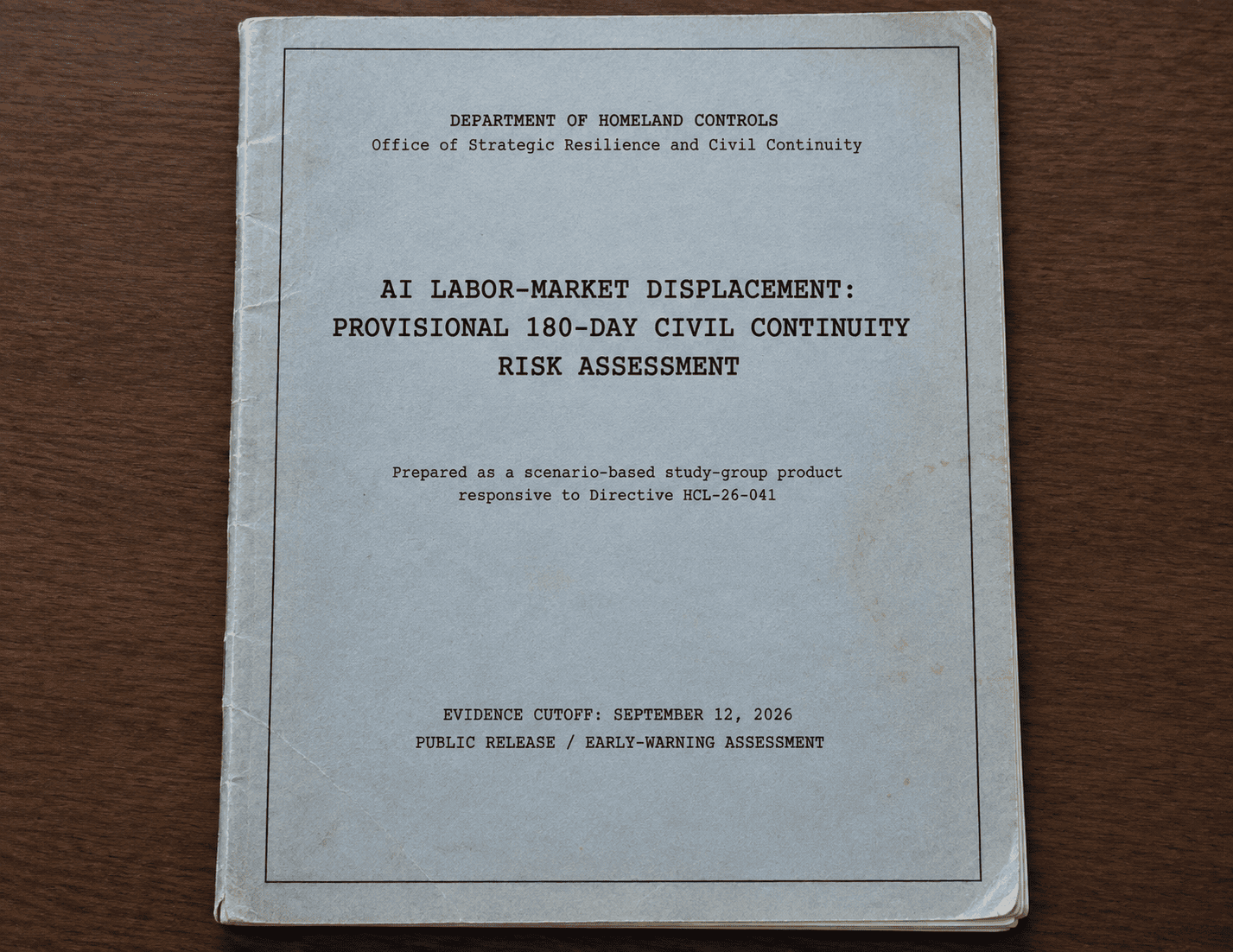
Prepared as a scenario-based study-group product responsive to Directive HCL-26-041
Evidence cutoff: September 12, 2026
Status: Simulated and prospective—not an actual report of the United States government or any existing federal agency
Classification: Public release / early-warning assessment
AI Labor-Market Displacement: Executive Summary
AI Labor-Market Displacement: Bottom-line judgment
The study group’s central conclusion is negative but qualified: the United States is not yet experiencing proven economy-wide technological unemployment caused by artificial intelligence, but the evidence is sufficient to justify an immediate national early-warning posture. The most credible danger is not a single wave of conspicuous layoffs. It is a slower, harder-to-measure process in which employers hire fewer entry-level workers, automate portions of professional and clerical jobs, compress wages, reduce hours, consolidate functions, and allow the career ladder to break from the bottom upward.
That conclusion reconciles apparently conflicting findings. The Stanford Digital Economy Lab’s August 2026 update found no widespread economy-wide AI displacement, yet reported that employment of workers ages 22–25 in highly exposed occupations stood 19% below where it would have been had it kept pace with less-exposed peers; the divergence mainly reflected reduced hiring rather than increased separations. By contrast, The Budget Lab at Yale found no clear AI-related footprint in occupational mix, employment, or unemployment through July 2026, while the Federal Reserve’s analysis of firm job-posting behavior found no evidence that greater AI adoption had reduced job postings. These results do not cancel one another. They indicate that aggregate stability can coexist with concentrated damage among younger workers and in uses of AI that substitute for labor.
The negative assessment rests on five compounding vulnerabilities. First, exposure is broad: the International Monetary Fund estimates that about 60% of employment in advanced economies is exposed to AI, with roughly half of that exposed employment potentially affected adversely and the remainder potentially benefiting from complementarity. Second, AI capability continues to advance rapidly; METR reports an exponential increase in the length of tasks frontier systems can complete. Third, actual AI usage is moving beyond isolated experimentation: the Anthropic Economic Index documents AI use across many occupations and distinguishes automation, in which users delegate tasks, from augmentation, in which workers collaborate with systems. Fourth, the United States enters this transition with food, housing, health-insurance, mental-health, and local-fiscal vulnerabilities already present. Fifth, the principal protective systems—unemployment insurance, workforce retraining, portable benefits, housing assistance, and local economic adjustment—are fragmented and are not designed for persistent, cross-income displacement.
AI Labor-Market Displacement: Key conclusions
- The first national warning is likely to appear in hiring, not layoffs. Entry-level recruiting, junior professional roles, internships, apprenticeships, contract work, and replacement hiring are the most sensitive indicators. A labor market may look stable while an entire cohort loses access to the experience required for later-career employment.
- The severe risk is occupational ladder failure. If AI performs the routine work through which novices learn, organizations can retain experienced workers temporarily while eliminating the roles that produce their successors. The near-term result is youth underemployment; the delayed result is a shortage of experienced human judgment, supervisors, maintainers, auditors, and emergency replacements.
- Retraining alone is unlikely to be sufficient. Training is useful when it leads to verified demand. It fails when large numbers of workers are trained for the same narrow occupations, when AI capability changes faster than curricula, when displaced workers cannot finance transition periods, or when destination jobs are themselves exposed to automation.
- The burden will be geographically uneven. The Brookings Institution’s analysis of automation and place shows why communities concentrated in routine employment and with weaker reallocation capacity can experience deeper disruption than national averages reveal. A national unemployment rate can therefore understate local civil-continuity risk.
- Household distress can accelerate faster than employment statistics. Lost hours, unstable schedules, depleted savings, benefit loss, delinquency, food insecurity, and postponed care may become visible before official unemployment. The USDA’s research found that higher unemployment is associated with greater food insecurity, while KFF’s analysis confirms that job loss or employer change remains a major reason adults lose health coverage.
- Long-duration displacement is a public-health threat. A systematic review and meta-analysis found elevated suicide risk after unemployment, with the greatest relative risk in the first five years. A more recent meta-analysis of 327 results from 65 peer-reviewed articles found that unemployment’s strongest effects fall on psychological health and that long-term spells are more harmful than short ones.
- Fraud and criminal exploitation will rise if emergency benefits are expanded without modern controls. The Government Accountability Office estimated that fraud in pandemic unemployment programs was likely between $100 billion and $135 billion, demonstrating the scale of loss possible when obsolete state systems are forced to deliver emergency aid quickly.
- Civil-continuity danger comes from feedback loops. Displacement reduces earnings and consumption; lower consumption weakens local businesses and tax receipts; fiscal stress reduces services; declining services and opportunity accelerate migration, family stress, criminal recruitment, political anger, and distrust; those effects then impair investment and recovery.
- Critical infrastructure presents a two-sided risk. AI investment can create labor shortages in specialized construction and maintenance even while displacing other workers. CSIS estimates that major AI-infrastructure expansion could require tens of thousands of additional electricians, HVAC technicians, welders, and related skilled workers by 2030. The country could therefore face simultaneous unemployment in some occupations and shortages in safety-critical trades.
- The government should establish an interagency working group now, but should not yet create a permanent department. The recommended immediate institution is a time-limited National AI Labor Displacement and Civil Continuity Working Group. A cabinet-level body should be considered only if predefined indicators show persistent, multi-sector, multi-region disruption that existing agencies cannot manage.
- “Department of AI Controls” may be used only as a provisional scenario-planning name. If used, “control” must refer to controlling destabilizing technological and economic conditions—not controlling displaced people. The name carries a serious risk of implying that unemployed citizens are alien, contaminating, or dangerous; any actual department should therefore use a neutral statutory name such as the Department of Economic Continuity and Human Resilience.
- Rights protections are operational necessities. Population control, compelled labor, involuntary treatment, religious or political screening, generalized domestic surveillance, movement restrictions, discriminatory status systems, and denial of ordinary services would violate the directive and would intensify the instability the government seeks to prevent.
AI Labor-Market Displacement: Immediate warning
The warning is not that mass unemployment has already arrived. The warning is that the systems needed to detect and manage it are not ready, while labor substitution can spread faster than legislation, benefit modernization, educational reform, housing relief, and local economic diversification. Waiting for an economy-wide unemployment spike would leave the government reacting after household balance sheets, local tax bases, career pipelines, and public trust had already deteriorated.
 Must See Also: AI Jobs Shock: Why Anthropic’s “White-Collar Bloodbath” Matches The Government’s Plan to Contain the Alien Contagion
AI Labor-Market Displacement: Mandate and Method
AI Labor-Market Displacement: Mandate
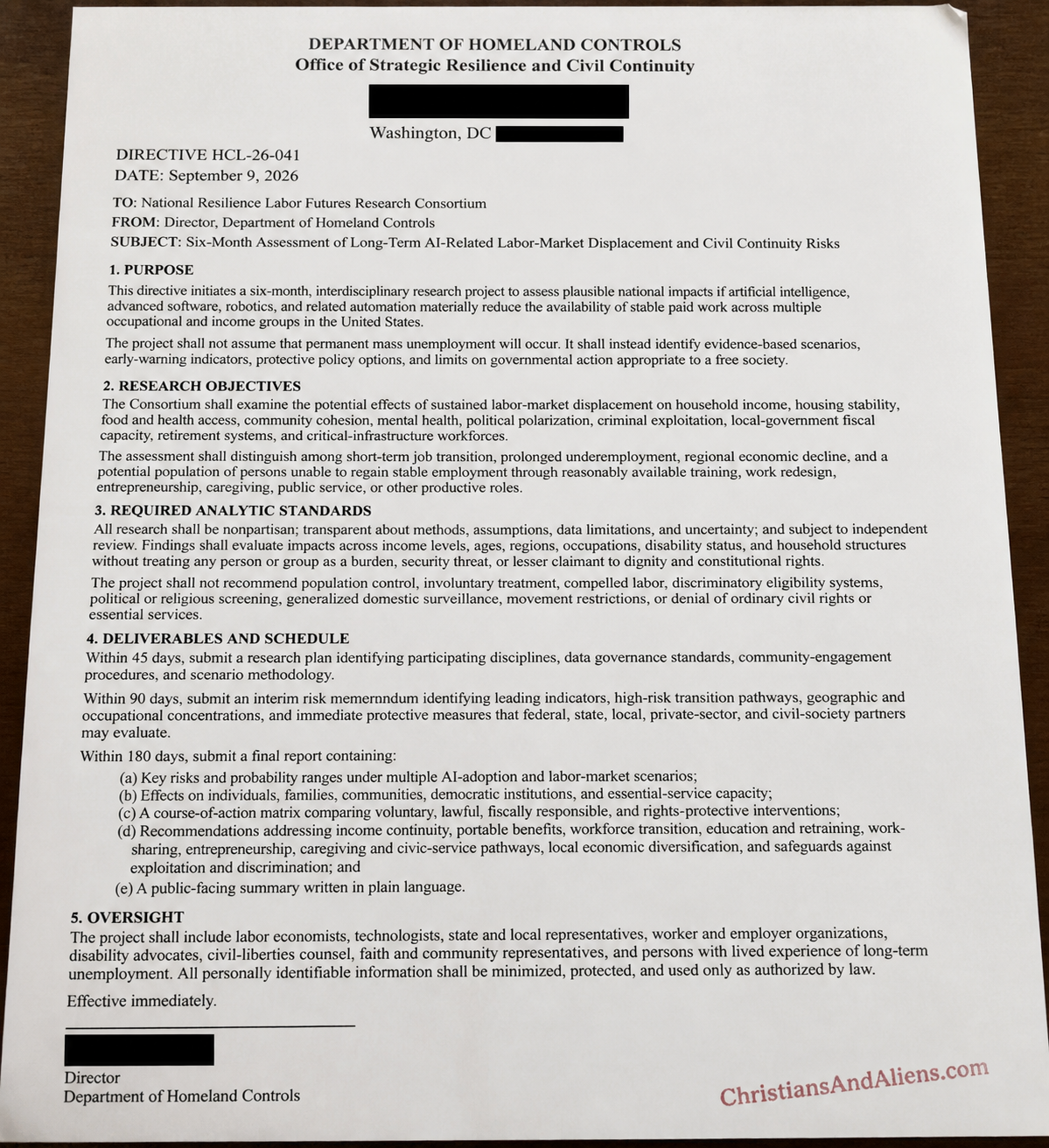
This assessment responds to the scenario directive published as Directive HCL-26-041. The directive calls for evidence-based scenarios, early-warning indicators, protective options, and limits on government action while expressly forbidding population control, involuntary treatment, compelled labor, discriminatory eligibility, political or religious screening, generalized domestic surveillance, movement restrictions, and denial of ordinary rights or essential services.
Because the directive is dated September 9, 2026 and the evidence cutoff is September 12, 2026, this document is a prospective simulation of the conclusions a 180-day study group could reach. It is not represented as the completed work of a real agency, and its scenario probability ranges are structured planning judgments rather than measured forecasts.
AI Labor-Market Displacement: Analytical approach
The study group applied six principles:
- Triangulation: Give greatest weight to administrative payroll data, official labor-market statistics, peer-reviewed research, government evaluations, and primary-source AI-usage data.
- Contrary evidence: Include findings that do not show present disruption, rather than selecting only pessimistic evidence.
- Mechanism over headlines: Distinguish job exposure, task automation, reduced hiring, hours reductions, wage effects, layoffs, unemployment, and permanent labor-force exit.
- Distribution over averages: Examine age, occupation, geography, disability, education, household structure, and income rather than relying on national averages.
- Cascade analysis: Evaluate how labor displacement can transmit into housing, food, health, local finance, retirement, political trust, crime, and essential services.
- Rights-protective response: Treat every person as a citizen and rights-holder, not as a cost center, threat category, or “surplus” population.
AI Labor-Market Displacement: Evidence limits
Current evidence cannot establish that permanent mass unemployment will occur. The Budget Lab and the Federal Reserve provide strong reasons not to declare an existing economy-wide AI employment crisis. Exposure estimates also do not equal displacement: a task may be assisted, transformed, or automated without eliminating the whole job.
The downside case nevertheless deserves elevated attention because weak aggregate effects can conceal cohort and occupational damage. The National Academies does not foresee an imminent vast increase in technological unemployment, but warns that AI can erode the market value of human expertise, put downward pressure on wages, and amplify surveillance, privacy, fairness, and discrimination concerns. That is precisely the pattern in which hardship accumulates before it becomes visible as mass unemployment.
 Must See Also: WHO Contingency Plans and the PHSM Navigator—How Global Health Playbooks Echo The Government’s Plan to Contain the Alien Contagion
AI Labor-Market Displacement: Scenario Findings
AI Labor-Market Displacement: Planning scenarios through 2031
The following bands are judgmental planning estimates, not econometric predictions. They are intentionally downside-sensitive and should be revised quarterly against observed data.
| Scenario | Judgmental probability | Labor pattern | Civil-continuity consequence |
|---|---|---|---|
| A. Uneven augmentation | 40%–55% | Economy-wide employment remains broadly stable; AI changes tasks; concentrated entry-level and clerical losses; wage pressure in exposed occupations | Manageable nationally, but severe for selected cohorts and communities; persistent resentment if gains accrue mainly to capital and senior workers |
| B. Persistent displacement | 25%–40% | Reduced hiring spreads across professional, administrative, customer-service, finance, media, and technology roles; underemployment and labor-force exit rise; replacement occupations grow too slowly | Housing, health, food, and local-budget pressures become visible in multiple regions; existing workforce systems become overloaded |
| C. Structural employment emergency | 10%–20% | Broad substitution combines with recession or financial shock; unemployment reaches sustained high single digits or worse; long-term unemployment grows across income groups | Major benefit expansion, mortgage and rental intervention, state fiscal aid, and critical-service workforce protection required; political extremism and fraud accelerate |
| D. Systemic rupture | 2%–8% | Rapid autonomous capability, corporate adoption, and macroeconomic contraction outpace job creation and policy response; stable paid work becomes unavailable to a large minority | Existing federal-state delivery systems fail under scale; national civil-continuity operations required; extraordinary risk of authoritarian overreach |
The scenarios are mutually directional but not mechanically exclusive. The country could move from Scenario A to Scenario C if rapid capability gains coincide with recession, credit tightening, energy disruption, a financial crisis, or aggressive cost-cutting. Conversely, AI-led productivity growth, work redesign, new business formation, shorter workweeks, and effective income stabilization could keep the country within Scenario A.
AI Labor-Market Displacement: Why the downside is credible
The downside becomes credible when broad exposure combines with substitution rather than augmentation. The IMF’s exposure analysis places about 60% of advanced-economy employment in AI-exposed occupations. The Anthropic Economic Index shows that real usage includes both collaborative and delegated modes across computer, media, education, sales, administrative, and other work. The Stanford AI Economic Indicators report that occupations with higher automation-oriented usage show weaker early-career employment trends than occupations where AI usage is more augmentative.
Capability progress strengthens the case for vigilance. METR’s research found rapid growth in the length of software and research tasks frontier models can complete autonomously. Benchmarks do not translate directly into layoffs, but they indicate that the technical boundary is moving faster than most workforce, education, and benefit systems can be redesigned.
AI Labor-Market Displacement: Why catastrophe is not predetermined
The World Economic Forum’s Future of Jobs Report 2025 projects substantial global job creation as well as job displacement by 2030, with a positive net balance in its employer survey. The Federal Reserve has found no reduction in job postings associated with higher AI adoption, and Yale’s Budget Lab has found no clear aggregate AI labor-market footprint. These findings make an immediate declaration of mass unemployment unsupportable.
They do not justify passivity. Forecasts of net job creation do not guarantee that displaced workers will occupy the new jobs, that new jobs will exist in the same communities, that wages and benefits will be equivalent, or that transitions will occur without years of hardship. A positive national net can coexist with devastated local labor markets and a generation shut out of professional entry.
 Must See Also: AI Job Losses Are Already Here—And the “Fixes” on the Table Prove the Overpopulation Problem
AI Labor-Market Displacement: Point-by-Point Foundations
AI Labor-Market Displacement: Employment and wages
Conclusion: The initial impact is likely to be occupationally concentrated, age-skewed, and visible through reduced hiring and work intensity before unemployment.
Foundation: Stanford’s payroll-based evidence identifies a widening gap for workers ages 22–25 in highly AI-exposed occupations, driven primarily by reduced hiring. Yale and Federal Reserve analyses do not find aggregate disruption, which suggests that the early phase can remain hidden inside an apparently stable national market. The National Academies warns that AI may reduce the value of human expertise and put downward pressure on wages even without mass unemployment.
Negative implication: A hiring freeze at the bottom of the ladder can be more structurally damaging than a temporary layoff cycle. Firms can preserve senior output while cutting junior opportunities, but after several years they will have fewer experienced humans capable of independent judgment, management, quality control, or emergency substitution when automated systems fail.
Required indicator set: Track hiring, separations, hours, base pay, contract conversion, internship availability, age-specific employment, job-posting requirements, and time-to-hire by occupation and AI-use mode. Aggregate unemployment must never be the sole trigger.
AI Labor-Market Displacement: Household income
Conclusion: Income loss will exceed measured unemployment because displacement can appear as fewer hours, irregular schedules, lower starting pay, involuntary self-employment, contract substitution, and labor-force exit.
Foundation: AI can reallocate tasks without immediately eliminating job titles. Workers may remain “employed” while losing bargaining power, hours, promotion pathways, or benefits. If productivity gains flow mainly to capital owners and high-complementarity workers, income and wealth inequality can widen even while output rises, a risk identified in the IMF analysis.
Negative implication: Traditional unemployment insurance will miss many affected workers because it is built around job separation, not persistent erosion of hours, pay, or market demand for independent workers. Household distress may therefore rise while official claims remain deceptively low.
Required indicator set: Monitor real disposable income by decile, payroll hours, involuntary part-time work, contractor earnings, benefit loss, consumer delinquency, emergency withdrawals, savings depletion, and household reliance on multiple jobs.
AI Labor-Market Displacement: Housing stability
Conclusion: Sustained labor displacement would transmit rapidly into rent arrears, mortgage delinquency, forced moves, overcrowding, eviction, foreclosure, and homelessness, especially where housing costs are already high.
Foundation: Income interruption is a direct housing shock. Evidence from the pandemic response indicates that emergency rental assistance reduced eviction filings, particularly in places with high unemployment and heavy rent burdens, according to a HUD-funded large-scale evaluation. Research summarized by the Aspen Economic Strategy Group links eviction to persistent housing instability, homelessness risk, deteriorating credit, and greater emergency health use.
Negative implication: Housing loss turns a labor-market problem into a family, school, health, and public-safety problem. It also reduces workers’ ability to search for employment, maintain internet access, preserve transportation, and complete training.
Required indicator set: Rent and mortgage arrears, eviction filings, foreclosure starts, utility shutoff notices, shelter entries, doubled-up households, moving rates, and geographic overlap with AI-exposed employment declines.
AI Labor-Market Displacement: Food access
Conclusion: Food insecurity will rise before many other official crisis measures and should be treated as a leading civil-continuity indicator.
Foundation: The USDA found that 13.5% of U.S. households experienced food insecurity at some point in 2023. Separate USDA research found that a one-percentage-point increase in unemployment was associated with a 0.5-percentage-point increase in food insecurity over the period studied.
Negative implication: Food insecurity reduces physical and cognitive functioning, worsens chronic disease management, increases family stress, and forces tradeoffs among food, rent, utilities, transportation, and medicine. A surge would strain food banks and local charities at the same time donations and local revenues weaken.
Required indicator set: Household food-security survey results, SNAP applications and processing times, school-meal participation, food-bank demand, meal-skipping reports, and retail food inflation in displacement hotspots.
AI Labor-Market Displacement: Health coverage and care
Conclusion: Job-linked health insurance makes labor displacement a health-access shock even when safety-net programs prevent the worst-case loss of coverage.
Foundation: KFF reports that job loss or employer change is a major reason previously insured adults become uninsured. Pandemic experience also showed that Medicaid and marketplace coverage can cushion losses, but transitions are administratively complex and do not eliminate provider, premium, deductible, or continuity-of-care problems.
Negative implication: Displaced workers may postpone care, interrupt medication, lose established clinicians, and accumulate medical debt. Health deterioration then reduces employability and makes retraining less likely to succeed, creating a self-reinforcing loop.
Required indicator set: Employer-sponsored coverage losses, Medicaid and marketplace enrollment, uninsured rates, medication interruption, mental-health wait times, medical debt, and avoidable emergency-department use in affected regions.
AI Labor-Market Displacement: Mental health
Conclusion: Persistent underemployment and unemployment present a foreseeable mental-health and suicide risk that cannot be addressed solely through job-search requirements.
Foundation: The PLOS ONE systematic review found that long-term unemployment is associated with greater suicide and attempted-suicide risk, with the greatest relative risk during the first five years. The 2024 meta-analysis in the Journal of Economic Surveys found unemployment’s strongest adverse effects in psychological health and greater harm from long-duration spells.
Negative implication: Shame, status loss, social isolation, family conflict, substance misuse, and hopelessness can outlast the original economic shock. If a whole occupational identity is displaced, workers may not experience the event as a temporary setback but as evidence that their skills and social contribution have become worthless.
Required indicator set: Crisis-line volume, depression and anxiety screening, overdose, suicide attempts and deaths, domestic-violence calls, substance-treatment demand, social isolation, and duration of underemployment.
AI Labor-Market Displacement: Community cohesion
Conclusion: Repeated displacement can weaken voluntary associations, churches, civic groups, small businesses, schools, and informal caregiving networks even when no single event qualifies as a national emergency.
Foundation: Communities depend on stable schedules, disposable income, local employers, and confidence in the future. Geographic research from Brookings shows that automation’s effects differ sharply by place and can reinforce long-standing regional disparities.
Negative implication: Population outflow removes working-age families and community leaders; property values and local commerce weaken; remaining residents face higher per-capita service burdens; distrust grows between places benefiting from AI investment and places experiencing displacement.
Required indicator set: Business closures, school enrollment, church and civic participation, migration, vacancy rates, charitable demand, volunteering, and local survey measures of trust and belonging.
AI Labor-Market Displacement: Political polarization
Conclusion: Labor displacement can intensify political extremism when people believe institutions protected technology owners while treating displaced citizens as failures or threats.
Foundation: Research on earlier automation waves finds political effects in exposed communities. An NBER study found that greater robot exposure was associated with changes in voting and political behavior, illustrating a plausible pathway from labor-market shock to polarization.
Negative implication: The danger is not confined to one party or ideology. Persistent exclusion can increase receptivity to conspiratorial explanations, scapegoating, political violence, anti-democratic promises, and demands for coercive state control. Heavy-handed surveillance or classification of displaced populations would magnify that danger.
Required indicator set: Trust in institutions, support for political violence, threats against public officials and employers, hate incidents, protest activity, extremist recruitment, and the geographic overlap between political stress and labor underutilization.
AI Labor-Market Displacement: Criminal exploitation
Conclusion: Displaced workers and emergency programs will become targets for identity theft, benefit fraud, fake-job schemes, predatory training, labor trafficking, high-risk financial products, and recruitment by criminal enterprises.
Foundation: The GAO estimated $100 billion to $135 billion in fraud across pandemic unemployment programs from April 2020 through May 2023. The lesson is not to withhold aid; it is that emergency speed without identity, data, audit, and recovery capacity can divert resources on a historic scale.
Negative implication: Fraud depletes aid, delays legitimate claims, undermines trust, and produces political backlash against victims. AI-generated identities, documents, voices, job advertisements, and applicant profiles can raise both the volume and sophistication of abuse.
Required indicator set: Imposter claims, synthetic identities, account takeover, fake-job complaints, training-provider outcomes, wage theft, trafficking referrals, benefit error rates, and recovery times for legitimate claimants whose identities were stolen.
AI Labor-Market Displacement: Local-government capacity
Conclusion: Local governments face a fiscal pincer: rising demand for housing, health, public safety, libraries, workforce assistance, and emergency aid alongside falling income, sales, payroll, and property-related revenues.
Foundation: Geographic concentration means the communities with the largest needs may also have the narrowest tax bases and weakest administrative capacity. National growth generated by AI clusters does not automatically flow to affected counties, towns, or school districts.
Negative implication: Service cuts during rising distress can accelerate disorder and outmigration. Deferred maintenance, reduced transit, slower emergency response, library closures, school cuts, and understaffed courts can turn a labor transition into institutional decline.
Required indicator set: Monthly local receipts, reserve drawdowns, bond spreads, pension contributions, staffing vacancies, service backlogs, school funding, emergency-aid demand, and infrastructure-maintenance deferrals.
AI Labor-Market Displacement: Retirement systems
Conclusion: Prolonged displacement threatens both household retirement security and public retirement finance.
Foundation: Workers who lose stable employment stop contributing, withdraw savings early, claim Social Security sooner, lose employer matches, or move into jobs without plans. Public systems experience lower payroll-tax inflows while demand for disability, health, and income support can rise.
Negative implication: The effects compound over decades. A worker who loses prime-age employment may recover a job but never recover foregone contributions, compounding returns, seniority, or employer benefits. State and local governments under fiscal pressure may defer pension contributions, increasing long-run liabilities.
Required indicator set: Contribution rates, hardship withdrawals, plan leakage, early claiming, disability applications, employer-plan coverage, pension contribution shortfalls, and retirement insecurity by displaced occupation.
AI Labor-Market Displacement: Critical infrastructure
Conclusion: Critical infrastructure could be weakened by indiscriminate labor substitution even while AI infrastructure itself creates shortages in electricians, cooling technicians, engineers, construction workers, and operators.
Foundation: CSIS identifies skilled labor as a potential constraint on AI infrastructure and estimates substantial additional demand under multiple buildout scenarios. Meanwhile, automated systems increase dependence on cybersecurity, electricity, telecommunications, data centers, and a shrinking pool of humans able to operate during failures.
Negative implication: Efficiency-driven staffing cuts can eliminate redundancy and tacit knowledge. A system may work under normal conditions but fail during cyberattack, natural disaster, software defect, grid emergency, or communications loss if no trained human workforce can take over.
Required indicator set: Vacancy duration in critical roles, apprenticeship completions, overtime, retirement eligibility, contractor dependence, manual-operations proficiency, cyber incidents, near misses, and restoration time after outages.
AI Labor-Market Displacement: Distributional effects
Conclusion: The burden will cross income groups but will not be equal.
| Group | Principal downside risk | Why ordinary policy may miss it |
|---|---|---|
| Ages 18–25 | Entry-level hiring collapse, weak experience accumulation, delayed household formation | Low layoffs because many are never hired; may appear as school enrollment, gig work, or labor-force nonparticipation |
| Mid-career professionals | Role consolidation, wage compression, loss of identity and status, mortgage and family obligations | Earnings may remain above poverty thresholds while fixed costs make households fragile |
| Older workers | Skill obsolescence, age discrimination, involuntary early retirement | May exit labor force rather than appear unemployed |
| Clerical and customer-service workers | Direct task automation and offshoring combined with AI | Displacement can occur through attrition and scheduling cuts |
| Creative and media workers | Contract-rate erosion, uncompensated use of output, unstable demand | Independent-worker losses are poorly captured by UI |
| People with disabilities | Remote-work loss, algorithmic screening, benefit cliffs, inaccessible retraining | Standard programs may not provide accommodations or protect continuity of care |
| Rural and single-industry regions | Thin replacement labor markets, weak transit and broadband, outmigration | National averages obscure county-level collapse |
| Single parents and caregivers | Schedule instability, childcare constraints, benefit loss | Training and job-search rules often assume flexible time and transportation |
| Small-business owners | Demand loss, platform dependence, AI competition, credit stress | Owner income loss may not qualify for ordinary unemployment support |
Negative implication: A policy centered only on poverty relief will miss middle-income households with high fixed obligations, while a policy centered only on degree attainment will miss experienced professionals whose entire occupation is being repriced. Assistance must be triggered by verified displacement and household need, not stereotypes about which workers should be resilient.
AI Labor-Market Displacement: Limits of retraining
Conclusion: Retraining is necessary but cannot be the default answer to every form of displacement.
Training fails when:
- Employers do not validate demand before programs enroll workers.
- Curricula lag changing tools and occupational requirements.
- Programs measure enrollment and completion rather than earnings, retention, and benefit quality.
- Workers cannot afford childcare, transportation, housing, equipment, or unpaid study time.
- Credentials are not portable or recognized by employers.
- Too many workers are directed into the same “safe” occupation.
- The destination occupation is itself being automated.
- Disability, age, health, criminal-record, licensing, or geographic barriers remain unaddressed.
- Training ignores entrepreneurship, caregiving, public service, work sharing, and job redesign.
The study group therefore rejects “retrain and move” as a complete national strategy. Every publicly funded program should disclose employer commitments, completion rates, placement, median earnings, benefit quality, retention at 6, 12, and 24 months, and participant debt.
 Must See Also: Alien Encounter Control Outline
AI Labor-Market Displacement: Early-Warning System
AI Labor-Market Displacement: Indicator architecture
The government should establish a National AI Labor and Civil Continuity Observatory using privacy-protective, aggregated data. The National Academies recommends near-real-time capacity to observe AI progress, adoption, and workforce effects. The system should combine federal statistics with voluntary, audited data from payroll processors, job boards, benefits administrators, states, training providers, employers, unions, and community organizations.
The observatory must not create individual “AI-risk scores,” employment-status passports, political profiles, religious classifications, or a centralized database of displaced persons. Its unit of analysis should normally be an occupation, industry, cohort, region, or anonymized program outcome.
AI Labor-Market Displacement: Proposed triggers
These thresholds are proposed policy triggers, not claims about current conditions.
| Domain | Green | Amber | Red |
|---|---|---|---|
| Early-career employment in highly AI-exposed occupations | Within 5% of less-exposed peer trend | 5%–15% below peer trend for 2 quarters | More than 15% below peer trend for 2 quarters across multiple occupation groups |
| Hiring versus separations | Stable hiring and replacement | Hiring falls while separations remain normal | Hiring collapse plus rising separations across 3 or more major sectors |
| Hours and earnings | Real hours and pay stable | Involuntary part-time work or real wages deteriorate in exposed roles | Multi-quarter decline in hours and real earnings across income groups |
| Long-term unemployment | Within recent historical range | Rising for 2 quarters in exposed occupations | Sustained rise across 5 or more states and multiple income groups |
| Housing | Stable arrears and filings | Arrears or eviction filings rise in exposed labor markets | Concurrent rent, mortgage, utility, and shelter stress in multiple regions |
| Food and health | Stable access | SNAP, food-bank, coverage-loss, or deferred-care indicators rise | Multiple access measures deteriorate concurrently for 2 quarters |
| Local government | Stable revenues and staffing | Reserve drawdowns and service backlogs grow | Emergency aid requests, service cuts, and critical vacancies spread across affected regions |
| Critical infrastructure | Stable staffing and redundancy | Vacancy duration, overtime, and contractor dependence rise | Safety-critical shortages or restoration failures appear in multiple sectors |
| Public order and trust | Stable | Threats, fraud, extremist recruitment, or unrest rise in hotspots | Coordinated violence, widespread fraud, or sustained institutional disruption linked to displacement |
AI Labor-Market Displacement: Composite escalation
- Level 0—Monitoring: No aggregate disruption; concentrated risks managed through normal programs.
- Level 1—Targeted adjustment: Two amber domains in the same cohort, occupation, or region for two quarters.
- Level 2—Regional continuity activation: One red or four amber domains in at least three labor markets.
- Level 3—National employment emergency: Three red domains, including employment or income, across at least five states for two quarters.
- Level 4—Civil continuity emergency: Level 3 plus critical-service degradation, severe housing/food/health stress, or sustained public-order disruption.
No level should automatically authorize surveillance, detention, movement control, compelled labor, censorship, or suspension of ordinary due process. Escalation should unlock aid, administrative surge capacity, independent oversight, and time-limited economic stabilization—not population control.
AI Labor-Market Displacement: Public reporting
A public dashboard should disclose methods, revision history, uncertainty, subgroup impacts, false-alarm risk, and conflicting indicators. Independent researchers should have access to privacy-protected data. Employers receiving public transition subsidies should report job reductions, AI-related task changes, training expenditures, worker consultation, and outcomes in a standardized form.
 Must See Also: COVID Travel App: How Europe’s Green Pass Foreshadowed The Government’s Plan to Contain the Alien Contagion
AI Labor-Market Displacement: Courses of Action
AI Labor-Market Displacement: Course-of-action matrix
| Course | Speed | Fiscal exposure | Principal benefit | Principal risk | Study-group judgment |
|---|---|---|---|---|---|
| Modernize UI and identity controls | Medium | Medium | Faster, more accurate income continuity | Fraud, exclusion errors, state implementation gaps | Begin now |
| Expand short-time compensation/work sharing | Fast where systems exist | Low–medium | Preserves jobs, skills, benefits, and employer-worker matches | May delay necessary reallocation; uneven state availability | Immediate priority |
| Portable health and retirement benefits | Medium–slow | Medium–high | Reduces job lock and benefit loss | Complex federal-state design | Design immediately |
| AI Adjustment Assistance | Medium | Medium | Wage insurance, transition income, relocation, training, case management | Provider capture and weak outcome accountability | Pilot with strict evaluation |
| Employer incentives for augmentation | Medium | Medium | Encourages redesign around human capability | Subsidizes changes firms would make anyway | Target and condition |
| Apprenticeship and paid work-based learning | Medium | Medium | Rebuilds entry ladder and serves infrastructure shortages | Capacity and employer participation limits | Scale rapidly |
| Caregiving and civic-service pathways | Medium | Medium–high | Recognizes socially valuable work and creates transitions | Risk of low-paid secondary labor tier | Pilot with wage and rights floors |
| Entrepreneurship and employee ownership | Medium | Medium | Distributes ownership and supports local diversification | High failure rate and unequal access to capital | Use as one pathway, not universal answer |
| Housing, food, and health automatic stabilizers | Fast after authorization | High in severe scenario | Prevents cascading household failure | Cost and administrative surge risk | Pre-authorize triggers |
| Place-based diversification grants | Slow | High | Reduces single-industry dependence | Political allocation and weak local capacity | Start before red conditions |
| Unconditional universal basic income | Medium after legislation | Very high | Simple income floor and bargaining support | Cost, benefit interaction, political durability, regional price effects | Study and pilot; do not rely on as sole response |
| Federal job guarantee | Slow–medium | Very high | Employment, income, and public-service capacity | Administrative complexity, displacement of existing work, politicization | Contingency option for Level 3–4 |
AI Labor-Market Displacement: Income continuity
Modernize unemployment insurance before crisis activation. Common federal standards should support online and offline access, rapid wage verification, secure identity recovery, appeals, multilingual service, and coverage for reduced hours and qualifying nontraditional work. Fraud controls should be layered and risk-based so legitimate claimants are not trapped by opaque automated denials.
Create temporary transition income that phases down as earnings recover rather than terminating at a single threshold. Benefits should coordinate with housing, food, health, disability, and childcare programs to avoid cliffs. Every automated eligibility decision should be explainable, appealable, auditable, and reviewable by a human.
AI Labor-Market Displacement: Work sharing
Expand short-time compensation, also called work sharing, nationwide. The Congressional Research Service explains that these programs prorate unemployment benefits when employers reduce hours instead of laying off workers. GAO has found existing layoff-aversion strategies underused and identified opportunities to integrate work sharing with incumbent-worker training.
Work sharing is especially valuable when AI raises productivity but does not eliminate the need for human oversight. A firm that can produce the same output with fewer labor hours should have a practical alternative to concentrating all losses on a smaller number of workers. Guardrails should prevent employers from using public benefits to subsidize permanent wage cuts or executive compensation while distributing hardship downward.
AI Labor-Market Displacement: Portable benefits
Develop benefits that follow the person across employer, contract, part-time, entrepreneurial, caregiving, training, and public-service periods. The package should include health coverage continuity, retirement contributions, disability protection, paid leave, and workers’ compensation equivalents. Portability reduces the destructive all-or-nothing choice between keeping a declining job and losing the protections attached to it.
AI Labor-Market Displacement: Training and apprenticeships
Fund training only where employers, unions, public agencies, or independently verified labor data demonstrate durable demand. Require paid work-based learning wherever practical. Prioritize infrastructure, healthcare support, advanced manufacturing, construction, energy, cybersecurity, maintenance, education, and person-centered services, while continuously reassessing their AI exposure.
Create a national entry-level compact: employers receiving AI tax credits, federal contracts, or transition grants should maintain paid internships, apprenticeships, junior positions, and documented skill progression. AI productivity should not be publicly subsidized while the training ladder is privately dismantled.
AI Labor-Market Displacement: Entrepreneurship and ownership
Offer small-business technical assistance, procurement access, community lending, and employee-ownership conversions in affected regions. Entrepreneurship cannot absorb everyone, and encouraging distressed workers to take on debt would be irresponsible. Programs should therefore emphasize validated markets, cooperative purchasing, shared services, and staged financing rather than motivational rhetoric.
Consider broadening worker ownership of AI-generated productivity through employee stock ownership, profit sharing, pension investment, community investment funds, or a public AI dividend. Income support is more durable when people receive a share of productive assets rather than remaining permanently dependent on annual appropriations.
AI Labor-Market Displacement: Caregiving and civic service
Create voluntary, paid pathways in elder care, disability support, tutoring, conservation, disaster preparedness, public-health outreach, infrastructure inspection support, and community technology assistance. Compensation must meet ordinary wage, safety, nondiscrimination, organizing, and due-process standards. These programs must never become compelled labor or a condition for food, housing, healthcare, worship, movement, or political rights.
AI Labor-Market Displacement: Local diversification
Provide multi-year adjustment grants to regions showing concentrated displacement. Funding should support broadband, industrial-site reuse, small-business ecosystems, technical colleges, childcare, transit, energy infrastructure, and recruitment of sectors that complement local capabilities. Allocation should depend on transparent metrics and local plans, not political loyalty.
AI Labor-Market Displacement: Household stabilization
Pre-authorize temporary rental and mortgage assistance, utility protection, expanded nutrition support, health-coverage continuity, and mental-health surge funding when regional indicators cross defined thresholds. The evidence that emergency rental assistance reduced eviction filings supports acting before displacement becomes homelessness.
AI Labor-Market Displacement: Fraud safeguards
Build anti-fraud capacity before benefits expand. Measures should include modern identity verification with non-digital alternatives, cross-state duplicate detection, bank-account risk controls, device and network analytics subject to due process, rapid identity-theft remediation, employer verification, provider audits, and public reporting. Automated flags must never constitute final proof of fraud.
AI Labor-Market Displacement: International and ethical alignment
The OECD Recommendation on Artificial Intelligence calls for stakeholder preparation, lifelong training, support for displaced workers, social protection, access to opportunity, social dialogue, and broad sharing of AI’s benefits. U.S. action should align with those principles while preserving constitutional protections and democratic accountability.
Must See Also: AI Jobs Shock: Why Anthropic’s “White-Collar Bloodbath” Matches The Government’s Plan to Contain the Alien Contagion
AI Labor-Market Displacement: Governance Recommendation
AI Labor-Market Displacement: Immediate working group
Establish within 30 days a National AI Labor Displacement and Civil Continuity Working Group by executive action to coordinate existing authority, followed by legislation where new authority or appropriations are required. The group should have a 24-month initial charter, quarterly public reporting, an independent inspector general or equivalent audit function, and a statutory civil-liberties board.
Membership should include:
- Departments of Labor, Commerce, Treasury, Education, Health and Human Services, Housing and Urban Development, Agriculture, Transportation, Energy, and Homeland Security.
- Social Security Administration, Small Business Administration, Federal Reserve observers, Council of Economic Advisers, Office of Management and Budget, National Science Foundation, and relevant statistical agencies.
- State, tribal, territorial, county, and municipal representatives.
- Employers, small businesses, labor unions, worker centers, disability advocates, civil-liberties organizations, faith communities, educators, housing and food-security organizations, and people with lived experience of long-term unemployment.
- Independent labor economists, technologists, demographers, mental-health experts, fraud investigators, critical-infrastructure operators, and privacy engineers.
Its first 180-day tasks should be to build the observatory, validate trigger thresholds, inventory legal authorities, map program-delivery bottlenecks, conduct state and regional exercises, propose UI and portable-benefit legislation, establish data-governance rules, and publish a costed course-of-action plan for Levels 1–4.
AI Labor-Market Displacement: Provisional Department of AI Controls
For continuity with the scenario language in The Government’s Plan to Contain the Alien Contagion, planners may tentatively use Department of AI Controls (DAC) as an internal placeholder. Its legitimate interpretation would be narrow: a department designed to control the alienating effects of technological displacement and the systemic risks created by uncontrolled automation—not a department empowered to control “alien” people.
The study group nevertheless recommends against using that name in actual legislation. Language shapes institutional behavior. Calling an agency “Alien Controls” could encourage officials or the public to view displaced citizens as outsiders, contaminants, dependents, or security risks. The preferred name is Department of Economic Continuity and Human Resilience (DECHR).
AI Labor-Market Displacement: Creation threshold
A new executive department should not be created merely because AI is advancing. It should require congressional authorization and a public finding that all of the following conditions are met:
- National Level 3 indicators persist for at least two quarters.
- Displacement affects at least five major occupational families and five states.
- Existing interagency coordination has demonstrably failed to deliver timely income, housing, health, and transition support.
- GAO and an independent review panel find that consolidation would improve outcomes rather than duplicate existing agencies.
- Enabling legislation contains a fixed sunset, measurable objectives, transparent budgets, judicial review, whistleblower protection, inspector-general oversight, and a ban on prohibited powers.
AI Labor-Market Displacement: Limited mission
If established, the department’s mission should be limited to:
- Labor-market monitoring and public early warning.
- Coordination of income continuity, work sharing, portable benefits, and transition services.
- Regional economic stabilization and local-government support.
- Critical-infrastructure workforce continuity.
- Benefit-system integrity and identity-theft remediation.
- Independent evaluation, public reporting, and protection against algorithmic discrimination.
It should have no authority over biological status, medical treatment, religious practice, political belief, lawful speech, travel, reproductive decisions, detention, compulsory service, or generalized domestic surveillance.
AI Labor-Market Displacement: Civil-liberties charter
The following statutory prohibitions should be non-waivable:
- No person may be classified as less deserving of rights because of employment status, productivity, income, disability, age, belief, or acceptance of AI systems.
- No benefit may be conditioned on political speech, religious affiliation, worship practices, biometric submission beyond narrowly necessary identity verification, location tracking, compelled labor, medical treatment, or waiver of constitutional rights.
- No individual predictive “unrest,” “dependency,” “social worth,” or “employability” score may determine access to ordinary services.
- No automated decision may deny essential assistance without notice, explanation, accessible appeal, and meaningful human review.
- No emergency authority may continue without periodic legislative renewal and judicial review.
- No private contractor may reuse program data for advertising, employment screening, insurance pricing, credit decisions, or law enforcement unrelated to a specific warrant or statutory fraud investigation.
AI Labor-Market Displacement: Institutional danger
The most dangerous government response would be to redefine an economic transition as a population-security problem. The Government’s Plan to Contain the Alien Contagion dramatizes that danger through a fictional Department of Alien Controls, status codes, emergency classification, and permanent control structures. This assessment reaches the opposite policy conclusion: the proper object of control is systemic instability, fraud, exploitative deployment, benefit failure, and concentration of economic power—not the people whose labor loses market value.
Must See Also: Alien Encounter Control Outline
AI Labor-Market Displacement: Link to The Government’s Plan to Contain the Alien Contagion
AI Labor-Market Displacement: Shared warning
The Government’s Plan to Contain the Alien Contagion presents an extreme scenario in which AI-driven unemployment contributes to a belief that large populations are economically unnecessary, after which emergency institutions recategorize people as biological or security risks. The relevant connection is not evidence that such a plan currently exists. It is a warning about how language, institutions, and emergency powers can convert economic worth into a measure of human worth.
This assessment finds a real basis for concern about employment disruption, household distress, regional decline, and political instability. It rejects the book scenario’s coercive logic. No empirical evidence reviewed here supports treating displaced workers as a contaminating class, restricting worship or movement, imposing medical controls, or creating permanent personal status codes.
AI Labor-Market Displacement: Department parallel
The book’s Department of Alien Controls illustrates mission creep: a body created for emergency management expands into employment, movement, health, information, and religious life. A real AI-displacement institution must be designed to prevent that expansion. Its authorities should be economically specific, time-limited, auditable, appealable, and distributed across independent checks.
AI Labor-Market Displacement: Status-system parallel
The book’s GeneShield-style status architecture is a caution against tying ordinary life to centralized classifications. An AI labor observatory should publish population-level conditions without assigning citizens a permanent status. Eligibility systems may verify income or displacement for defined programs, but data collection must be minimal, purpose-limited, and erasable under law.
AI Labor-Market Displacement: “Non-contributing” language
The phrase “non-contributing population” should be excluded from official policy. Paid employment is not the only form of contribution; caregiving, parenting, worship, volunteering, learning, art, community leadership, and mutual aid all create value that markets often fail to price. The loss of market demand for a task does not reduce the dignity, citizenship, or moral worth of the person who performed it.
AI Labor-Market Displacement: Early-warning lesson
The book’s strongest usable policy lesson is that institutions built during fear can outlast the emergency and be repurposed. Therefore, protective economic systems should be strengthened before crisis, while coercive authorities should remain unavailable. A government that can deliver income, housing, health, training, and trustworthy information quickly has less incentive—and less public permission—to substitute control for competence.
Must See Also: WHO Contingency Plans and the PHSM Navigator—How Global Health Playbooks Echo The Government’s Plan to Contain the Alien Contagion
AI Labor-Market Displacement: Implementation Schedule
AI Labor-Market Displacement: First 30 days
- Establish the National AI Labor Displacement and Civil Continuity Working Group.
- Adopt a public charter, evidence standards, privacy rules, conflict-of-interest policy, and civil-liberties prohibitions.
- Name independent scientific, worker, employer, disability, state-local, faith-community, and civil-liberties advisers.
- Begin weekly review of early-career hiring, hours, wage, UI, food, housing, and critical-workforce indicators.
- Issue a request for information to payroll processors, job boards, unions, employers, states, benefits administrators, and community organizations.
AI Labor-Market Displacement: Days 31–90
- Publish the first national indicator dashboard and methodology.
- Map occupational and regional hotspots.
- Inventory state UI, work-sharing, identity, appeals, and surge capacity.
- Draft model state legislation for short-time compensation and rapid benefit modernization.
- Identify critical occupations where junior pipelines are weakening.
- Design regional exercises for Scenarios B, C, and D.
- Publish a legal authorities and civil-liberties gap analysis.
AI Labor-Market Displacement: Days 91–180
- Submit legislation for UI modernization, portable benefits, AI Adjustment Assistance, and triggered household stabilizers.
- Launch paid apprenticeship, entry-level compact, work-sharing, and regional diversification pilots.
- Establish common outcome measures and independent evaluation.
- Conduct multi-state exercises covering benefit surge, housing distress, cyber fraud, critical-infrastructure staffing, public communications, and local fiscal failure.
- Publish cost ranges for Levels 1–4 and identify funding mechanisms.
AI Labor-Market Displacement: Months 7–24
- Expand successful pilots and terminate unsuccessful ones.
- Issue quarterly probability updates and annual stress tests.
- Integrate state and local dashboards while preserving privacy.
- Review whether a permanent department is necessary under the creation threshold.
- Submit all emergency authorities for sunset review.
 Must See Also: Directive HCL-26-041: Six-Month Assessment of AI Labor-Market Displacement and Civil Continuity Risks
AI Labor-Market Displacement: Final Conclusions
AI Labor-Market Displacement: Conclusions by directive objective
- Plausible national impacts: Sustained AI-related displacement could reduce household income and benefits, destabilize housing and food access, worsen mental health, weaken community institutions, intensify polarization and criminal exploitation, erode local fiscal capacity, damage retirement security, and hollow out human redundancy in critical infrastructure.
- Transition categories: Short-term transition remains the most common current interpretation at the aggregate level. Prolonged underemployment is already a credible concentrated risk. Regional decline is a foreseeable second-order effect. A population unable to regain stable work is not yet established but is plausible under rapid substitution, weak demand, and inadequate policy response.
- Probability judgment: Uneven augmentation remains the most likely five-year scenario, but the combined probability assigned to persistent displacement, structural emergency, and systemic rupture is too high for ordinary monitoring alone.
- Most important early warning: A widening gap in entry-level hiring and employment in automation-intensive occupations, especially when accompanied by falling hours, real earnings, housing stability, and local revenue.
- Highest-risk transition pathway: Reduced junior hiring leads to underemployment and debt; household consumption falls; local businesses and revenues weaken; public services deteriorate; migration and political anger increase; fraud and extremist recruitment exploit the vacuum.
- Most immediate protective measure: Establish the working group and observatory, modernize UI and identity recovery, and scale work sharing before a recession or rapid automation shock.
- Most important structural reform: Detach health, retirement, and transition security from a single full-time employer while ensuring that AI productivity gains are shared with workers and communities.
- Most important workforce reform: Rebuild paid entry pathways and tie public AI subsidies and contracts to human training, augmentation, and transparent workforce outcomes.
- Most important regional reform: Trigger early place-based adjustment before tax bases and civic institutions collapse.
- Most important rights safeguard: Prohibit any system that equates unemployment with dangerousness, contamination, diminished personhood, or reduced entitlement to ordinary civil life.
AI Labor-Market Displacement: Final warning
The study group does not conclude that permanent mass unemployment is inevitable. It concludes that the United States is poorly prepared for a transition in which automation can advance faster than hiring, education, benefits, housing protection, local diversification, and democratic adaptation. The absence of current economy-wide disruption is a reason to prepare while options remain open—not a reason to wait until preparation becomes emergency improvisation.
The recommended response is protective rather than coercive: measure early, stabilize households, preserve work where possible, shorten and share work when productivity rises, create paid transition pathways, distribute gains, protect local capacity, harden programs against fraud, and place enforceable limits on government power. If a provisional Department of AI Controls is discussed, its mandate must be to control alienating economic conditions and institutional failure. It must never control, classify, confine, medically manage, silence, or dehumanize the citizens it exists to serve.
AI Labor-Market Displacement: Public-facing summary
AI has not yet caused proven mass unemployment across the United States, but warning signs are visible among young workers in highly exposed occupations. The greatest near-term danger is that companies quietly stop hiring beginners while keeping experienced workers and automating routine tasks. That can damage careers for years before the national unemployment rate signals a crisis.
If the pattern spreads, the effects will reach far beyond jobs. Families may lose income, housing, food security, healthcare, retirement savings, and hope. Communities may lose businesses, tax revenue, public services, and trust. Criminals will target desperate workers and rushed benefit programs. Critical systems may become too dependent on automation and too short of trained people to recover from failures.
The country should act now by creating a temporary national working group, publishing a privacy-protective early-warning dashboard, modernizing unemployment insurance, expanding work sharing, making benefits portable, protecting housing and healthcare, rebuilding paid entry-level pathways, and helping vulnerable regions diversify. A permanent department should be considered only if clear national triggers are crossed and existing agencies cannot respond.
Above all, the government must never treat people without paid work as less valuable or more dangerous. Employment status cannot become a passport to rights. The purpose of preparation is to preserve human dignity and democratic continuity while technology changes—not to create a permanent control system.
Must See Also: Alien Encounter Control Outline