The Government is Prepared for an Alien Encounter and has Already Practiced Control Contingencies
Long before any real alien encounter, governments and aligned institutions have already built contingency frameworks—legal, logistical, and narrative—that can be repurposed to manage, and potentially exploit, such a crisis.
For decades, U.S. officials have rehearsed large‑scale emergency responses through pandemic tabletop exercises like Crimson Contagion, which accurately anticipated underfunding, hospital overload, supply‑chain chaos, and the need for strict distancing and school closures—problems that appeared almost point‑for‑point during COVID‑19. At the same time, elite studies like NASA’s 1960 Brookings Report quietly advised that if evidence of extraterrestrial intelligence were ever found, leaders should explicitly consider not just how to tell the public, but whether the public should be told at all, recommending research on how “peoples and their leaders” behave under dramatic, unfamiliar shocks before deciding what to reveal or withhold. Building on that, today’s SETI community has formal post‑detection protocols that instruct scientists not to respond to an alien signal on their own but to wait for guidance from broadly representative international bodies such as the United Nations, treating coordinated silence and tightly managed disclosure as the default.
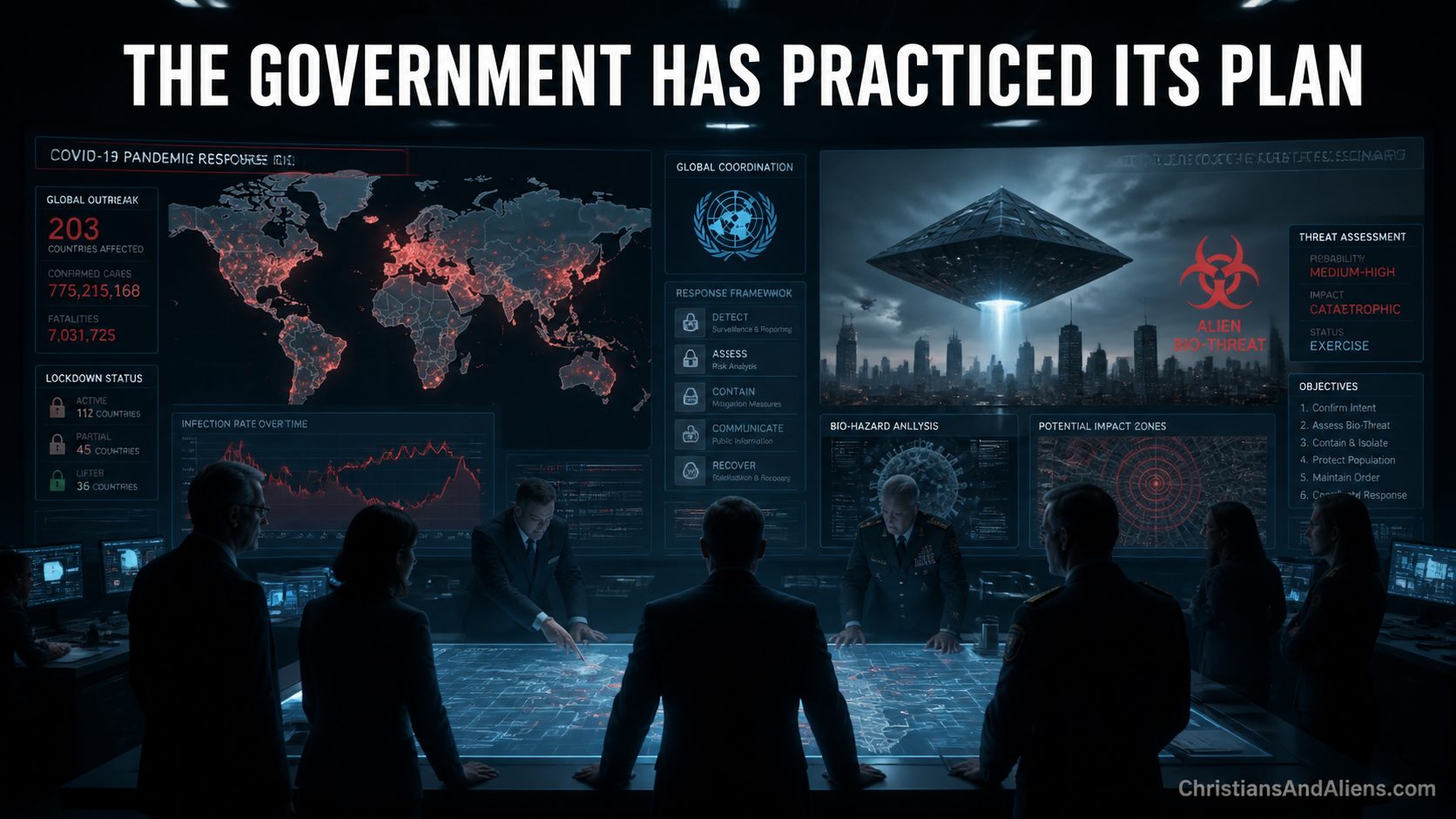
Taken together, these pandemic rehearsals, extraterrestrial policy studies, and post‑detection playbooks show that the machinery for emergency rule, information control, and centralized “first contact” messaging is already in place; an actual alien encounter would not arrive in a vacuum, but into a world where powerful actors have long prepared to use such a moment rather than simply endure it.
The following sections provide specific examples of how the government and other organizations have prepared in the past and some of the plans for alien encounters in the future.
Pre‑COVID tabletop exercises and government simulations
Several major tabletop exercises and public talks effectively “ran” the COVID-19 playbook in advance, and a number of high‑profile videos and podcasts walked through lockdown‑style scenarios before 2020.
Event 201 (October 2019)
In October 2019, global leaders practiced a novel coronavirus pandemic complete with media control, economic shutdowns, and rushed medical countermeasures, months before COVID‑19 emerged — see the official Event 201 materials and video archive.
-
What it was: A 3½‑hour, high‑level pandemic tabletop exercise hosted by the Johns Hopkins Center for Health Security with the World Economic Forum and the Bill & Melinda Gates Foundation, simulating a global outbreak of a novel coronavirus and coordinated public‑private response.
-
Why it matters: The scenario involved a zoonotic coronavirus starting in livestock, spreading via air travel, overwhelming hospitals, disrupting supply chains, and prompting recommendations on censorship of “misinformation,” coordination with social media, vaccine development, and emergency powers.
-
Official materials:
-
Johns Hopkins description and archived content: Event 201 – Johns Hopkins Center for Health Security
-
World Economic Forum press note on the live simulation: “Live Simulation Exercise to Prepare Public and Private Leaders for Pandemic Response”
-
Video playlist (full exercise): Event 201 – YouTube playlist
-
Segment 1 video (intro and medical countermeasures): Event 201 Pandemic Exercise: Segment 1
-
PDF overview: Event 201: Pandemic Exercise Overview
-
Clade X (May 2018)
In 2018, Clade X walked U.S. leaders through a catastrophic respiratory pandemic, including national security–driven emergency powers and social controls, years before COVID‑19.
-
What it was: A full‑day pandemic tabletop exercise hosted by Johns Hopkins Center for Health Security, simulating a novel respiratory pathogen released by a terrorist group and modeled through National Security Council meetings.
-
Why it matters: Clade X examined federal coordination, school closures, supply chain collapse, vaccine scarcity, and difficult decisions about social distancing and travel restrictions at the highest levels of government — the same issues that later defined COVID‑19 policy.
-
Official materials:
-
Johns Hopkins report: “Clade X: A Pandemic Exercise”
-
Peer‑reviewed write‑up: Clade X in Health Security (PubMed)
-
Livestream archive: Clade X Pandemic Exercise – Segment 1 (YouTube)
-
Additional streaming info: Clade X tabletop livestream notice
-
Crimson Contagion (January–August 2019)
HHS modeled a deadly respiratory pandemic in 2019 and documented weaknesses that would later manifest almost point‑for‑point during COVID‑19.
-
What it was: A large federal functional exercise run by the U.S. Department of Health and Human Services (HHS) simulating a severe influenza pandemic originating in China, executed across 12 states and all 10 FEMA regions.
-
Why it matters: The draft after‑action report, later obtained via FOIA, showed that the exercise predicted underfunding, confusion over authority, shortages of ventilators and PPE, and breakdowns between federal and state governments — almost exactly what happened in 2020.
-
Official / primary documents to link:
-
HHS after‑action report (FOIA): “Crimson Contagion 2019 Functional Exercise After Action Report” (PDF)
-
Technical data write‑up: Pandemic Data for HHS’s Crimson Contagion Exercise
-
NPR discussion with NYT reporter David Sanger: “What Last Year’s Government Simulation Predicted About Today’s Pandemic”
-
High‑profile talks and media that “predicted” a COVID‑style response
These are not tabletop games but widely viewed talks and shows that described global pandemics, mass vaccination and even “lockdown‑like” scenarios years before 2020.
Bill Gates’ 2015 TED Talk — “The next outbreak? We’re not ready”
-
What it said: Gates argued that a highly infectious virus was the most likely cause of mass casualties in our lifetime and that the world lacked surveillance systems, vaccine capacity, and rapid‑response teams. He urged governments to run “germ games, not war games,” pairing medical staff with military logistics to secure areas and move supplies — a blueprint very close to what nations later attempted during COVID‑19.
-
Links to use:
-
TED/YouTube video: “The next outbreak? We’re not ready”
-
Transcript summary: Bill Gates TED Talk summary
-
Full transcript: Bill Gates TED talk transcript on pandemics
-
Netflix’s “Explained – The Next Pandemic” (2019)
-
What it showed: This 2019 episode (released months before COVID) explained that another major pandemic was likely “in the near future” and would almost certainly come from a zoonotic virus jumping from animals to humans, emphasizing global spread via travel and the need for better preparedness.
-
Coverage to link:
-
Summary article: “Netflix’s ‘Explained’ predicted the COVID‑19 pandemic”
-
Futurist simulations and podcasts
Serious thinkers were already imagining lockdown‑like worlds.
-
Jane McGonigal’s 2010 pandemic simulation: A large‑scale game that asked 20,000 participants to imagine life in a global respiratory pandemic, including working from home and radically changing social habits — widely discussed later as a “prediction” of COVID.
-
Podcast/article explaining it: “10 Years Ago, She Predicted COVID. Here’s What She’s Worried About Next”
-
Tim Ferriss interview clip: Jane McGonigal — How She Predicted COVID in 2010
-
-
Science Vs “fictional pandemic” episode (late 2019): The podcast Science Vs produced a fictional pandemic episode modeled on a novel virus just two months before COVID‑19, then revisited it under the title “Did We Predict the Pandemic?”, noting how closely it matched real events and that they had played it for Dr. Anthony Fauci.
-
Podcast episode page: “Did We Predict the Pandemic?” – Science Vs
-
-
Public policy/pandemic experts: Epidemiologists like Michael Osterholm had been warning in Foreign Affairs and mainstream media for years that the U.S. had eroded its ability to respond to a severe pandemic.
-
Background: Michael Osterholm biography
-
Alien Foundational Policy / think‑tank scenarios
There are fewer “alien contact wargames” than pandemic drills, but there are serious reports, protocols, and media projects that sketch detailed first‑contact scenarios, including government behavior, information control, and public reaction.
Brookings Report (1960) – NASA–Brookings “Proposed Studies…”
-
What it is: A 1960 report prepared for NASA by the Brookings Institution, Proposed Studies on the Implications of Peaceful Space Activities for Human Affairs, famous for its section on the discovery of extraterrestrial life.
-
Why it matters: It explicitly raises the possibility that governments might withhold information about contact depending on expected public reaction and calls for studies of how leaders behave under “dramatic and unfamiliar events.”
-
Key ideas you can cite:
-
Discovery of simple life vs. superior intelligence could have very different psychological and political effects.
-
Anthropological examples show societies “sure of their place in the universe” sometimes disintegrate when confronted with unfamiliar, more advanced cultures.
-
The report recommends studying past UFO waves and the 1938 War of the Worlds broadcast to understand public response, and explicitly discusses whether and how to inform the public or withhold information.
-
-
Link to use:
-
Overview and quotations: “Brookings Report” summary
-
Background and “withholding information” section: Brookings Report
-
This is almost a proto–“alien contact tabletop exercise” for elites: not a live game, but a formal policy document imagining leadership decisions, secrecy, and social shock after discovery.
Post‑Detection Protocols (SETI / IAA)
-
What they are: Guidelines drafted by the International Academy of Astronautics and SETI scientists, called “post‑detection policy” or “Declaration of Principles Concerning Activities Following the Detection of Extraterrestrial Intelligence.”
-
Why it matters: These protocols lay out step‑by‑step scenarios for what to do if a confirmed signal is detected: verification, international consultation, UN involvement, and strong recommendations that no one respond to ET without global consensus.
-
Key scenario elements:
-
Establishing an international task group to verify the signal and advise on implications.
-
Recommending that any reply be decided through the UN Committee on the Peaceful Uses of Outer Space, and ultimately the UN General Assembly.
-
Stating that messages should be sent “on behalf of all Humankind,” not by individual states or actors.
-
-
Link to use:
-
Background and full protocol list: Post‑detection policy
-
This is the closest thing to a formal “playbook” for first contact—focused on signals, not landed craft, but rich in governance mechanics.
Exosociology / First‑contact scenario analysis (academic)
Serious scholars are already constructing detailed first‑contact scenarios using the same methods used for war‑gaming and futures studies.
-
Example: “Meeting extraterrestrials: Scenarios of first contact from the perspective of exosociology” in Acta Astronautica.
-
What it does: Uses scenario analysis and social‑science tools (Delphi method, simulations) to map different first‑contact paths (radio signal, probes, physical arrival) and their social consequences, arguing that social science should treat first contact as a real policy‑planning problem.
-
Link:
-
Abstract and access: Meeting extraterrestrials: Scenarios of first contact…
-
Simulations and “live games” about alien messages
“A Sign in Space” (2023–) – Global ET message simulation
First contact drills already exist
-
What it is: A live global experiment where ESA’s ExoMars Trace Gas Orbiter transmitted an encoded message toward Earth to simulate receiving a signal from extraterrestrial intelligence.
-
Why it matters: It’s a practical tabletop exercise for the decoding and interpretation phase of first contact. The project explicitly frames itself as a rehearsal for the social and interpretive process of receiving a message.
-
Scenario details:
-
Message transmitted from orbit around Mars as a stand‑in for an alien beacon.
-
Scientists, artists, and the general public invited to decode the message via an open platform, Discord, and online submissions.
-
Follow‑up Zoom discussions on cultural, ethical, and political implications.
-
-
Official links:
-
Project description: First Contact: Global team simulates message from extraterrestrial intelligence
-
Main site: A Sign in Space
-
SETI / first‑contact gaming in science communication
The bridge between scientific guidelines and realpolitik, especially around biohazards and information control.
-
Popular‑mechanics style synthesis: A 2025 Popular Mechanics feature gathers existing SETI protocols, Cornell’s geopolitical first‑contact paper, the 2023 A Sign in Space drill, and NASA’s “first contact” communication workshop into a single, scenario‑driven discussion of how governments and scientists might actually respond.
-
Why helpful: It stitches the pieces into a coherent storyline, including:
-
SETI’s updated protocols that now explicitly address social‑media misinformation after detection.
-
A 2022 Cornell paper outlining geopolitical risks and benefits of first contact and recommending transparency and data sharing between nations.
-
NASA’s own work on “first contact protocols” and planetary protection as de‑facto biosecurity guidance if alien life is found.
-
-
Link:
Classic case study: media‑induced “alien invasion” panic
Orson Welles’ War of the Worlds radio broadcast (1938)
This as a proto‑scenario revealing the interplay of media, government reassurance, and public religious reaction to an “alien” story.
-
What it was: A live radio drama presented as breaking news of a Martian invasion, widely remembered for causing panic among listeners; modern scholarship suggests the panic was exaggerated but still demonstrates media‑driven fear responses.
-
Why it matters: Brookings explicitly recommended studying War of the Worlds to understand how societies react to ET‑type shocks, and it functions as an early “informal experiment” in public reaction to perceived alien attack.
-
Links:
-
Background and impact: The War of the Worlds (1938 radio drama)
-
NEH analysis: “The Fake News of Orson Welles: The War of the Worlds at 80”
-
PBS documentary: War of the Worlds | American Experience
-
First‑contact podcasts, videos, and long‑form discussions
These are not official government drills, but they do walk through detailed “what would happen if aliens contacted us” scenarios, often including policy, military, and religious angles.
“Aliens Have Contacted Us… Now What?” (podcast + video)
-
What it is: A 2024 long‑form narrative episode exploring step‑by‑step what might happen after confirmed alien contact — how governments could respond, what secrecy might look like, and how public reaction might unfold.
-
Links:
-
YouTube version: Aliens Have Contacted Us… Now What?
-
Audio / narration‑only podcast: Aliens Have Contacted Us… Now What? (Narration Only)
-
Sky at Night – “If we made contact with aliens, what would happen?”
-
What it is: A 2026 feature in BBC Sky at Night drawing on “UFO defence” and planetary‑protection experts, explicitly asking whether there is a “playbook” and what real‑world plans exist.
-
Scenario elements:
-
Discusses risks of alien germs and biosphere contamination, and the need for protocols to prevent “alerting a super‑predator civilisation.”
-
Notes that existing SETI protocols largely cover signal verification, not physical arrival or security responses.
-
-
Link:
Big‑brains / Lex‑style long‑form conversations
-
Avi Loeb – “Taking Aliens Seriously” (Big Brains podcast): Argues that discovering superior alien technology (e.g., ‘Oumuamua) would profoundly affect how we see ourselves and could provoke turmoil, emphasizing the societal stakes and need for preparation.
-
Adam Frank – “Alien Civilizations and the Search for Extraterrestrial Life” (Lex Fridman Podcast): Devotes a long segment to how contact might unfold, touching on public reaction, UFOs, and policy.
Where government and alien scenarios meet (indirect but useful)
There are no publicly acknowledged U.S. government tabletop exercises that run a full “aliens land, here’s the domestic crackdown” scenario. But you can triangulate from:
-
-
-
Example link: NASA to participate in tabletop exercise simulating asteroid impact
-
Example link: NASA–FEMA Planetary Defense Interagency Tabletop Exercise
NASA / planetary protection and biohazard simulations – The Office of Planetary Protection and repeated NASA tabletop exercises for asteroid impacts already build interagency response models for rare but catastrophic space‑origin threats (discovery, risk assessment, communication, and emergency measures). These are not ET drills, but the infrastructure and methods (NASA + FEMA + State Department tabletop exercises) are the same ones that would be used in an alien‑biohazard scenario.
-
-
-
NSA “UFO and Other Paranormal Information” FOIA page – A collection of released NSA documents around UFOs, showing that intelligence agencies have long treated anomalous aerial phenomena as a national‑security planning issue, even if they have not published full alien‑contact scenarios.