Will AI cause massive permanent unemployment in the United States? Not yet by the current evidence, but a Homeland Controls scenario-planning assessment finds that falling hiring, rising long-term joblessness, and a shrinking entry-level job market already justify building income-continuity, portable-benefit, and early-warning infrastructure now, before that outcome becomes irreversible.
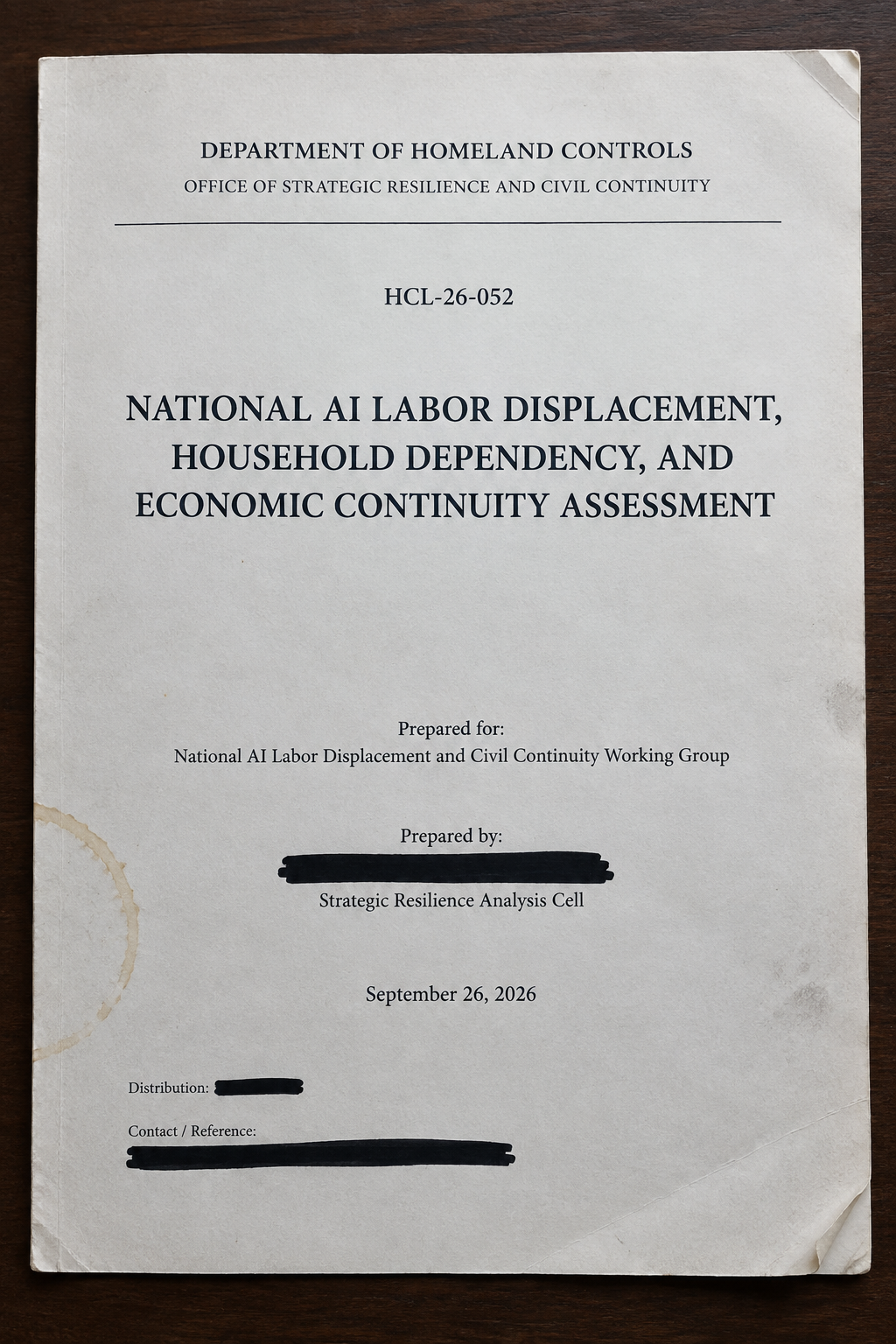
Department of Homeland Controls
Office of Strategic Resilience and Civil Continuity
Document: HCL-26-052
Prepared for: National AI Labor Displacement and Civil Continuity Working Group
Prepared by: Strategic Resilience Analysis Cell
Date: September 26, 2026
Status: Independent scenario-planning research and analysis prepared for Christians and Aliens. This document is not issued by, on behalf of, or under the authority of the United States Government or any existing government agency.
Classification: Public Release / Analytical Planning Assessment
Evidence cutoff: September 26, 2026
Executive Summary
Bottom-line judgment
The Working Group concludes that the United States must begin building economic-continuity infrastructure now for a plausible future in which artificial intelligence, advanced software, robotics, and related automation reduce the availability of stable paid work for a large and persistent share of the population.
This assessment does not find that the United States is already experiencing proven, economy-wide, AI-caused mass unemployment. Broad labor indicators do not yet establish that conclusion. Current national evidence instead describes a mixed picture: overall underemployment has remained stable, continued unemployment claims have declined, job openings have increased, and state-local tax receipts have grown. At the same time, completed hiring has fallen, long-term unemployment has increased, early-career labor-market conditions remain weaker than conditions for somewhat older workers, mortgage delinquency has risen, and demand for crisis-line services has expanded. These conditions are consistent with a labor market that remains functional at the aggregate level while accumulating risks in entry pathways, job quality, household resilience, and regional capacity.
The principal danger is not necessarily a single, visible event in which millions of workers are dismissed on the same day. The more credible warning pattern is a quiet transition: employers hire fewer junior workers, use AI to absorb routine tasks that once trained new professionals, consolidate administrative and professional roles, reduce contract rates, lower hours, weaken promotion paths, and retain experienced workers while reducing the number of people who can gain experience behind them. Under that pattern, national unemployment can remain deceptively moderate while a growing share of workers becomes unable to regain stable work with adequate pay, benefits, and a credible path to advancement.
The Working Group’s conclusion is therefore direct: the federal government must begin installing the infrastructure required to prevent AI-related labor displacement from becoming massive permanent unemployment. That infrastructure must be rights-protective, transparent, decentralized where possible, and designed to support citizens rather than control them. People whose work is displaced by technology are not a threat class, a surplus population, or an administrative burden. They are citizens entitled to dignity, due process, ordinary civil rights, and a fair opportunity to share in the productivity gains created by technological change.
Central finding
The national risk is the creation of a large population facing durable economic exclusion. This population includes more than workers formally counted as unemployed. It includes underemployed workers whose hours or earnings no longer sustain a household; discouraged workers who stop searching; independent contractors whose demand or rates collapse; workers forced into lower-quality jobs after displacement; households that lose employer-linked benefits; and younger adults blocked from the first career-track role needed to enter stable employment.
The analysis must also count the people who rely on the affected worker. A spouse, child, dependent parent, disabled household member, or other person whose housing, food access, health coverage, caregiving arrangements, or basic stability depends on a disrupted earner is affected even if that person is not in the labor force and is not counted as unemployed. The true civil-continuity burden is therefore household-level, not worker-level.
The phrase massive permanent unemployment is used in this report as a planning condition, not as a present fact. It means a sustained, cross-income, multi-region condition in which a large share of people cannot secure adequate stable work under prevailing market arrangements despite reasonable access to training, job redesign, mobility, entrepreneurship, caregiving, public-service, and transition supports. A person need not be formally counted as unemployed to be caught in that condition.
Required decision
The Working Group recommends immediate creation of a 24-month National AI Labor Displacement and Civil Continuity Working Group, supported by a permanent privacy-protective measurement capability. The first purpose is to establish whether early signs of persistent displacement are emerging. The second is to build the delivery systems that would be needed before a severe scenario occurs.
The federal government should not yet create a permanent cabinet-level department. A future institution may become necessary if persistent, multi-sector, multi-region disruption exceeds the capacity of existing agencies. If that threshold is reached, its mission must be economic continuity and human resilience, not the control of displaced people. A lawful future name would be the Department of Economic Continuity and Human Resilience, not a department defined by the control of citizens.
Immediate actions
The Working Group recommends the following actions during the next 24 months:
- Establish a National AI Labor and Civil Continuity Observatory using aggregated, privacy-protected data on hiring, separations, hours, earnings, benefit loss, long-term unemployment, housing stress, food access, health coverage, local fiscal capacity, dependent-household exposure, and critical-workforce shortages.
- Modernize unemployment insurance, identity recovery, and benefit-delivery systems before emergency-scale claims are necessary.
- Expand short-time compensation and work-sharing arrangements so employers can reduce hours with partial income replacement instead of concentrating losses in layoffs.
- Build portable health, retirement, training, leave, and disability benefits that are not dependent on one traditional employer.
- Protect entry-level career ladders through paid apprenticeships, work-based learning, junior-role preservation incentives, and employer reporting requirements tied to publicly supported AI deployment.
- Pre-authorize targeted housing, food, health-coverage, child-care, caregiving, and behavioral-health stabilizers for regions that cross transparent escalation thresholds.
- Establish local economic-continuity grants for areas with concentrated AI exposure, weak job diversification, high housing burdens, limited fiscal capacity, and high dependent-household exposure.
- Prohibit generalized surveillance, personal employment-risk scores, compulsory labor, political or religious screening, movement restrictions, service denial, detention, and any policy that treats displaced people or their dependents as dangerous or less deserving of rights.
Analytical caution
The evidence does not support an immediate declaration that AI has caused nationwide mass unemployment. The evidence does support urgent preparation. Waiting for an economy-wide unemployment spike would mean reacting after household savings, career ladders, local tax bases, housing stability, health access, child care, caregiving arrangements, and public trust have already deteriorated. The United States should prepare while it still has the capacity to choose humane, democratic, and constructive responses.
The indicators cited above are tracked in the AI Employment Status Report: National Early-Warning Dashboard.
1. Mandate and Scope
1.1 Purpose
This assessment implements the analytical direction established by Directive HCL-26-041: Six-Month Assessment of AI Labor-Market Displacement and Civil Continuity Risks. It expands the earlier 180-day framework into a ten-year scenario-planning assessment of AI-related labor displacement, household dependence on disrupted earners, reliance on public systems, and the infrastructure required to protect civil continuity.
The assessment is designed to answer a central question: if AI adoption advances faster than job creation, training systems, benefit modernization, and regional economic adjustment, how many people in the United States could lose access to stable work, how many dependent household members could be affected, and how many people could require public or publicly supported assistance over the next decade?
The answer cannot be a single number. Outcomes depend on technology capabilities, employer behavior, macroeconomic conditions, sector-specific demand, whether AI substitutes for or augments workers, the distribution of productivity gains, labor-market institutions, household composition, housing costs, public policy, and the effectiveness of transition supports. The proper task is to model a range of scenarios and identify the systems required across them.
1.2 Research questions
The Working Group shall evaluate:
- The potential number of workers affected by job loss, reduced hiring, hours cuts, wage compression, contract substitution, labor-force exit, and career-ladder failure.
- The number of dependent household members whose economic stability relies on workers facing displacement, underemployment, income loss, or benefit loss.
- The number of individuals and households likely to rely on unemployment insurance, transition income, food assistance, subsidized health coverage, housing assistance, child-care or caregiving support, disability programs, emergency charity, or state and local support under different scenarios.
- Which occupations, age groups, regions, household structures, and communities face the greatest risk of durable exclusion from stable work.
- The fiscal and operational effects of displacement and household dependency on federal, state, local, tribal, nonprofit, health-care, education, and community institutions.
- The safeguards required to ensure that any public response strengthens constitutional rights, social trust, and democratic legitimacy.
- The conditions under which existing agencies become insufficient and a new statutory institution should be considered.
1.3 Governing principle
The United States must treat AI displacement as an economic and institutional challenge, not as a defect in the people affected by it. A citizen’s dignity and rights are not contingent on current market productivity. The government’s role is to protect continuity, widen opportunity, preserve social trust, and ensure that technological gains do not create a permanent class excluded from meaningful participation.
This mandate builds directly on the earlier AI Labor-Market Displacement: Provisional 180-Day Civil Continuity Risk Assessment.
2. Evidence and Limits
2.1 Current national status
The national employment picture is mixed. The existing early-warning dashboard reports that U-6 underemployment was 7.7% in August 2026, unchanged from September 2024; continued unemployment claims and involuntary part-time employment declined over that period; job openings increased; and national state-local tax receipts increased. These indicators argue against claiming that the United States is currently in a confirmed, AI-driven national employment emergency.
The same dashboard identifies substantial reasons for elevated monitoring. Actual monthly hires declined from approximately 5.43 million in September 2024 to 5.05 million in July 2026. People unemployed for 27 weeks or longer increased from approximately 1.61 million to 1.93 million. Prime-age labor-force participation edged down, mortgage delinquency rose, and 988 crisis-line contacts increased. These indicators do not prove that AI is the cause, but they identify vulnerabilities that can worsen if labor substitution accelerates.
The Bureau of Labor Statistics likewise cautions that AI effects on employment projections are uncertain and dependent on assumptions about adoption, productivity, occupational task change, and employer use. AI exposure is not job loss. A job can be augmented, redesigned, deskilled, moved, split into contract work, or eliminated through attrition without a large immediate layoff count.
2.2 Early-career vulnerability
The first durable warning is likely to appear in hiring, not layoffs. Employers can retain experienced workers while reducing entry-level roles, internships, junior analyst positions, administrative apprenticeships, customer-service training roles, and replacement hiring. When AI absorbs the routine tasks through which beginners acquire knowledge, organizations may preserve short-term productivity while eroding the pipeline that produces future supervisors, operators, auditors, managers, maintainers, and independent professionals.
This mechanism creates an intergenerational danger. A young worker denied an entry pathway may not appear as a laid-off worker, may cycle through temporary work, return to school, leave the labor force, or remain dependent on family. The consequence can remain statistically obscured until delayed earnings losses, household formation delays, debt strain, lower lifetime retirement savings, and skill shortages become visible years later.
2.3 Why aggregate stability can mislead
A positive national net-jobs figure does not prove that workers displaced from one field can obtain equally stable work elsewhere. New jobs may be located in different regions, require different credentials, offer lower wages or fewer benefits, or be inaccessible to people with caregiving responsibilities, disabilities, transportation limits, health constraints, or high housing costs.
The country may also experience simultaneous displacement and shortage. AI investment may increase demand for electricians, HVAC technicians, grid operators, construction workers, cybersecurity personnel, data-center specialists, and maintenance roles even as it reduces demand for selected clerical, professional, media, customer-service, and routine analytical work. A sound policy must therefore address matching, access, training quality, wage standards, and geographic mobility—not merely count the total number of jobs.
2.4 Evidence limits
This report is a scenario-planning analysis. It does not prove future outcomes and does not assume that catastrophic displacement is inevitable. It is intentionally designed to identify the threshold at which normal labor-market adjustment becomes inadequate.
The evidence base has several limitations:
- AI capability benchmarks do not directly measure employment effects.
- Employer surveys can overstate intended automation or job creation.
- Official employment data lag changes in hiring, task composition, contractor use, and career-ladder availability.
- Technology is one cause among many, alongside recession risk, interest rates, trade, demographic change, policy, industrial concentration, and consumer demand.
- National averages can conceal severe regional, occupational, and age-specific outcomes.
- Household size and dependency vary substantially by age, income, geography, disability status, family structure, and whether a household has multiple earners.
For a closer look at which occupations face substitution versus redesign, see Jobs AI Is Likely to Change—Not Simply Replace.
3. Scenario Model
3.1 Modeling approach
The Working Group uses a ten-year range model rather than a point forecast. Each scenario estimates the number of directly affected workers, the number likely to require some form of public or publicly supported economic-continuity assistance, and the larger population affected when household dependents are counted. These ranges represent planning exposure, not predictions of formal unemployment or permanent benefit enrollment.
For purposes of planning, the United States labor force is treated as roughly 170 million people and the total U.S. population as roughly 340 million people. Affected workers include people whose earnings, hours, benefits, job security, or career access deteriorate materially—not only individuals counted as unemployed in monthly statistics.
The household-dependency ranges use a conservative planning approach. They do not assume every affected worker supports a full household, and they do not assume every spouse, child, parent, or other household member would need public aid. They estimate the number of people whose household stability could be materially affected when a principal or contributing earner loses stable work, earnings, hours, or benefits.
3.2 Why a newspaper unemployment rate understates the exposure
A newspaper unemployment rate measures a specific and important category: people who do not have a job, are available for work, and have actively looked for work recently. It does not count every person whose economic stability has been weakened by a changing labor market.
The standard formula is:
Official unemployment rate = (people officially unemployed ÷ labor force) × 100
With a planning labor force of approximately 170 million people, a newspaper headline that reports 10% unemployment describes roughly 17 million officially unemployed people. That is a major national emergency. But it may still describe only part of the population experiencing AI-related labor displacement.
The larger population at risk includes officially unemployed people plus people who have stopped looking for work, people who can find only inadequate or intermittent work, workers whose hours or earnings have fallen materially, independent contractors whose income has collapsed, people who have lost employment-linked benefits, and younger workers who cannot obtain the first career-track job necessary to enter the labor market. It also includes workers who accept lower-quality work after displacement but no longer earn enough to sustain a household.
The rate also excludes the dependent household members whose well-being depends on a disrupted worker’s income or benefits. Children, spouses, dependent parents, disabled adults, and other household members can experience food insecurity, housing instability, loss of health coverage, interrupted care, or reduced educational opportunity even though they are not themselves counted in the labor force or unemployment rate.
3.3 Official unemployment, direct support, and household-dependency translation model
The following table translates newspaper-style unemployment rates into estimated numbers of officially unemployed people. It then distinguishes three additional planning measures: broader worker displacement, direct need for economic-continuity support, and the total population affected when dependent household members are included.
The expanded measures are not additional unemployment rates. They are civil-continuity exposure estimates. They are intended to show why a single headline unemployment rate can materially understate the population whose income, housing, food access, health coverage, child care, caregiving, and basic household stability are at risk.
| Newspaper unemployment rate | Officially unemployed workers, assuming a 170 million labor force | Share of total U.S. population represented by official unemployment, using an approximately 340 million population | Broader displaced or economically unstable workers | Workers likely to need direct continuity support | Total people affected when dependent household members are included | Share of total U.S. population affected |
|---|---|---|---|---|---|---|
| 4% | About 6.8 million | About 2% | Approximately 10–18 million | Approximately 4–9 million | Approximately 12–25 million | Approximately 4–7% |
| 6% | About 10.2 million | About 3% | Approximately 18–30 million | Approximately 8–16 million | Approximately 25–45 million | Approximately 7–13% |
| 8% | About 13.6 million | About 4% | Approximately 25–40 million | Approximately 12–23 million | Approximately 40–65 million | Approximately 12–19% |
| 10% | About 17.0 million | About 5% | Approximately 30–50 million | Approximately 18–30 million | Approximately 55–85 million | Approximately 16–25% |
| 15% | About 25.5 million | About 7.5% | Approximately 45–70 million | Approximately 30–45 million | Approximately 85–125 million | Approximately 25–37% |
| 20% | About 34.0 million | About 10% | Approximately 60–95 million | Approximately 40–65 million | Approximately 115–175 million | Approximately 34–51% |
| 25% | About 42.5 million | About 12.5% | Approximately 75–115 million | Approximately 55–80 million | Approximately 150–215 million | Approximately 44–63% |
| 30% | About 51.0 million | About 15% | Approximately 90–135 million | Approximately 70–100 million | Approximately 190–260 million | Approximately 56–76% |
The planning ranges are deliberately broad. They reflect the fact that the relationship between official unemployment, underemployment, labor-force withdrawal, household dependency, and need for public support changes with the form of disruption. A short recession can raise official unemployment sharply while many workers recover quickly. A slow AI-driven transition may keep official unemployment lower while a much larger population experiences weak hiring, declining hours, stagnant or falling real earnings, low-quality contingent work, uninsurance, repeated labor-force exit, and dependence on another household member’s lost income.
3.4 Illustrative example: a 10% newspaper unemployment rate
A newspaper reader who sees “U.S. unemployment reaches 10%” will correctly understand that the country faces a severe labor-market emergency. Under the 170 million-person labor-force assumption, that headline means approximately 17 million people are formally unemployed.
That figure does not capture the complete social impact. In an AI-driven displacement scenario, the Working Group estimates that the broader directly affected workforce could range from approximately 30 to 50 million people. This group could include the 17 million officially unemployed, discouraged workers who stopped actively searching, workers whose hours have been cut, people forced into lower-paying jobs, contractors who lost clients, households that lost employer health coverage, and young adults unable to secure an entry-level foothold.
Of the broader directly affected workforce, approximately 18 to 30 million people may require direct economic-continuity assistance such as unemployment insurance, wage insurance, food assistance, subsidized health coverage, rental aid, training income, child-care support, or other stabilization. Once spouses, children, dependent parents, disabled household members, and others reliant on those workers’ income or benefits are counted, the population whose household stability is materially affected could rise to approximately 55 to 85 million people.
Expressed as a share of the total population, the official 10% unemployment headline represents about 5% of all Americans. The directly displaced and economically unstable workforce may represent roughly 9% to 15% of all Americans. When their dependent household members are included, the total affected population can reach roughly 16% to 25% of the country. A 10% unemployment rate should therefore not be understood as a crisis affecting only 10% of workers or 5% of the overall population. Under a prolonged AI-driven displacement scenario, it could signal a household-level emergency affecting as much as one-quarter of the country.
3.5 Ten-year national scenarios
| Scenario | Adoption and economic pattern | Directly affected workers | People likely to need direct continuity support | Total affected including dependent household members | Approximate newspaper-style unemployment rate that could accompany the scenario | Planning judgment |
|---|---|---|---|---|---|---|
| Managed augmentation | AI assists workers more often than it replaces them; productivity gains are broadly shared; job redesign, shorter work arrangements, and new demand absorb most displacement | 5–12 million | 2–6 million | 6–16 million | Approximately 4–5% | Existing systems can manage if strengthened early; concentrated harm remains likely among early-career and routine-task workers |
| Uneven displacement | AI substitutes for selected routine cognitive, clerical, customer-service, and professional tasks; entry-level hiring falls; regional effects vary sharply | 15–30 million | 7–15 million | 20–42 million | Approximately 5–7% | Major expansion of transition assistance, portable benefits, housing stabilization, and local adjustment capacity needed |
| Persistent exclusion | Substitution spreads across professional, administrative, finance, media, technology, sales, legal-support, and service roles; job creation and retraining lag | 30–50 million | 18–30 million | 55–85 million | Approximately 7–10% | Existing workforce and benefit systems become structurally inadequate; national economic-continuity infrastructure required |
| Structural employment emergency | Rapid adoption combines with recession, credit contraction, or widespread corporate cost cutting; long-term unemployment and labor-force exit rise across income groups | 50–75 million | 30–50 million | 85–140 million | Approximately 10–15% | Emergency-scale federal-state coordination, fiscal support, benefit delivery, household stabilization, and caregiver support required |
| Systemic rupture | Highly capable autonomous systems spread faster than institutions can adapt; stable paid work becomes unavailable to a large minority and local systems fail under cumulative stress | More than 75 million | More than 50 million | More than 140 million | 15% or higher, potentially with a lower reported rate if labor-force exit is extensive | National civil-continuity operations required; extraordinary danger of political extremism and authoritarian overreach |
3.6 Interpretation of direct support and household dependency
The direct-support ranges are not estimates that all affected individuals would rely exclusively on the federal government. Many households would use a mixture of wages, savings, family support, employer severance, state programs, charitable aid, health subsidies, housing support, educational grants, or short-duration income replacement. The model therefore measures likely reliance on an economic-continuity system, broadly defined.
Likewise, the household-dependency ranges do not mean every affected dependent would become a public-benefit recipient. They identify the population exposed to household instability because an earner or contributing worker has lost stable employment, adequate hours, earnings, benefits, or a viable entry path. Some people will be protected by another income source; some will not. The purpose of the range is to size the potential civil-continuity problem before the country is forced to react.
A person receiving temporary wage insurance, health-coverage assistance, rental aid, food assistance, child-care support, caregiving support, or paid retraining should not be classified as permanently dependent. The objective of public infrastructure is to prevent temporary labor shocks from becoming long-term exclusion for workers and long-term instability for the people who rely on them.
3.7 Scenario drivers
The country moves toward the severe scenarios when several conditions combine:
- AI capability improves faster than firms, workers, schools, and regulators can adapt.
- Employers use AI to replace labor rather than redesign work around human judgment and accountability.
- Productivity gains accrue largely to owners of capital and already advantaged workers.
- Entry-level positions disappear faster than alternative career paths are created.
- A recession, credit shock, energy disruption, geopolitical conflict, or financial crisis coincides with rapid adoption.
- Housing, child care, health care, transportation, caregiving, and training costs prevent workers from changing fields or locations.
- State benefit systems fail to deliver timely help or make errors that exclude legitimate applicants.
- Local governments lose revenue while demand for housing, food, public safety, workforce services, child care, elder care, and behavioral health rises.
The country remains closer to the managed-augmentation scenario when productivity gains are shared through rising wages, shorter work arrangements, worker training, new business formation, public investment, strong consumer demand, portable benefits, child-care and caregiving support, and deliberate preservation of career ladders.
Related analysis: AI Job Losses Are Already Here—And the “Fixes” on the Table Prove the Overpopulation Problem Is Real.
4. Dependency and Civil Continuity
4.1 What dependency means in this assessment
The phrase “government dependency” is used only as a fiscal and service-delivery term. It does not describe a person’s character, worth, loyalty, or contribution. Dependence on public systems often reflects a market failure, a medical event, caregiving responsibility, regional decline, or a technology-driven loss of bargaining power—not an individual moral failure.
The relevant question is whether public systems can provide temporary support quickly enough to protect households from irreversible harm and can create credible routes back into stable work, ownership, caregiving, civic contribution, education, or other productive participation.
The analysis recognizes two forms of dependency exposure. The first is direct support dependency, in which an affected worker or household must rely on public or publicly supported income, food, housing, health, child-care, disability, training, or emergency services. The second is household dependency exposure, in which a person relies on another household member’s disrupted income or benefits and may experience instability even if they do not apply directly for assistance.
4.2 Benefit and service pressure points
Under the persistent-exclusion and structural-emergency scenarios, the principal pressure points are likely to include:
- Unemployment insurance and wage insurance.
- Medicaid, ACA marketplace subsidies, employer-coverage transitions, and mental-health services.
- SNAP, WIC, school nutrition, food banks, and emergency food distribution.
- Rental assistance, mortgage forbearance, utility support, eviction prevention, shelters, and homeless services.
- Child-care subsidies, elder-care supports, family caregiver services, and respite care.
- Disability programs and disability-accessible employment supports.
- Community colleges, apprenticeship systems, adult education, career navigation, and job-matching services.
- Transportation, broadband, and caregiving support required for successful transition.
- Local government revenues, public safety, libraries, schools, public-health capacity, and courts.
- Retirement savings, employer contributions, Social Security claiming patterns, and public pension funding.
4.3 Household cascade
Displacement becomes a civil-continuity problem through feedback loops. Reduced earnings and hours weaken household purchasing power. Lower consumer demand harms local businesses. Business closures and reduced earnings weaken local tax receipts. Falling revenue reduces local service capacity. Housing and food stress increase. Health coverage is interrupted. Child-care and caregiving arrangements break down. Mental-health needs rise. Fraud, predatory lending, fake-job schemes, and criminal exploitation increase. Residents lose trust in institutions and may leave affected communities, further weakening schools, commerce, and civic organizations.
This sequence is why the response cannot be limited to job training. Training remains important, but it fails if workers cannot afford the transition period, if families cannot secure child care or elder care, if destination jobs do not exist, if credentials are not recognized, or if jobs are eliminated before trainees complete the program.
4.4 Unequal exposure
AI-related displacement can cross income groups but will not fall equally. The Working Group identifies the following primary risk pathways:
| Group | Primary risk | Why routine policy may fail |
|---|---|---|
| Ages 18–25 | Entry-level hiring collapse, delayed experience accumulation, unstable early employment | Workers may never be hired and thus never appear in layoff or unemployment-claims data |
| Mid-career professionals | Role consolidation, wage compression, mortgage and family stress, loss of occupational identity | Households may remain above poverty thresholds while fixed costs make them financially fragile |
| Older workers | Skill obsolescence, age discrimination, involuntary early retirement | Many leave the labor force and are no longer counted as unemployed |
| Clerical and customer-service workers | Direct task automation, attrition, scheduling cuts, offshoring combined with AI | Loss may appear as lower hours or fewer replacement hires rather than layoffs |
| Creative and media workers | Contract-rate erosion, declining demand, uncompensated use of work, unstable project income | Independent-worker losses are not well captured by unemployment insurance |
| People with disabilities | Algorithmic screening, inaccessible retraining, loss of accommodations, benefit cliffs | Standard programs may not protect continuity of care or accessibility |
| Rural and single-industry regions | Thin replacement labor markets, weak transit and broadband, outmigration | National averages obscure local collapse |
| Single parents and caregivers | Schedule volatility, child-care gaps, caregiving demands, inability to complete unpaid training | Workforce systems often assume flexible time, transportation, and available care |
| Children and dependent adults | Food insecurity, housing instability, interrupted health care, loss of supervision or care arrangements | They are not counted as unemployed even though a worker’s displacement directly affects them |
| Small-business owners | AI competition, platform dependence, declining local demand, credit stress | Business-income loss may not qualify for ordinary unemployment assistance |
4.5 The moral and operational limit
A system that labels displaced people or their dependents as economically unnecessary, dangerous, or administratively controllable will worsen the crisis. It will increase distrust, decrease voluntary participation, create stigma, and make communities less willing to cooperate with legitimate support programs.
The warning described in The Government’s Plan to Contain the Alien Contagion is relevant here as a fictional caution: when a state makes human worth contingent on usefulness, crisis planning can become a justification for classification and abuse. The correct response to labor displacement is economic security, voluntary opportunity, accountable institutions, and rights protection—not surveillance, coercion, or social sorting.
See also Brace Yourselves for the Governmental Control Super Storm.
5. Early-Warning Architecture
5.1 National AI Labor and Civil Continuity Observatory
The Working Group recommends creation of a National AI Labor and Civil Continuity Observatory. The Observatory should operate as an independent, transparent, privacy-protective analytical capability. It should track conditions by occupation, industry, age cohort, income range, geographic labor market, work arrangement, household type, and dependent-household exposure.
The Observatory must not create individual employment-risk scores, a centralized registry of displaced people, political or religious profiles, benefit-status passports, or any system that conditions civil rights on work status. Its normal unit of analysis should be the aggregate: occupation, sector, region, cohort, anonymized program outcome, or audited employer report.
5.2 Core indicators
The early-warning system should monitor:
- Hiring, replacement hiring, layoffs, separations, and job openings.
- Entry-level hiring, internships, apprenticeships, and junior-role availability.
- Hours worked, involuntary part-time employment, wages, benefits, and contractor earnings.
- Long-term unemployment, repeated joblessness, labor-force participation, and early retirement.
- Employer-sponsored health coverage loss, Medicaid enrollment, marketplace enrollment, and care interruption.
- Rent arrears, mortgage delinquency, eviction filings, utility shutoffs, shelter entries, and housing instability.
- SNAP processing, food-bank demand, meal-skipping, and school-meal participation.
- Child-care availability, caregiver burden, elder-care disruption, and disability-service continuity.
- Crisis-line demand, mental-health wait times, overdose, and suicide-prevention capacity.
- Local tax receipts, reserve drawdowns, service backlogs, staffing vacancies, and infrastructure maintenance deferrals.
- Critical-workforce shortages, apprenticeship completion, overtime, contractor dependence, and manual-operations readiness.
- Fraud complaints, synthetic-identity events, fake-job schemes, training-provider outcomes, and benefit payment errors.
5.3 Escalation thresholds
| Level | Trigger | Required response |
|---|---|---|
| Level 0: Monitoring | No aggregate disruption; isolated risks remain within normal program capacity | Publish transparent data and maintain research capacity |
| Level 1: Targeted adjustment | Two adverse indicators persist for two quarters in the same cohort, occupation, or labor market | Targeted retraining, work sharing, local grants, child-care support, and enhanced data review |
| Level 2: Regional continuity activation | One severe indicator or four adverse indicators occur in at least three labor markets | Activate housing, food, health, child-care, caregiving, and local-fiscal stabilizers; deploy technical assistance |
| Level 3: National employment emergency | Severe employment or income deterioration appears across at least five states for two quarters with related household stress | Expand national income continuity, benefit delivery, worker transition, household support, and state assistance |
| Level 4: Civil continuity emergency | Level 3 plus sustained failure in housing, food, health, child care, caregiving, local services, or critical workforce capacity | National civil-continuity operations under statutory safeguards and independent oversight |
No escalation level automatically authorizes surveillance, detention, movement restrictions, compulsory labor, censorship, political classification, religious classification, or suspension of due process. Escalation must unlock aid, administrative capacity, public reporting, and time-limited economic stabilization—not control of persons.
5.4 Employer transparency
Firms receiving federal AI tax incentives, procurement awards, transition grants, or infrastructure support should report standardized information on:
- AI-related task changes and major workforce redesigns.
- Changes in hiring, layoffs, contract use, hours, pay, and benefits.
- Preservation or loss of junior roles and training pathways.
- Worker consultation and retraining investments.
- Geographic effects and community mitigation measures.
- Audited outcomes for workers affected by publicly supported automation.
These indicators feed the AI Employment Status Report: National Early-Warning Dashboard.
6. Infrastructure Plan
6.1 Income continuity
Existing unemployment systems are structured around a traditional separation from a traditional employer. They are poorly designed for declining hours, platform work, repeated short contracts, wage erosion, independent-worker income loss, and career-entry failure.
The federal government should develop:
- Modernized unemployment insurance with shorter processing times and interoperable state systems.
- Wage insurance for workers who regain employment at substantially lower pay.
- Income support for qualifying independent workers and workers with recurring short employment spells.
- Strong identity verification, account recovery, fraud prevention, audit capability, and appeal rights.
- Automatic administrative surge capacity when transparent regional triggers are met.
- Simple eligibility rules that do not punish caregiving, disability, part-time work, or good-faith retraining.
6.2 Work sharing
Work sharing should become a primary first-line response. Instead of dismissing a portion of the workforce, employers should be encouraged to reduce hours across a broader workforce while public systems replace part of the lost earnings. This can preserve skills, benefits, organizational memory, and future recovery capacity.
Federal policy should expand state short-time compensation programs, simplify employer participation, protect workers from retaliation, and pair reduced-hour arrangements with training and job redesign.
6.3 Portable benefits
Health coverage, retirement saving, disability protection, training, leave, and basic income security should not disappear when a person changes employers, loses hours, moves between payroll and contract work, or takes time for caregiving.
The Working Group recommends immediate design work on portable benefit accounts and cross-employer contribution systems. The design must protect low-income and intermittent workers, avoid benefit cliffs, preserve disability accommodations, and provide simple enrollment and appeal mechanisms.
6.4 Entry-ladder recovery
The country must actively rebuild pathways into skilled work. Publicly supported AI deployment should not be allowed to erase junior jobs without creating credible alternative routes to competence.
Recommended measures include:
- Paid apprenticeships and work-based learning in technology, health care, infrastructure, energy, manufacturing, repair, cybersecurity, public administration, and care work.
- Junior-role preservation incentives for firms using public procurement, tax incentives, or transition grants.
- Human-supervised learning roles in which beginners acquire judgment rather than merely oversee automated outputs.
- Verified employer commitments on hiring, compensation, benefits, and retention.
- Outcome reporting at 6, 12, and 24 months for publicly funded training programs.
6.5 Housing, food, health, child-care, and caregiving stabilizers
A labor transition becomes a household crisis when income loss creates eviction, foreclosure, hunger, loss of medication, untreated illness, family stress, loss of child care, failure of elder-care arrangements, or homelessness. The federal government should pre-authorize lawful, targeted, time-limited stabilizers that activate under transparent regional conditions.
The package should include rental assistance, mortgage forbearance coordination, utility support, SNAP administrative surge capacity, school-meal continuity, health-coverage navigation, medication continuity, child-care assistance, caregiver respite and support, behavioral-health expansion, and grants to trusted local providers.
6.6 Local economic continuity grants
Communities with high AI exposure, weak diversification, thin tax bases, housing stress, limited training capacity, and high dependent-household exposure will need tailored support. Grants should be awarded through transparent criteria and used for locally chosen strategies such as broadband, child care, transportation, community-college partnerships, small-business capital, energy and infrastructure work, care-sector expansion, repair and maintenance trades, entrepreneurship, and worker ownership.
6.7 Public-purpose pathways
A technologically advanced economy may underprice activities that are socially necessary but difficult to monetize through ordinary markets. The United States should expand voluntary, properly compensated pathways in elder care, disability support, child care, tutoring, public health, environmental restoration, local food resilience, disaster readiness, records modernization, infrastructure inspection, and community services.
These pathways must not become a coercive labor regime. They must offer fair wages, benefits, worker voice, portable credentials, meaningful work, and the ability to leave for other opportunities.
On the entry-level risk pathway specifically, see Will Gen Z Be Employable?
7. Governance and Safeguards
7.1 Working Group structure
The Working Group should include representatives from Labor, Commerce, Treasury, Education, Health and Human Services, Housing and Urban Development, Agriculture, Energy, Transportation, the Small Business Administration, state and local governments, tribal governments, labor organizations, employers, disability advocates, civil-liberties counsel, technologists, economists, faith and community organizations, caregivers, and people with lived experience of long-term unemployment.
7.2 Independent oversight
The program should be subject to independent review by economists, civil-rights experts, privacy specialists, state and local administrators, worker representatives, caregiver representatives, and public-interest organizations. Major methodologies, assumptions, dashboard definitions, audit results, and revisions should be public except where disclosure would compromise lawful privacy protections.
7.3 Prohibited actions
No program established under this assessment may recommend, authorize, or normalize:
- Population control or any policy that treats people as economically disposable.
- Compelled labor or coercive work requirements that deny basic subsistence.
- Involuntary medical treatment.
- Political, religious, genetic, medical, racial, or ideological screening.
- Generalized domestic surveillance or individual economic-risk scoring.
- Employment, benefit, movement, or service passports.
- Restrictions on movement, association, worship, speech, voting, or ordinary due process.
- Denial of food, housing, health care, legal process, child care, caregiving support, or essential public services based on employment status.
- Punitive or stigmatizing classifications of unemployed, underemployed, disabled, retired, caregiving, dependent, or displaced people.
7.4 Data governance
Data collection must follow minimization, purpose limitation, security, independent audit, retention limits, access controls, appeal rights, and public transparency. The country does not need a national database of economically vulnerable people to understand macroeconomic risk. Aggregated, anonymized, and properly governed data can support early warning without building a permanent architecture of personal control.
7.5 Threshold for a future department
A permanent cabinet-level institution should be considered only when all of the following conditions are met:
- Persistent multi-sector and multi-region displacement exceeds the management capacity of existing agencies.
- Transparent evidence shows that conventional workforce, benefit, housing, health, child-care, and caregiving systems cannot sustain delivery at the required scale.
- Congress authorizes a narrowly defined statutory mission, funding, oversight, sunset review, and enforceable rights protections.
- The institution is named and structured around economic continuity and human resilience rather than control of affected citizens.
- Independent oversight confirms that the institution reduces harm without expanding surveillance, coercion, or discrimination.
For historical precedent on each safeguard category, see The Historical Case for Alien Encounter Scenarios: U.S. Government Precedents Behind Each Category.
8. Conclusion
The United States is not required to choose between complacency and authoritarian control. It can acknowledge the possibility that AI will permanently alter the labor market while refusing to treat people displaced by that change—or the people who depend on them—as a burden, a threat, or a population to be managed.
The conclusion of this assessment is that massive permanent unemployment must be treated as a serious national planning risk. It is not yet established as a present reality or an inevitable future. But the systems required to prevent it—early warning, income continuity, portable benefits, work sharing, entry-ladder recovery, housing and health stabilization, child-care and caregiving support, local economic resilience, and enforceable rights protections—take years to build.
The federal government must begin that work now. The proper national objective is not to control people who may become dependent on public systems. It is to ensure that no American, and no household dependent on an affected earner, becomes permanently excluded from dignity, security, opportunity, health, housing, family stability, or civic belonging because technology advanced faster than the institutions responsible for protecting the public.
The lasting test of this era will be whether the country treats productivity as a tool for human flourishing or allows it to become a mechanism for human abandonment. The Working Group recommends that the nation choose human continuity, democratic accountability, and the equal worth of every person.
This assessment updates and extends the AI Labor-Market Displacement: Provisional 180-Day Civil Continuity Risk Assessment.
Appendix A: Key Definitions
Official unemployment rate: The percentage of the civilian labor force that is without a job, available for work, and actively seeking work under the standard labor-force survey definition.
Broader AI labor-displacement exposure: The estimated population of workers experiencing official unemployment, inadequate hours, inadequate earnings, involuntary temporary or contingent work, loss of employment-linked benefits, labor-force withdrawal after unsuccessful job search, contract-income collapse, or blocked entry into stable work due in part to AI-related economic change.
Direct continuity-support population: The portion of the broader displaced or economically unstable workforce likely to require unemployment benefits, wage insurance, food assistance, health-coverage subsidies, housing support, child-care support, disability services, paid training, or other public or publicly supported stabilization.
Household dependency population: Spouses, children, dependent parents, disabled household members, and other people whose economic security, housing, food access, health coverage, caregiving arrangements, or basic household stability materially depends on an earner experiencing unemployment, underemployment, income collapse, benefit loss, or labor-force exclusion.
Total affected population: Directly affected workers plus dependent household members whose material well-being is exposed to the worker’s loss of stable earnings, hours, benefits, or employment.
AI-related labor displacement: A material reduction in stable work, hours, earnings, benefits, bargaining power, career access, or employment security associated with the adoption of AI, advanced software, robotics, or related automation.
Stable work: Employment or self-employment that provides reasonably predictable earnings, hours, legal protections, access to benefits or substitutes, and a credible pathway for continuing participation in the economy.
Long-duration displacement: At least 26 weeks without comparable stable work, with separate monitoring at 12 months, 24 months, and repeated short work spells.
Economic-continuity reliance: Use of public benefits, subsidized coverage, housing support, food assistance, transition income, child-care or caregiving assistance, or publicly supported services because of verified income instability, job loss, underemployment, or loss of stable employment.
Massive permanent unemployment: A planning condition in which a large share of the population cannot obtain adequate stable work under prevailing market arrangements despite reasonable access to transition supports, training, work redesign, mobility, entrepreneurship, caregiving, public service, and other lawful routes to participation.
Civil continuity: The ability of households, communities, institutions, and critical systems to maintain basic economic security, essential services, social cohesion, caregiving capacity, and lawful democratic functioning during sustained disruption.
Appendix B: Recommended 24-Month Deliverables
Within 45 days: Publish the Working Group charter, membership, evidence standards, data-governance plan, scenario assumptions, household-dependency methodology, and civil-liberties safeguards.
Within 90 days: Deliver an interim memorandum identifying priority occupations, early-career pathways, regional exposure clusters, dependent-household exposure, benefit-system gaps, and immediate modernization actions.
Within 180 days: Publish the first national AI Labor and Civil Continuity Dashboard with methodology, uncertainty ranges, household-dependency measures, privacy protections, and public feedback procedures.
Within 12 months: Deliver pilots for work sharing, wage insurance, portable-benefit design, entry-ladder recovery, local continuity grants, child-care and caregiving support, and anti-fraud/identity-recovery modernization.
Within 18 months: Produce a state and local readiness assessment covering benefit delivery, housing stabilization, behavioral health, child care, caregiving, workforce training, fiscal capacity, and critical-workforce shortages.
Within 24 months: Submit a final statutory options report specifying which measures can be implemented through existing authority, which require congressional authorization, estimated fiscal ranges, oversight mechanisms, and criteria for considering a permanent Department of Economic Continuity and Human Resilience.