What would a true civil continuity emergency response to mass AI-driven unemployment look like? The Homeland Controls Study Committee recommends a single 18-month National Civil Continuity Operations Authority that guarantees essential household support and expands real capacity in housing, food, health, and energy—while explicitly barring detention, compelled labor, movement restriction, or election suspension as part of the response.
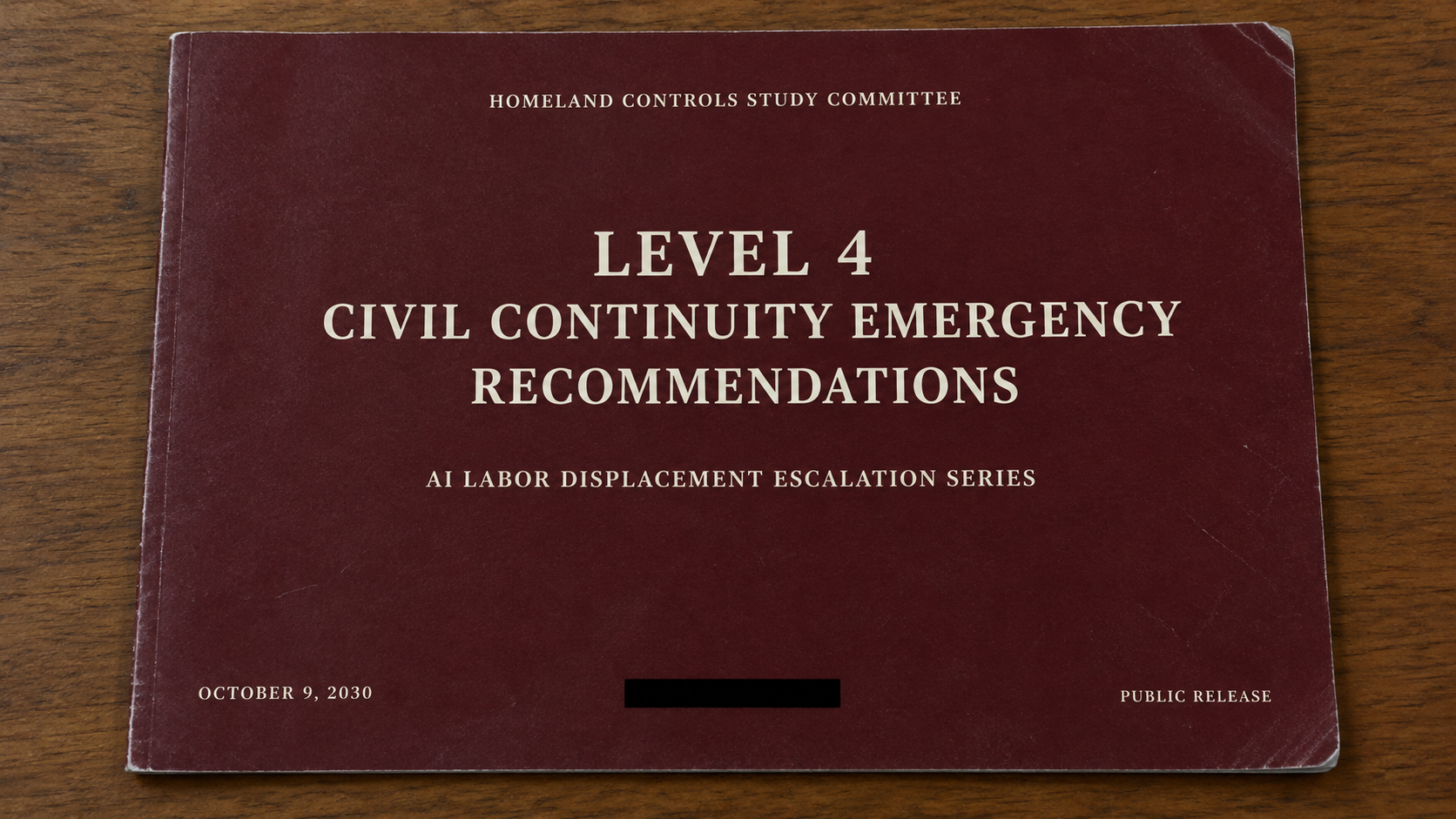
Homeland Controls Study Committee
Document: HCL-30-058
Prepared for: Homeland Controls Study Committee
Proposed operating authority: National Civil Continuity Operations Authority under explicit congressional authorization
Activation level: Level 4 — Civil Continuity Emergency
Status: Independent scenario-planning research prepared for Christians and Aliens. This document is not issued by, on behalf of, or under the authority of the United States Government, any state government, or any existing public agency. The institutions and authorities proposed below do not exist unless established through lawful executive, legislative, or interstate action.
Classification: Public Release — Analytical Planning Assessment
Date: October 9, 2030
Executive Summary
The official U.S. unemployment rate has reached 15 percent, equal to approximately 25.5 million unemployed workers under the study’s 170 million-person labor-force planning assumption. The broader economically unstable workforce is estimated at 45 million to 70 million people, approximately 30 million to 45 million workers require direct continuity support, and 85 million to 125 million people are exposed when dependent household members are included. California, Texas, Florida, New York, Pennsylvania, Illinois, Ohio, Georgia, North Carolina, and Michigan now report persistent Level 3 employment conditions accompanied by sustained failures in one or more essential systems. The activation record documents housing loss and shelter pressure, food-distribution strain, health and behavioral-health backlogs, child-care and caregiving capacity loss, local-government service degradation, and shortages in critical maintenance, energy, transportation, health, and care work. Ordinary programs and the Level 3 framework remain necessary but are no longer sufficient to preserve consistent access to essentials across affected regions. The Level 4 threshold is met. The Committee recommends that Congress establish a National Civil Continuity Operations Authority for a single 18-month term, renewable once for no more than 12 additional months after a recorded vote and independent finding. The Authority should coordinate essential household support, critical-service restoration, national logistics, state and local fiscal stabilization, voluntary workforce mobilization, and accelerated supply expansion. It should not become a permanent department unless Congress later enacts a separate organic statute after ordinary hearings and review. Under the study model, a 15 percent unemployment condition may require approximately $2.3 trillion to $3.4 trillion in additional annual public support under a full-and-partial support policy. With illustrative revenue loss and automatic-stabilizer pressure, combined fiscal deterioration could reach approximately $3.1 trillion to $4.8 trillion annually. These figures are planning ranges, not formal budget scores. At this scale, money alone cannot guarantee continuity; government must expand and allocate real capacity in housing, food, health, energy, transportation, care, and critical maintenance while preserving markets, choice, rights, and democratic legitimacy. Civil continuity does not mean social control. The Authority shall have no power to detain people based on unemployment, compel civilian labor, restrict movement, censor criticism, suspend elections, create employment or benefit passports, impose political or religious tests, or deny essential services because a person declines a work assignment. Courts, inspectors general, legislatures, free press, public records, labor rights, and constitutional protections shall remain operative.
Findings
- The emergency has crossed systems. Employment loss now interacts with failures in housing, food, health, care, local services, and critical workforces.
- Real resources are the principal constraint. Fiscal support cannot create apartments, clinicians, caregivers, electricity, repair crews, transport, or food logistics without organized investment and labor pathways.
- Decentralized delivery remains essential. Federal financing and logistics must reinforce states, tribes, localities, nonprofits, and private providers rather than replace them indiscriminately.
- Allocation rules require legitimacy. Where capacity is temporarily insufficient, transparent need-based prioritization and appeal are safer than secret discretion, favoritism, automated scoring, or coercion.
- Authoritarian overreach is a primary continuity risk. Public trust and voluntary cooperation will collapse if unemployed people are treated as a dangerous or disposable population.
Statutory Framework
Congress should enact a Civil Continuity Act that defines the factual findings, scope, appropriations, term, powers, restrictions, oversight, renewal, judicial review, and termination of the Authority. The statute should preempt state law only where Congress expressly determines that a uniform national rule is necessary and constitutionally authorized. The Authority should be led by a Senate-confirmed Civil Continuity Administrator and a Council of Cabinet officials, governors, tribal representatives, and local-government representatives. Operational directorates should cover household continuity, critical services, logistics and supply, workforce pathways, state and local stabilization, fiscal operations, data and evaluation, and rights and oversight. An independent Civil Continuity Review Commission should have continuous access to records, authority to issue public reports and emergency recommendations, and standing as provided by Congress to seek judicial enforcement of statutory limits. Inspectors general and GAO should retain independent audit authority. Congress should receive monthly classified and unclassified briefings as appropriate, but classification shall not be used to conceal budgets, rights violations, program failure, or politically embarrassing facts.
Recommendations
Guarantee Essential Household Continuity
Congress should establish a federally financed Essential Household Continuity Guarantee administered primarily through states and existing programs. The guarantee should protect minimum access to food, safe shelter, essential utilities, health coverage and medication, child and dependent care, transportation required for essential needs, communications access, and due process. The guarantee should combine cash, vouchers, direct provider payments, and services according to market function and local capacity. It should preserve household choice wherever supplies are available. Categorical restrictions and direct allocation should be used only when necessary to prevent acute deprivation or system collapse, under published standards and appeal rights.
Create Essential-Service Operating Plans
Every activated state should maintain a 30-, 90-, and 180-day operating plan for housing and shelter, food logistics, hospitals and clinics, behavioral health, pharmacies, child care, disability and elder care, energy and utilities, water, communications, transportation, schools, courts, public safety, and benefit delivery. Plans should identify minimum service levels, staffing, backup facilities, supply dependencies, mutual-aid agreements, cybersecurity, manual workarounds, accessibility, continuity for institutionalized and homebound people, and recovery priorities. Plans should be exercised, publicly summarized, and independently tested.
Establish a National Logistics Coordination Center
The Authority should coordinate federal, state, tribal, local, nonprofit, and private logistics for essential goods and services. It should map aggregate shortages, transportation bottlenecks, warehouse and cold-chain capacity, critical imports, domestic production, and infrastructure failures. The Center may coordinate voluntary contracts, priority procurement, transportation assistance, and mutual aid under statutory authority. It shall not seize property, commandeer labor, impose rationing, or override contracts without explicit lawful authority, compensation where required, published criteria, and judicial review.
Use Transparent Scarcity Protocols
When an essential resource is temporarily insufficient, agencies should use public, clinically or operationally relevant priority rules based on urgency, vulnerability, continuity of essential function, and likelihood of preventing irreversible harm. Protected traits, political affiliation, religion, viewpoint, immigration enforcement interest, employment status, social worth, or individual behavioral prediction shall not determine access except where law expressly requires a relevant eligibility factor. Every allocation system should provide notice, a human appeal or clinical review, conflict-of-interest controls, records, and after-action audit. Algorithms may support logistics but shall not make unreviewable decisions about an individual’s access to shelter, food, health care, or other essentials.
Stabilize Housing at Scale
HUD, Treasury, USDA, VA, and participating states should coordinate rental and mortgage stabilization, emergency shelter, rapid rehousing, rehabilitation, manufactured housing where lawful, preservation of affordable units, and infrastructure for accelerated construction. Localities should identify usable vacant properties and lawful conversion opportunities while maintaining safety, accessibility, fair-housing, labor, and environmental requirements. Congress should authorize temporary financing and guarantee mechanisms for projects that add net usable capacity quickly. Price-gouging enforcement, procurement transparency, cost benchmarks, and anti-fraud controls should accompany rapid deployment.
Protect Food and Water Systems
USDA and the Authority should finance food-assistance administration, school and community meals, regional warehouses, cold-chain capacity, last-mile delivery, local food production and processing, and emergency nutrition for medically vulnerable people. Water agencies should receive support for treatment chemicals, maintenance, staffing, backup power, cybersecurity, and affordability programs. The objective is reliable supply, not indefinite centralized distribution. Private grocers, producers, processors, cooperatives, food banks, schools, and local providers should remain central partners under transparent contracts and competition rules.
Maintain Health and Care Capacity
HHS should coordinate coverage continuity, provider stabilization, medication supply, behavioral-health response, home and community-based services, child care, elder care, disability services, and caregiver respite. Medicaid flexibilities remain governed by statute and federal approval; Section 1115 demonstrations are case-specific tools for testing approaches that further Medicaid objectives, not a general emergency power (Medicaid.gov). Congress should fund retention payments, accelerated training, supervised scope expansion where professionally appropriate, interstate licensing support consistent with state authority, mobile teams, telehealth infrastructure, and reserve staffing. Quality, consent, privacy, disability rights, and professional accountability remain in force.
Mobilize Critical Workforces Voluntarily
The Authority should create a Civil Continuity Service Reserve composed of volunteers and paid personnel who opt into predefined terms for health support, care work, food logistics, utilities, transportation, communications, benefits administration, housing repair, cybersecurity, and infrastructure maintenance. Reserve members should receive fair wages, benefits, training, protective equipment, legal protections, credential recognition, accommodations, and reemployment rights. Participation shall not be compelled, and receipt of essential benefits shall not depend on joining the Reserve.
Expand Paid Pathways and Public-Purpose Work
Congress should scale Registered Apprenticeship, transitional employment, community-college partnerships, professional residencies, and supervised public-purpose work. Registered Apprenticeship provides paid experience, mentorship, progressive wages, instruction, and a portable credential and can serve as one established model (Apprenticeship.gov). Projects should address real shortages and deferred work: housing, weatherization, grid resilience, water systems, transport maintenance, health and care support, tutoring, food resilience, records modernization, environmental restoration, and disaster readiness. Programs must avoid replacing regular workers, meet wage and safety standards, provide worker voice, and permit exit.
Preserve State and Local Government
Treasury should provide continuity financing sufficient to prevent collapse of core public functions while requiring monthly financial plans, staffing reports, reserve data, procurement disclosure, and recovery milestones. Courts, election administration, schools, public health, emergency communications, transit, utilities, libraries, and benefit agencies should receive priority according to statutory criteria. Federal receivership, displacement of elected officials, or suspension of local democracy should not occur absent separate constitutional and statutory authority and full judicial review. Technical and fiscal assistance is the default response.
Secure Payment and Benefit Systems
Treasury, Labor, HHS, Agriculture, HUD, states, financial institutions, and technology providers should maintain redundant payment capacity, offline recovery procedures, fraud controls, identity remediation, and rapid replacement for compromised accounts. GAO’s work on unemployment modernization shows the risks created by aging systems and the need for standards and measured performance (GAO). No person should be forced into a single digital identity, device, bank, or biometric method to receive essential support. Secure assisted and non-digital alternatives should remain available.
Finance Supply, Not Only Transfers
Congress should create a Civil Continuity Supply Fund for housing, energy, grid, water, transportation, broadband, health, medication, care, food distribution, domestic manufacturing, repair, and critical inputs. Awards should use milestones, independent cost estimates, open-book accounting for major projects, labor and accessibility standards, domestic-capacity criteria where lawful, and clawbacks. Transfers should be calibrated to available supply to prevent avoidable price spirals, but scarcity shall not become a rationale for abandoning households. The correct response is targeted support plus rapid capacity expansion, competition, anti-gouging enforcement, and transparent prioritization.
Establish a Durable Revenue Plan
Treasury, OMB, CBO, and a bipartisan fiscal commission should present Congress with options for temporary and durable financing, including borrowing during acute contraction, reprioritization, progressive revenues, reforms affecting concentrated AI gains, and shared federal-state financing. Each option should disclose distributional effects, inflation risk, interest costs, investment effects, avoidance risk, administrative feasibility, and sunset design. The Authority may not create taxes, issue unappropriated spending, or establish monetary policy. Those powers remain with Congress and the institutions designated by law.
Protect Markets and Competition
The Department of Justice, FTC, procurement agencies, and state attorneys general should monitor concentration, collusion, price gouging, fraudulent job and training schemes, predatory lending, benefit theft, and exploitation of public contracts. Emergency procurement should not entrench monopolies or permit dominant AI, platform, housing, health, food, or logistics firms to convert public dependency into permanent market control. Small businesses, cooperatives, employee-owned firms, nonprofits, and regional suppliers should receive fair access to contracts and finance. Antitrust and consumer-protection enforcement remain essential continuity functions.
Maintain Democratic Operations
Election administration, courts, legislative bodies, public-records systems, inspector-general offices, labor adjudication, civil-rights enforcement, and independent media access should be included in continuity planning. Emergency funds may protect operations but may not condition support on favorable coverage, political loyalty, or suppression of dissent. The Authority should hold weekly public briefings, publish data and methodology, correct errors, answer oversight requests, and maintain protected channels for whistleblowers and affected communities.
Funding and Fiscal Controls
All Level 4 expenditures should flow through appropriated accounts with purpose, amount, availability period, transfer limits, and reporting specified by Congress. Treasury should publish a monthly cash and obligation report. OMB should publish quarterly projections of direct support, revenue loss, debt service, inflation-sensitive sectors, state and local conditions, and supply-fund outputs. Major contracts should include beneficial-ownership disclosure, conflict screening, cost and price data, audit access, cybersecurity requirements, performance milestones, termination rights, and clawbacks. Sole-source awards should receive written justification and rapid after-the-fact review. Emergency speed does not justify secret budgets or waiver of basic integrity controls.
Implementation Schedule
| Deadline | Required action |
|---|---|
| First 72 hours after enactment | Confirm national and state triggers; preserve existing benefits; appoint acting leadership; issue rights, privacy, procurement, and fiscal-control orders. |
| First 15 days | Activate state operating plans, logistics center, payment redundancy, provider reserves, and congressional reporting; publish shortage and capacity map. |
| First 30 days | Begin Essential Household Continuity Guarantee; release state and local financing; activate voluntary service reserve; award urgent supply contracts. |
| First 60 days | Open national paid pathways; deploy housing, food, health, care, energy, water, and transport capacity projects; publish first independent review. |
| First 90 days | Exercise manual and backup systems; audit allocation protocols; correct access gaps; publish fiscal and real-resource outlook. |
| Six months | Conduct congressional hearing, judicial and civil-rights compliance review, program evaluation, and supply-capacity assessment. |
| Twelve months | Begin wind-down of measures no longer required; submit any renewal request with independent findings and full fiscal estimate. |
| Eighteen months | Authority expires unless Congress approves one final extension of no more than 12 months. |
Deactivation and Recovery
Level 4 should deactivate when Level 3 employment conditions are improving and sustained essential-system failures have ended for two consecutive quarters. The Authority should transfer remaining functions to ordinary agencies, states, and localities under a published 180-day recovery plan. The recovery plan should preserve lawful benefits already earned, complete critical projects, terminate emergency contracts, dispose of temporary assets transparently, delete data under retention schedules, resolve appeals, collect improper payments with hardship protections, and publish a final audit. No emergency directorate, registry, surveillance capability, allocation rule, or extraordinary contracting method should continue by bureaucratic inertia. A permanent Department of Economic Continuity and Human Resilience should be considered only through separate legislation after the emergency, and only if evidence shows that persistent multi-sector and multi-region displacement exceeds existing agency capacity. Any permanent institution must have a narrow mission, ordinary appropriations, enforceable rights protections, independent oversight, and no mandate to control unemployed people.
Rights, Privacy, and Democratic Safeguards
Activation of this level expands assistance and administrative capacity. It does not convert displaced workers or their dependents into a security category. Every participating agency shall operate under the following restrictions:
- No generalized domestic surveillance, individual employment-risk score, centralized registry of displaced persons, political or religious profile, genetic or medical classification, or benefit-status passport.
- No compelled labor, forced relocation, movement restriction, detention, censorship, involuntary medical treatment, or denial of food, housing, health care, education, legal process, or other essential service based on employment status.
- No fully automated adverse eligibility decision. Applicants shall receive notice, a plain-language explanation, access to the record used, human reconsideration, and an appeal before benefits are terminated or recouped, except for narrowly defined immediate fraud holds subject to prompt review.
- Data collection shall be limited to a stated program purpose, minimized, encrypted, access-controlled, independently audited, and deleted under published retention schedules. Aggregate occupational, sector, cohort, program-outcome, and regional data shall be preferred over person-level data.
- Program rules, trigger calculations, contracts, audit results, error rates, demographic access measures, and spending shall be publicly reported, except where disclosure would expose personal information or defeat lawful fraud controls.
- Inspector-general review, civil-rights review, privacy-impact assessment, legislative oversight, judicial review, and protected whistleblower reporting shall continue during every activation. The institutional warning explored in The Government’s Plan to Contain the Alien Contagion is treated here as a caution against allowing emergency planning to become a system for classifying, sorting, or controlling people. The lawful objective is economic continuity and human resilience.
Common Performance Measures
All funded measures shall report results at 30-day, quarterly, and annual intervals using a common data dictionary. Required measures include:
- Official unemployment, labor-force participation, long-duration unemployment, hiring, replacement hiring, separations, hours, real earnings, benefit loss, and contractor-income deterioration.
- Entry-level openings, apprenticeships, paid work-based learning, completions, six- and twelve-month retention, wage progression, credential portability, and employer demand.
- Claim-processing time, payment accuracy, appeal time, identity-recovery time, improper-payment rates, claimant abandonment, language access, disability access, and service wait times.
- Rent and mortgage arrears, eviction filings, utility disconnections, food-assistance demand, health-coverage interruptions, medication continuity, child-care availability, caregiver burden, crisis-line demand, and behavioral-health wait times.
- State and local revenue stress, reserve drawdowns, staffing vacancies, infrastructure deferrals, nonprofit capacity, school and hospital stress, and critical-workforce shortages.
- Program cost per household stabilized, cost per layoff averted, cost per sustained placement, administrative cost, fiscal exposure, geographic equity, and distribution of benefits by income and household type. The Observatory shall publish uncertainty ranges and distinguish correlation from verified AI causation. No single indicator, employer announcement, model output, or news report shall determine activation or eligibility.
Committee Direction
The Level 4 mission is to keep households, essential services, democratic institutions, and productive capacity functioning during a systemic employment emergency. The government must act at national scale without treating scale as permission for authoritarianism. The measure of success is not administrative control; it is restored access, lawful institutions, expanded capacity, voluntary participation, and a credible path back to ordinary governance.