What should the government do when regional unemployment becomes a continuity crisis, not just a jobs problem? The Homeland Controls Study Committee recommends activating time-limited, geographically bounded Federal–State Economic Continuity Compacts that combine work-sharing, benefit surges, and housing and care stabilization—explicitly barring surveillance, compulsory work, or movement controls as part of the response.
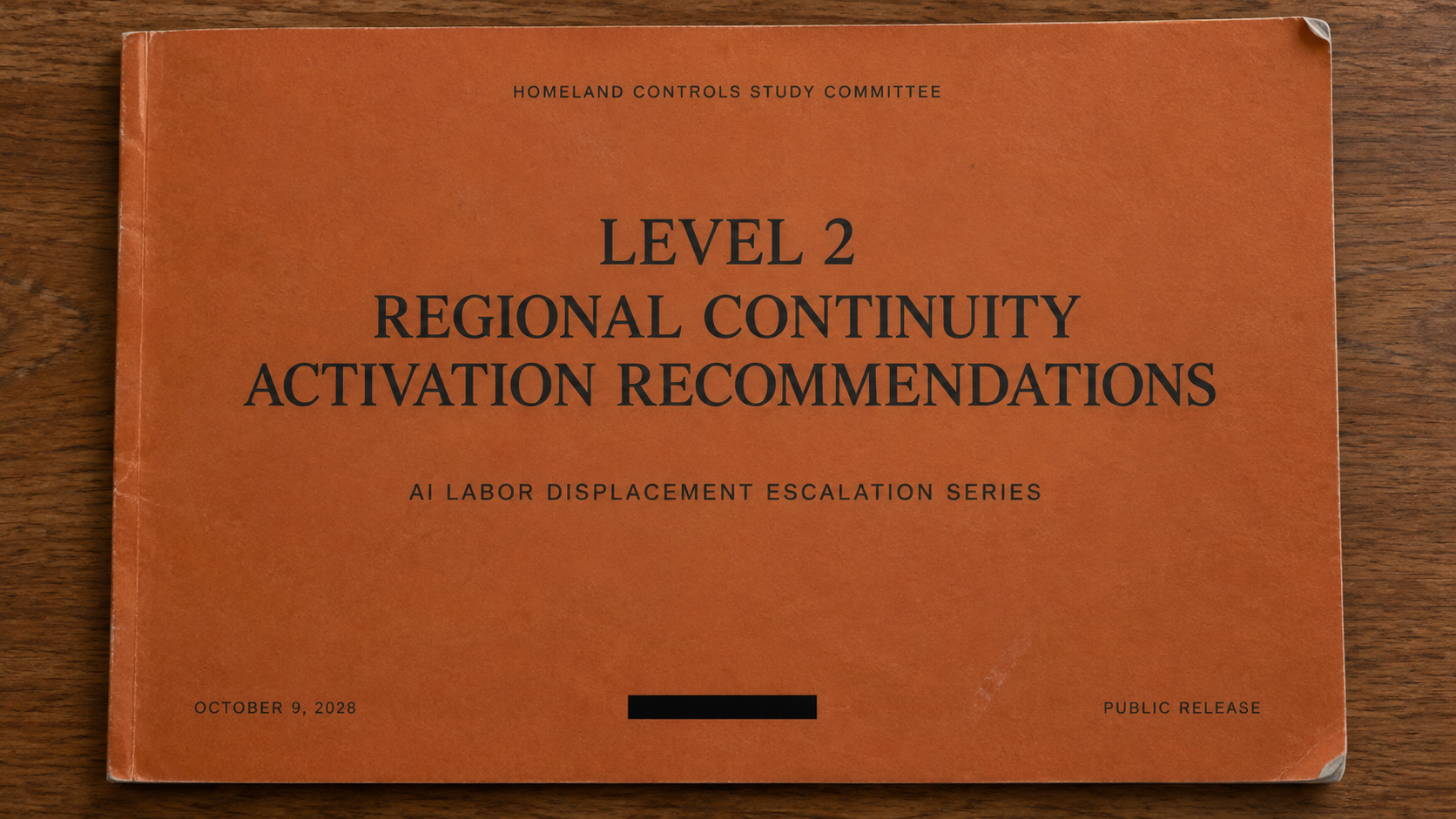
Homeland Controls Study Committee
Document: HCL-28-056
Prepared for: Homeland Controls Study Committee
Proposed operating authority: Federal–State Economic Continuity Compact Authority
Activation level: Level 2 — Regional Continuity Activation
Status: Independent scenario-planning research prepared for Christians and Aliens. This document is not issued by, on behalf of, or under the authority of the United States Government, any state government, or any existing public agency. The institutions and authorities proposed below do not exist unless established through lawful executive, legislative, or interstate action.
Classification: Public Release — Analytical Planning Assessment
Date: October 9, 2028
Executive Summary
The official U.S. unemployment rate has reached 8 percent, equal to approximately 13.6 million unemployed workers under the study’s 170 million-person labor-force planning assumption. Approximately 25 million to 40 million workers now face unemployment, inadequate hours or earnings, contract-income collapse, labor-force exclusion, benefit loss, or blocked access to stable career entry. Approximately 12 million to 23 million workers require direct continuity support, while total household exposure is estimated at 40 million to 65 million people. California, Texas, Florida, New York, and Illinois contain multiple labor markets in which employment deterioration is now accompanied by rising household and administrative stress. The activation record shows severe deterioration or at least four adverse indicators across three or more labor markets: weaker replacement hiring, longer unemployment duration, reduced hours, falling contractor demand, benefit-processing pressure, rent and utility arrears, increased food-assistance demand, health-coverage transitions, child-care instability, and weakening local revenue. The condition has moved beyond a targeted workforce adjustment and has become a regional continuity problem. The Committee recommends immediate activation of Federal–State Economic Continuity Compacts for an initial 18-month period. The Level 2 response should combine work sharing, wage and benefit continuity, regional household stabilization, local fiscal and administrative aid, paid transition pathways, small-business and supply-capacity investment, and regional economic diversification. Existing WIOA Rapid Response and National Dislocated Worker Grant authorities provide useful delivery channels for major economic dislocations, but the scale described here requires additional congressional appropriations and explicit authority for multi-program continuity grants (U.S. Department of Labor). Level 2 authority shall be geographically bounded, transparent, time-limited, and independently reviewed. It shall not authorize generalized surveillance, compulsory work, movement controls, political screening, indefinite emergency declarations, or denial of essential services. The function of activation is to deliver aid and restore regional capacity, not to control affected populations.
Findings
- Regional feedback loops are operating. Employment and income loss are reducing household spending, weakening local businesses and revenue, increasing service demand, and reducing the capacity of local institutions to respond.
- Single-program responses are inadequate. Training cannot work when participants lose housing, health coverage, transportation, child care, or caregiving arrangements, or when destination jobs do not exist.
- Delivery capacity is a binding constraint. Benefit money appropriated without staff, systems, appeals, provider networks, and local operating support will arrive late or not at all.
- Supply matters. Rental housing, health care, behavioral health, child care, elder care, energy, transportation, and skilled trades can become bottlenecks when support increases household purchasing power without expanding real capacity.
- Regional strategies must differ. Metropolitan technology and professional-service centers, logistics corridors, retirement regions, industrial communities, and rural areas face different labor and service constraints.
Recommended Authority
Congress should authorize a Federal–State Economic Continuity Compact program administered by the proposed National Economic Continuity Council. The statute should define the Level 2 trigger, eligible uses, cost-sharing rules, civil-rights protections, audit access, reporting, renewal, deactivation, and judicial review. A Compact Governing Board should include federal program leads and designated officials from activated states, plus nonvoting advisory representatives from affected counties and cities, tribal governments, labor, employers, disability and caregiver organizations, civil-liberties counsel, housing and health providers, and community-based organizations. The Board may coordinate but may not supersede state or local legal authority unless Congress has expressly provided otherwise. Each activated region should establish a Regional Continuity Operations Cell to integrate program delivery, logistics, provider capacity, and public reporting. The cell is not a law-enforcement fusion center and shall not collect intelligence unrelated to benefit integrity, program operations, or lawful aggregate risk measurement.
Recommendations
Activate Regional Compacts
Within 15 days, the Council should certify affected labor markets in California, Texas, Florida, New York, and Illinois. Certification should identify the indicators crossed, affected sectors and cohorts, household exposure, delivery constraints, and anticipated duration. Neighboring states or tribal jurisdictions should be permitted to join where commuting, supply chains, health systems, or housing markets cross boundaries. Each compact should contain a 90-day operating plan and an 18-month recovery plan. Plans must assign responsibilities, identify legal authorities, publish budgets, inventory providers, establish appeal and complaint channels, and set measurable deactivation conditions.
Create Continuity Block Grants
Congress should appropriate formula-and-need-based Regional Economic Continuity Grants. The formula should account for unemployment, long-duration unemployment, underemployment, benefit loss, dependent-household exposure, housing cost burden, fiscal capacity, service backlogs, critical-workforce shortages, rural access, and disability prevalence. Permitted uses should include unemployment administration, housing stabilization, food distribution, health-coverage navigation, medication continuity, child care, caregiver respite, behavioral health, transportation, broadband, legal aid, local workforce capacity, small-business retention, and regional diversification. Funds should supplement rather than displace ordinary state and local spending, except where a transparent maintenance-of-effort waiver is necessary to prevent service failure.
Expand Income Continuity
Work-sharing programs should be expanded throughout activated regions, with federal financing support as authorized by Congress. Employers receiving subsidies should preserve benefits, provide worker notice, maintain nondiscrimination, and report layoffs averted. Wage insurance should become available to eligible reemployed workers whose pay falls materially below prior earnings, with supplements declining over time. Congress should authorize a temporary income-continuity pathway for qualifying independent and intermittent workers whose verified earnings collapse is not adequately covered by ordinary unemployment insurance. Eligibility should use tax, platform, contract, bank, or business records chosen under published rules; applicants must retain a human alternative when automated verification fails.
Modernize and Surge Benefits
The Department of Labor should deploy joint federal-state delivery teams to activated regions. Teams should add call-center and adjudication staff, improve mobile and language access, establish identity-recovery clinics, test payment systems, and reduce appeals backlogs. GAO’s findings on aging unemployment systems and the need for federal standards and state performance measurement support a standards-based modernization approach (GAO). States should maintain offline and assisted application channels for people without reliable devices, broadband, literacy, language proficiency, documentation, or disability access. Fraud prevention should focus on system-level risk management, employer verification, identity recovery, and rapid correction rather than punitive presumptions against claimants.
Stabilize Housing and Utilities
HUD and participating states should establish time-limited eviction-prevention, rental-arrears, mortgage-servicing, and utility-continuity programs in certified regions. Assistance should prioritize preserving existing housing where feasible, mediation before eviction, and direct vendor payment with notice and appeal. Programs should include legal aid and housing counseling. Supply measures should accompany assistance: rehabilitation of vacant units, accelerated code-compliant repairs, conversion of suitable properties, infrastructure support for new housing, and lawful permitting improvements. Funds should not be used to waive safety, accessibility, labor, environmental, or fair-housing requirements.
Secure Food and Health Continuity
USDA should fund state administrative surge capacity, school-meal continuity, and regional food-distribution logistics under available authority, while Congress supplies any new benefit authority required. HHS and states should provide health-coverage navigation, continuity of essential medication, behavioral-health surge capacity, and protection for critical community providers. Section 1115 of the Social Security Act permits HHS to approve state Medicaid demonstrations likely to advance Medicaid objectives, while emergency uses and other flexibilities remain subject to federal findings and approval (Medicaid.gov). States should seek targeted waivers or demonstrations only where legally applicable; an economic activation alone should not be misrepresented as a public-health emergency.
Protect Child Care and Caregiving
HHS and states should issue provider-stabilization grants to prevent avoidable loss of licensed child-care, home-care, disability-service, and elder-care capacity in activated regions. Supports should include workforce retention, substitute pools, transportation, respite care, and extended-hour care tied to verified work or training schedules. Care recipients and family caregivers should participate in program design. Publicly supported care work should meet wage, training, safety, background-check, accessibility, and worker-rights standards. Unpaid family caregiving should not be treated as economic inactivity or used to deny transition support.
Build Paid Regional Pathways
The Compact Authority should procure paid pathways linked to verified regional needs in construction, housing rehabilitation, grid and energy work, water systems, health support, child and elder care, education support, cybersecurity, advanced manufacturing, logistics, transit maintenance, and environmental restoration. Registered Apprenticeship offers an established paid model with mentorship, progressive wages, related instruction, and a portable credential (Apprenticeship.gov). Programs should guarantee wage payment, worker protections, portable records, and transparent completion and placement reporting. No participant should be compelled to enter a public-purpose placement as a condition of receiving essential subsistence.
Provide Local Fiscal Aid
Treasury should administer temporary, targeted fiscal-stabilization grants to counties, municipalities, tribal governments, transit agencies, schools, and other eligible public entities experiencing the combination of revenue loss and service demand specified by statute. Aid should protect essential operations, benefit administration, libraries, public health, courts, transportation, emergency communications, and infrastructure maintenance. Recipients should publish monthly spending and staffing reports. Funds should not support unrelated capital projects, political advocacy, mass surveillance, or expansion of coercive authority.
Diversify Regional Economies
Commerce, SBA, Energy, Transportation, Agriculture, and participating states should coordinate place-based investments in small-business formation, employee ownership, domestic supply chains, broadband, repair capacity, advanced manufacturing, energy infrastructure, care-sector capacity, and community-college partnerships. Awards should be based on credible demand, local capacity, and long-term operating plans rather than speculative job announcements. Large awards should include clawbacks for false representations, failure to meet employment or wage commitments, prohibited stock distributions, or relocation that merely transfers jobs from another distressed U.S. region without net public benefit.
Establish Provider Reserve Capacity
Each compact should maintain prequalified pools of benefit administrators, legal-aid offices, housing counselors, navigators, behavioral-health providers, child-care and care providers, interpreters, cybersecurity specialists, and technology vendors. Contracts should specify activation time, rates, accessibility, data protection, continuity of operations, and performance measures.
Funding and Fiscal Controls
The Level 2 appropriation should be separated into household stabilization, administrative capacity, local fiscal aid, workforce transition, and supply expansion accounts. Transfers among accounts should require public notice and a written justification. Congress should prohibit hidden off-budget financing and require Treasury and OMB to report obligations, outlays, estimated revenue effects, improper payments, and future liabilities quarterly. The study’s fiscal model estimates that an 8 percent official unemployment condition could require approximately $0.9 trillion to $1.6 trillion in additional annual public support under a full-and-partial support policy, with broader fiscal deterioration of approximately $1.2 trillion to $2.2 trillion after illustrative revenue loss and automatic-stabilizer pressure. These are planning ranges rather than budget scores and must be updated before appropriations.
Implementation Schedule
| Deadline | Required action |
|---|---|
| First 15 days | Certify regions; publish trigger evidence; appoint Compact Board; issue privacy, civil-rights, fiscal, and procurement directives. |
| First 30 days | Sign compacts; release administrative surge funds; deploy benefit teams; open housing, food, health, care, and utility stabilization channels. |
| First 60 days | Award local fiscal aid; activate provider reserves; begin paid regional pathways and work-sharing expansion; publish regional dashboards. |
| First 90 days | Complete delivery stress tests; publish supply bottleneck plans; begin housing rehabilitation, care-capacity, and infrastructure projects. |
| Six months | Evaluate household stability, processing performance, layoffs averted, local service continuity, provider capacity, inflation pressure, and program equity. |
| Twelve months | Recalibrate formulas and terminate ineffective contracts; publish independent audit. |
| Eighteen months | Deactivate, renew under statutory criteria, or recommend Level 3 if national thresholds are met. |
Deactivation and Escalation
A region should leave Level 2 after adverse indicators remain below activation thresholds for two consecutive quarters, benefit and service backlogs return to published standards, and local governments demonstrate six months of essential-service capacity. Supports should taper rather than end abruptly. The Council should recommend Level 3 only when severe employment or income deterioration exists across at least five states for two quarters and is accompanied by verified household stress that exceeds regional compact capacity. Congress should receive a public evidentiary record, updated fiscal estimate, legal analysis, and independent review before national emergency powers or benefits are considered.
Rights, Privacy, and Democratic Safeguards
Activation of this level expands assistance and administrative capacity. It does not convert displaced workers or their dependents into a security category. Every participating agency shall operate under the following restrictions:
- No generalized domestic surveillance, individual employment-risk score, centralized registry of displaced persons, political or religious profile, genetic or medical classification, or benefit-status passport.
- No compelled labor, forced relocation, movement restriction, detention, censorship, involuntary medical treatment, or denial of food, housing, health care, education, legal process, or other essential service based on employment status.
- No fully automated adverse eligibility decision. Applicants shall receive notice, a plain-language explanation, access to the record used, human reconsideration, and an appeal before benefits are terminated or recouped, except for narrowly defined immediate fraud holds subject to prompt review.
- Data collection shall be limited to a stated program purpose, minimized, encrypted, access-controlled, independently audited, and deleted under published retention schedules. Aggregate occupational, sector, cohort, program-outcome, and regional data shall be preferred over person-level data.
- Program rules, trigger calculations, contracts, audit results, error rates, demographic access measures, and spending shall be publicly reported, except where disclosure would expose personal information or defeat lawful fraud controls.
- Inspector-general review, civil-rights review, privacy-impact assessment, legislative oversight, judicial review, and protected whistleblower reporting shall continue during every activation. The institutional warning explored in The Government’s Plan to Contain the Alien Contagion is treated here as a caution against allowing emergency planning to become a system for classifying, sorting, or controlling people. The lawful objective is economic continuity and human resilience.
Common Performance Measures
All funded measures shall report results at 30-day, quarterly, and annual intervals using a common data dictionary. Required measures include:
- Official unemployment, labor-force participation, long-duration unemployment, hiring, replacement hiring, separations, hours, real earnings, benefit loss, and contractor-income deterioration.
- Entry-level openings, apprenticeships, paid work-based learning, completions, six- and twelve-month retention, wage progression, credential portability, and employer demand.
- Claim-processing time, payment accuracy, appeal time, identity-recovery time, improper-payment rates, claimant abandonment, language access, disability access, and service wait times.
- Rent and mortgage arrears, eviction filings, utility disconnections, food-assistance demand, health-coverage interruptions, medication continuity, child-care availability, caregiver burden, crisis-line demand, and behavioral-health wait times.
- State and local revenue stress, reserve drawdowns, staffing vacancies, infrastructure deferrals, nonprofit capacity, school and hospital stress, and critical-workforce shortages.
- Program cost per household stabilized, cost per layoff averted, cost per sustained placement, administrative cost, fiscal exposure, geographic equity, and distribution of benefits by income and household type. The Observatory shall publish uncertainty ranges and distinguish correlation from verified AI causation. No single indicator, employer announcement, model output, or news report shall determine activation or eligibility.
Committee Direction
Level 2 is a regional continuity operation. Its purpose is to stop a labor shock from becoming a cascading failure of households, providers, businesses, and local government. Federal action should reinforce state, tribal, and local capacity while preserving ordinary democratic institutions and legal accountability.