What does the government’s first-stage response to AI-driven job losses look like? The Homeland Controls Study Committee recommends a 12-month Targeted Adjustment Program that expands work-sharing, wage insurance, and paid career-entry pathways in four named states—using existing federal and state systems rather than creating new emergency powers.
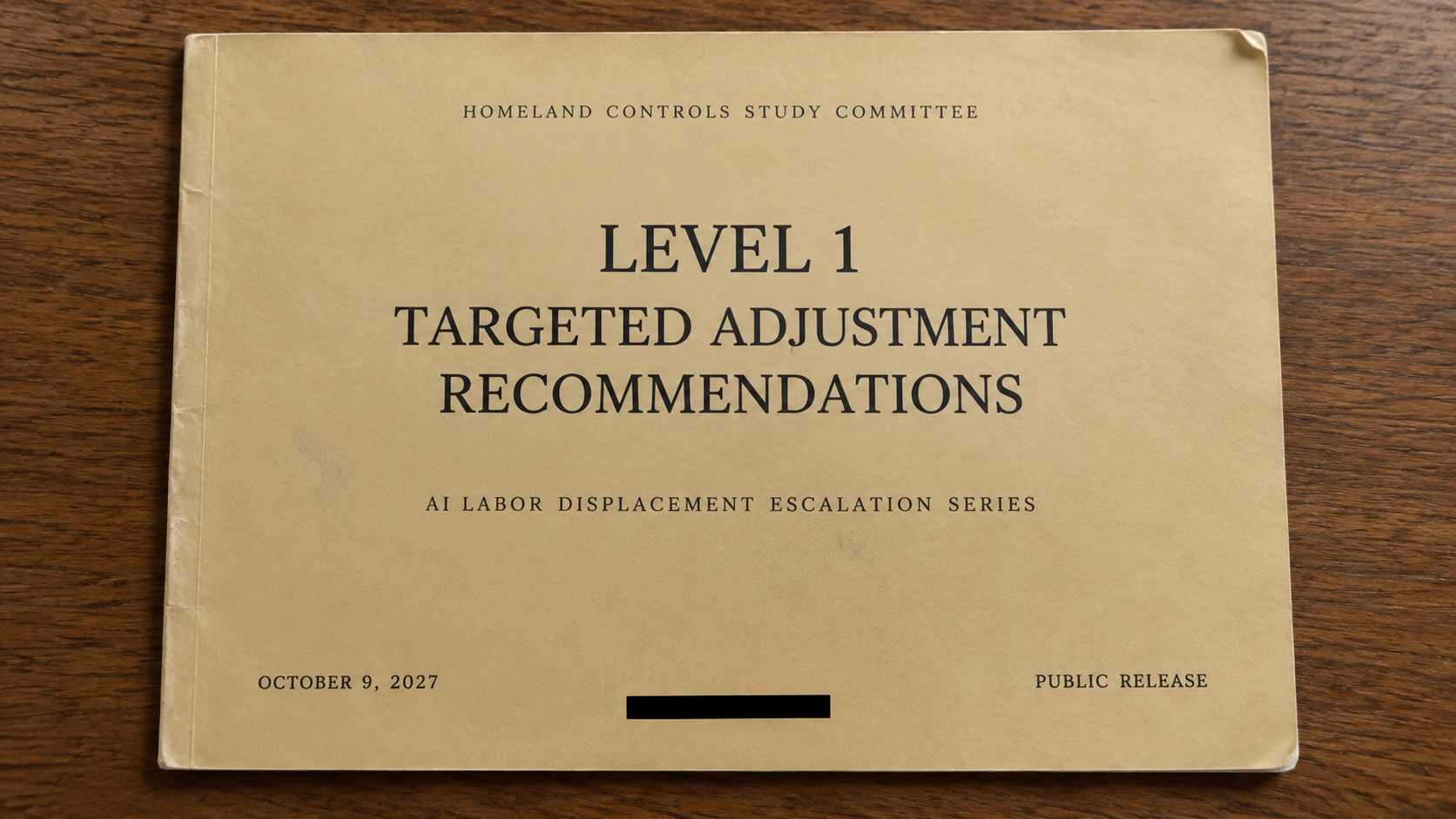
Homeland Controls Study Committee
Document: HCL-27-055
Prepared for: Homeland Controls Study Committee
Proposed operating authority: National Economic Continuity Council
Activation level: Level 1 — Targeted Adjustment
Status: Independent scenario-planning research prepared for Christians and Aliens. This document is not issued by, on behalf of, or under the authority of the United States Government, any state government, or any existing public agency. The institutions and authorities proposed below do not exist unless established through lawful executive, legislative, or interstate action.
Classification: Public Release — Analytical Planning Assessment
Date: October 9, 2027
Executive Summary
The official U.S. unemployment rate has reached 6 percent, equal to approximately 10.2 million unemployed workers under the study’s 170 million-person labor-force planning assumption. The headline rate understates the operating burden: approximately 18 million to 30 million workers are experiencing unemployment, reduced hours, wage or contract-income loss, benefit disruption, involuntary contingent work, labor-force withdrawal, or blocked entry into stable careers. An estimated 8 million to 16 million workers require direct continuity support, and household exposure reaches approximately 25 million to 45 million people when spouses, children, dependent parents, disabled household members, and other dependents are included. These values are planning ranges, not benefit caseload forecasts. California, Texas, Florida, and New York have each reported two or more adverse indicators persisting for two consecutive quarters in defined occupations, age cohorts, or metropolitan labor markets. The common pattern is a reduction in replacement and entry-level hiring across administrative support, customer operations, routine analytical work, selected media and technology functions, and junior professional roles. Employers continue to retain many experienced workers, but fewer workers are entering the positions through which occupational judgment and advancement are developed. Reduced hours, lower starting wages, contract substitution, longer job searches, and employer-benefit loss are beginning to increase household strain. The Level 1 threshold is met because the disruption is persistent and concentrated, but remains capable of correction through targeted action. The Committee recommends immediate activation of a 12-month Targeted Adjustment Program led by the proposed National Economic Continuity Council and administered through existing federal and state institutions wherever lawful. The program shall prioritize layoff avoidance, rapid reemployment, paid career entry, wage and benefit continuity, child-care and transportation access, targeted household stabilization, and reliable measurement. The initial response shall use existing delivery channels before creating new bureaucracies. The Department of Labor’s WIOA Adult and Dislocated Worker system already provides employment and training services through American Job Centers, and WIOA Rapid Response and National Dislocated Worker Grants provide established mechanisms for responding to major economic dislocations (U.S. Department of Labor; National Dislocated Worker Grants). Short-Time Compensation allows participating employers to reduce hours in lieu of layoffs while affected workers receive partial unemployment benefits (U.S. Department of Labor). Registered Apprenticeship provides paid work experience, mentorship, progressive wages, related instruction, and a portable credential (Apprenticeship.gov). Level 1 does not authorize a national employment emergency, unrestricted spending, compulsory work, surveillance, or a permanent department. It authorizes targeted grants, technical assistance, lawful demonstration programs, transparent employer agreements, and time-limited household support. Measures shall automatically expire after 12 months unless the Council documents continuing trigger conditions, publishes an evaluation, and obtains the approval required by law.
Findings
- Hiring is the principal early warning. A decline in junior and replacement hiring can close career pathways without producing a corresponding spike in layoffs or unemployment claims.
- The impact is household-level. Reduced hours, benefit loss, and inadequate new wages can endanger housing, food, health care, child care, caregiving, and transportation before a worker qualifies for conventional unemployment assistance.
- The response can still be targeted. Conditions in the four named states do not yet justify nationwide emergency benefits. They justify occupation-, cohort-, and labor-market interventions with national standards and state delivery.
- Existing systems need reinforcement. WIOA, American Job Centers, state unemployment insurance, Short-Time Compensation, community colleges, apprenticeship agencies, and local providers form a usable base, but staffing, technology, outreach, and outcome measurement must be expanded.
- Prevention costs less than full dependency. Preserving an employment attachment, benefits, and household stability reduces the probability that a temporary transition becomes long-duration exclusion.
Recommended Authority
The President should establish a 24-month National Economic Continuity Council by executive action to coordinate activities already authorized by law. Congress should separately authorize and appropriate any new benefit, grant, tax expenditure, employer mandate, interstate data system, or obligation that exceeds existing agency authority. The Council should be chaired jointly by the Secretaries of Labor and Commerce, with Treasury serving as fiscal lead. Permanent members should include Education, Health and Human Services, Housing and Urban Development, Agriculture, Energy, Transportation, the Small Business Administration, the Office of Management and Budget, and representatives of participating states, tribal governments, labor, employers, disability advocates, caregivers, civil-liberties organizations, community colleges, and local government. The Council’s analytical arm shall be the National AI Labor and Civil Continuity Observatory. Its normal unit of analysis shall be the occupation, industry, age cohort, labor market, household type, audited program outcome, or aggregated employer report—not the individual citizen.
Recommendations
Establish Targeted Adjustment Compacts
Within 30 days, the Council should invite California, Texas, Florida, and New York to enter voluntary 12-month Targeted Adjustment Compacts. Each compact should identify affected labor markets, designate a lead state official, inventory state authorities and delivery systems, set measurable objectives, and specify federal technical assistance. Compacts should include local workforce boards, unemployment agencies, community colleges, apprenticeship agencies, labor organizations, employers, disability and civil-rights representatives, and trusted community providers. Federal support should be conditioned on transparent reporting, human appeal channels, nondiscrimination, data minimization, independent evaluation, and a prohibition on using program data for unrelated law-enforcement, immigration, political, or commercial purposes absent specific lawful authority.
Expand Work Sharing
The Department of Labor should provide immediate technical assistance to each participating state to simplify and expand Short-Time Compensation enrollment. Employers proposing AI-related reductions in labor demand should be offered an expedited path to approved work-sharing plans when they preserve jobs and benefits, provide advance worker notice, and disclose the layoffs estimated to be avoided. Participating employers should reduce hours across an affected unit rather than selectively discharging junior or higher-cost workers; preserve health coverage on terms no worse than those applicable before the plan where feasible; prohibit retaliation; and offer paid training during a portion of reduced hours. Public subsidies should be recovered where a firm misrepresents avoided layoffs or uses the program to finance a previously planned permanent workforce elimination.
Launch Wage Insurance Pilots
Congress should authorize time-limited wage-insurance pilots for eligible workers who accept new employment paying materially less than the position lost. The supplement should decline over no more than 24 months, preserve an incentive to increase earned income, and coordinate with unemployment insurance and tax credits. Eligibility should not require surrender of legal claims, relocation, political activity, or acceptance of unsafe, inaccessible, or unsuitable work. Pilot evaluations should compare earnings recovery, job retention, benefit continuity, household arrears, and program cost with a matched group receiving ordinary reemployment services. Results should be reported in aggregate and independently reviewed.
Protect Career Entry
The Departments of Labor and Education should fund paid apprenticeships, internships, residencies, and junior professional pathways in sectors with verified demand. Priority fields should include health care, skilled trades, energy and grid operations, construction, infrastructure inspection, cybersecurity, advanced manufacturing, public administration, education support, logistics, repair, and care work. Firms receiving federal AI procurement awards, transition grants, or tax incentives should report changes in junior hiring, apprenticeships, hours, contract use, and worker training. New incentives should require a Junior-Role Continuity Plan stating how beginners will acquire supervised judgment when routine training tasks are automated. Registered Apprenticeship should be used where its paid experience, mentorship, wage progression, instruction, and portable credential fit the occupation.
Modernize Unemployment Delivery
The Department of Labor should establish minimum Level 1 operating standards for claim intake, identity recovery, payment timeliness, mobile access, language access, disability access, notices, human review, and appeals. GAO has documented legacy-system and service-delivery problems and recommended that Labor define modernization standards and measure state performance against them (GAO). The four states should receive technical teams to conduct 60-day readiness reviews, test surge capacity, map manual workarounds, and correct barriers affecting part-time, intermittent, self-employed, disabled, and caregiving workers. Fraud controls should use layered verification and prompt human remediation rather than opaque automatic denials.
Provide Transition Supports
Targeted grants should pay for child care, elder-care respite, disability accommodations, transportation, broadband, tools, licensing, and short-duration emergency expenses when those supports are necessary for paid training or reemployment. Training providers should not be paid solely for enrollment; a material portion of funding should depend on completion, placement, retention, wage quality, and participant satisfaction. Unpaid training should not be the default. Workers in intensive programs should receive a living stipend or wage, and training should be linked to verified employer demand or a recognized public-service need.
Stabilize At-Risk Households
Participating states should pre-authorize narrowly targeted rental, utility, food, medication, health-coverage, child-care, and caregiving assistance for households experiencing verified labor-income or benefit loss in activated labor markets. Assistance should arrive before eviction, utility termination, medication interruption, or loss of care arrangements whenever administratively feasible. States should establish a no-wrong-door referral protocol among unemployment agencies, American Job Centers, Medicaid and marketplace navigators, housing agencies, food-assistance offices, schools, and local providers. Enrollment in one program shall not automatically create eligibility or an adverse inference in another; consent and legal authority remain required.
Support Small Businesses
The Small Business Administration and participating states should offer technical assistance, credit counseling, procurement access, and time-limited working-capital support to viable local firms harmed by a sudden contraction in demand. Aid should prioritize retention, employee ownership, local supply chains, and new hiring; it should not preserve fraudulent, unsafe, or structurally insolvent enterprises without a credible recovery plan.
Require Employer Transparency
Large employers receiving federal support should submit standardized aggregate reports on AI-related task redesign, hiring, separations, hours, wages, benefits, contractor use, entry-level roles, training, and geographic effects. Reports should be independently auditable. Trade secrets and personal information shall be protected, but public money should not finance unmeasured labor displacement.
Funding and Fiscal Controls
The Office of Management and Budget and Treasury should publish a Level 1 funding crosswalk within 45 days identifying existing appropriations, statutory limits, proposed transfers, and new authorities required. No agency should imply that an existing appropriation can finance a new entitlement without legal review. Funding should be released in quarterly tranches based on enrollment capacity and verified need. Administrative costs, improper payments, contractor performance, geographic distribution, and outcomes should be reported publicly. Pilots should include control or comparison designs where ethical and feasible, and all awards should contain termination, recapture, audit-access, and records-retention clauses.
Implementation Schedule
| Deadline | Required action |
|---|---|
| First 15 days | Confirm triggers; publish affected occupations and labor markets; appoint Council and state leads; issue civil-rights and privacy directives. |
| First 30 days | Sign state compacts; open employer work-sharing assistance; deploy unemployment-system readiness teams; publish funding crosswalk. |
| First 60 days | Begin paid pathway procurements; open transition-support applications; launch employer reporting; complete benefit-delivery stress tests. |
| First 90 days | Enroll first work-sharing cohorts; award local adjustment grants; publish baseline dashboard and service standards. |
| Six months | Report layoffs averted, placements, wage recovery, claim performance, household stress, errors, and spending; correct underperforming programs. |
| Twelve months | Conduct independent evaluation and recommend deactivation, renewal, redesign, or escalation. |
Deactivation and Escalation
Level 1 should deactivate when the triggering adverse indicators remain below activation thresholds for two consecutive quarters, claim and service backlogs return to ordinary standards, and no severe indicator persists in an activated labor market. Targeted assistance may wind down over 90 days to avoid abrupt household harm. The Council should recommend Level 2 only if one severe indicator or four adverse indicators occur across at least three labor markets and the evidence shows that household and local-service stress exceed targeted program capacity. Escalation must be documented in a public finding and reviewed by independent economists, state administrators, worker representatives, civil-rights counsel, and privacy experts.
Rights, Privacy, and Democratic Safeguards
Activation of this level expands assistance and administrative capacity. It does not convert displaced workers or their dependents into a security category. Every participating agency shall operate under the following restrictions:
- No generalized domestic surveillance, individual employment-risk score, centralized registry of displaced persons, political or religious profile, genetic or medical classification, or benefit-status passport.
- No compelled labor, forced relocation, movement restriction, detention, censorship, involuntary medical treatment, or denial of food, housing, health care, education, legal process, or other essential service based on employment status.
- No fully automated adverse eligibility decision. Applicants shall receive notice, a plain-language explanation, access to the record used, human reconsideration, and an appeal before benefits are terminated or recouped, except for narrowly defined immediate fraud holds subject to prompt review.
- Data collection shall be limited to a stated program purpose, minimized, encrypted, access-controlled, independently audited, and deleted under published retention schedules. Aggregate occupational, sector, cohort, program-outcome, and regional data shall be preferred over person-level data.
- Program rules, trigger calculations, contracts, audit results, error rates, demographic access measures, and spending shall be publicly reported, except where disclosure would expose personal information or defeat lawful fraud controls.
- Inspector-general review, civil-rights review, privacy-impact assessment, legislative oversight, judicial review, and protected whistleblower reporting shall continue during every activation. The institutional warning explored in The Government’s Plan to Contain the Alien Contagion is treated here as a caution against allowing emergency planning to become a system for classifying, sorting, or controlling people. The lawful objective is economic continuity and human resilience.
Common Performance Measures
All funded measures shall report results at 30-day, quarterly, and annual intervals using a common data dictionary. Required measures include:
- Official unemployment, labor-force participation, long-duration unemployment, hiring, replacement hiring, separations, hours, real earnings, benefit loss, and contractor-income deterioration.
- Entry-level openings, apprenticeships, paid work-based learning, completions, six- and twelve-month retention, wage progression, credential portability, and employer demand.
- Claim-processing time, payment accuracy, appeal time, identity-recovery time, improper-payment rates, claimant abandonment, language access, disability access, and service wait times.
- Rent and mortgage arrears, eviction filings, utility disconnections, food-assistance demand, health-coverage interruptions, medication continuity, child-care availability, caregiver burden, crisis-line demand, and behavioral-health wait times.
- State and local revenue stress, reserve drawdowns, staffing vacancies, infrastructure deferrals, nonprofit capacity, school and hospital stress, and critical-workforce shortages.
- Program cost per household stabilized, cost per layoff averted, cost per sustained placement, administrative cost, fiscal exposure, geographic equity, and distribution of benefits by income and household type. The Observatory shall publish uncertainty ranges and distinguish correlation from verified AI causation. No single indicator, employer announcement, model output, or news report shall determine activation or eligibility.
Committee Direction
The Committee directs the proposed Council to treat Level 1 as a correction window. The immediate objective is to preserve employment attachments, reopen career entry, stabilize affected households, and learn which measures prevent long-duration exclusion. The government should build capacity now while refusing to normalize permanent emergency authority.