Can policy fixes solve the AI jobs crisis? A Brookings Institution report proposes twelve fixes for AI-driven job losses, even as estimates suggest AI could cut half of entry-level white-collar jobs. The book argues these piecemeal fixes can’t address what it calls a structural overpopulation crisis — one it warns will eventually pressure governments toward far more drastic “solutions.”
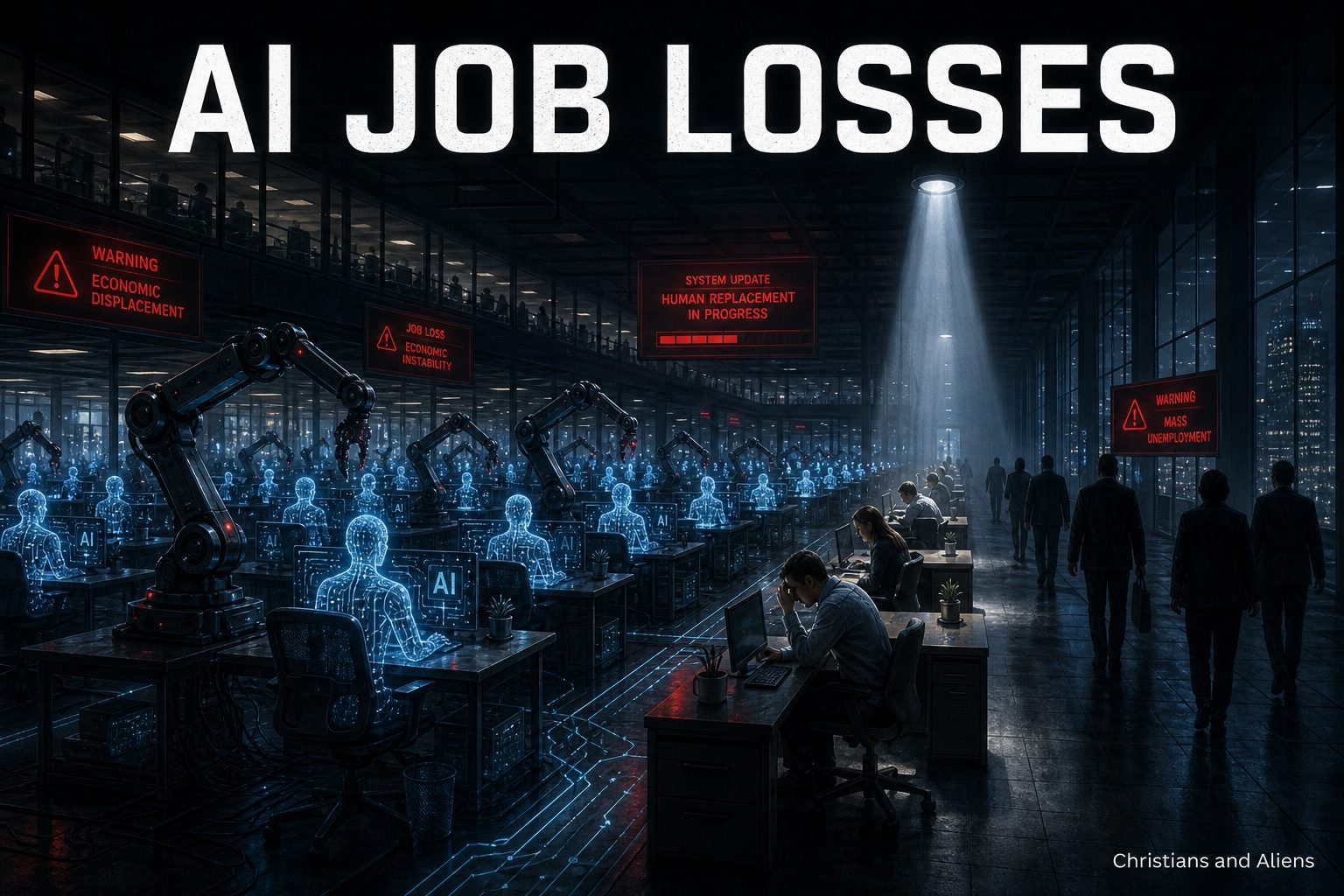
The Brookings stable of experts define world-class education, experience and thought leadership, yet their recommendations regarding mitigating AI-induced Job Losses are feeble and ineffective. I believe their inability to deliver reasonable solutions is because there are no reasonable solutions. They assume the same social and economic levers that exist today used in the same reasonable magnitudes. I believe that is a false assumption. My breakdown of the Brookings recommendations are below:
Brookings just published a list of ways to soften the blow of AI job losses, and reading it as someone familiar with The Government’s Plan to Contain the Alien Contagion feels like watching a fire department show up with a garden hose to a wildfire. The Brookings piece opens by citing Anthropic CEO Dario Amodei’s warning that AI “could cut half of all entry-level white-collar jobs in the coming years,” along with a McKinsey estimate that current AI “has the potential to automate work activities that absorb up to 70 percent of employees’ time today.” Those numbers are not fringe alarmism — they are coming from the people building the technology.
That is exactly the collision The Government’s Plan to Contain the Alien Contagion describes when it lays out the “Mega Trends” behind what it calls a coming crisis of mass structural unemployment: a world where “large proportions of the working-age population will be structurally unable to find meaningful employment that pays a living wage,” a problem the book insists “is not a cyclical unemployment problem solvable by job training programs” but “a fundamental mismatch between the skills and capacities of human workers and the needs of an AI-and-robot-powered economy.” Brookings offers twelve well-meaning policy tweaks. The book’s argument is that twelve tweaks, or twelve hundred, cannot fix a structural mismatch of this size — and that the resulting fiscal and social strain is precisely the pressure that could someday make a “solution” to too many economically unnecessary people look attractive to the people in charge. Below, each AI job losses recommendation from the article is examined in the order Brookings presented it, with its real upside and its real limitation.
Brookings Retraining Programs Can’t Outrun AI Job Losses
Brookings’ first recommendation is to “encourage companies to retrain workers,” arguing governments should expand “tax credits for businesses that retrain laid-off employees” because it is “not in the country’s national interest for large numbers of people to become part of a permanent underclass.” The positive here is real: a subsidized retraining program can genuinely help an individual worker land a new role, and the tax-credit mechanism at least tries to make the cost shared rather than dumped entirely on the unemployed.
The negative is scale. Retraining works when displacement is narrow and temporary — a factory closes, workers reskill, a new plant opens nearby. But The Government’s Plan to Contain the Alien Contagion points out that the coming wave is different in kind: “77 percent of new AI-related jobs require master’s degrees,” meaning workers pushed out of mid-skill roles face “severe barriers to re-entry in the very occupations that are expanding.” A retraining tax credit does nothing to close that credential gap for someone in their 40s or 50s, and it assumes companies still need enough humans on the other side of retraining to make the investment worthwhile. If the destination jobs themselves are also being automated within a few years, retraining becomes a subsidy for a treadmill, not a bridge.
Brookings Portable Health Benefits Are a Band-Aid, Not a Cure
The article’s second idea, making health benefits portable through mechanisms like the Affordable Care Act exchanges, addresses a genuine and immediate pain point: losing a job in America usually means losing health coverage at the worst possible moment. Keeping ACA exchanges strong is a low-cost, high-value fix for the individual worker caught between jobs.
But it only works if the gap between jobs is temporary. The book’s framework describes a labor market heading toward permanent, not temporary, non-employment for large segments of the population — a “shrinking tax base as labor income… is replaced by capital-owned automated systems.” Subsidized exchanges are funded by taxpayers and employer contributions tied to a labor market that the book argues is contracting. A safety net stretched to catch a growing, not shrinking, share of the population eventually strains the very tax base meant to sustain it.
Must See Also: Government Precedents Behind Alien Encounter Response
Brookings Shorter Vesting Periods Don’t Fix the Math of AI Job Losses
Brookings suggests employers cut retirement vesting requirements from three-to-six years down to three-to-six months, since “increasing rates of ‘job churn’ due to AI and automation” mean workers move between employers more often. This is a sensible, cheap fix for the specific problem of workers forfeiting retirement contributions during frequent job transitions.
Its limitation is that it assumes there will be a next job to vest into. The book’s mega-trends analysis warns that automation is not just accelerating job churn, it is shrinking the total number of jobs available, describing a scenario where “the number of jobs requiring human workers shrinks substantially” by the 2035–2060 window. Faster vesting helps someone bounce between five employers in a decade; it does nothing for someone who cannot find employer number six.
Brookings Loosening Job Licensing Helps a Sliver of Workers
The recommendation to loosen occupational licensing — allowing “work experience to fulfill certification requirements” instead of degrees — is one of the more genuinely useful ideas in the article, since it removes artificial, non-safety-related barriers to reemployment. It costs governments little and could meaningfully help specific workers with relevant experience but no formal credential.
Even so, it only helps people whose skills already transfer to a licensed field with unmet demand. It does nothing for the mass of workers whose entire occupational category — as the book details with drivers, warehouse staff, and white-collar analysts alike — is being displaced simultaneously across sectors. The book notes that Amazon’s internal documents, reviewed by the New York Times, describe plans to “replace more than 500,000 warehouse jobs by automating 75 percent of its operations” while avoiding hiring “more than 160,000 additional U.S. workers by 2027.” Loosened licensing rules do not create new occupations fast enough to absorb that volume.
Brookings Worker Retraining Accounts Shift the Cost, Not the Problem
Brookings proposes “worker retraining accounts” functioning like retirement accounts, letting people use tax-deferred money for job retraining. This has appeal because it decentralizes decision-making to the worker and creates a savings habit around skills development.
The catch is that it requires displaced or at-risk workers to have disposable income to defer in the first place — precisely the resource most threatened by the disruption the account is meant to address. It is also, functionally, asking individuals to self-fund their own adaptation to a labor shock they did not create and cannot control, echoing the book’s broader point that policy proposals like this “address part of the problem” but “none are sufficient alone.”
Brookings Monthly Tax Credits Help Cash Flow, Not Employment
The suggestion to pay earned income tax credits monthly instead of annually is a smart, nearly costless administrative fix that would meaningfully smooth the finances of low-income workers, particularly those in “vulnerable frontline jobs.” It is one of the cheapest fixes on this list and one of the easiest for government to implement quickly.
But it redistributes existing tax credit dollars over time; it does not create a single new job or dollar of income. For a worker who has lost employment entirely to automation, timing an existing credit differently does not change the underlying fact that their labor is no longer needed.
Brookings Clarifying Contractor Rules Fights a Symptom of a Bigger Trend
Brookings calls for clearer independent contractor classification, noting the tech industry “heavily relies on temp workers to perform core functions such as data analysis, content moderation, or administrative tasks” without offering them benefits. Clarifying these rules would genuinely extend benefits to workers currently denied them.
However, reclassifying contractors as employees raises costs for companies at the exact moment those companies are turning to AI specifically to cut labor costs — potentially accelerating the very automation the rule change is meant to cushion against. The book’s gig-economy analysis observes that “gig work is itself increasingly vulnerable to automation, as platform-matching algorithms, autonomous delivery vehicles, and AI customer service agents displace the gig workers who replaced traditional employees,” meaning today’s contractor protections may simply be legislating for a workforce that shrinks anyway.
Must See Also: How the SCIENCE VS PODCAST Helped Normalize Pandemic Power
Brookings Funding Community Colleges Is Necessary but Insufficient
Financially supporting community college retraining programs is, on its face, one of the more durable investments on the list — these institutions are indeed “a vital part of the retraining ecosystem.” Public funding here builds lasting infrastructure rather than a one-time payment.
The limitation is capacity and pace. Retraining pipelines take semesters or years to move a worker into a new field, while the book’s timeline for displacement is measured in months: it cites Microsoft AI chief Mustafa Suleyman predicting “human-level performance on most, if not all professional tasks… within 12 to 18 months” across accounting, legal, marketing, and project management. A two-year associate’s degree program cannot outrun an 18-month disruption cycle, and government budgets for higher education are themselves constrained by the same shrinking labor-tax base the book warns about.
Brookings Broadband Access Is a Prerequisite, Not a Solution
The call to close the digital divide — noting “twenty-four million Americans still lack access to high-speed internet at home” — is framed by Brookings as essential because “many adult retraining programs take place online.” This is true and important; without connectivity, none of the other remedies on this list are even reachable.
But closing a broadband gap only opens the door to retraining and job searching; it does not guarantee a job exists on the other side of that door. It solves an access problem while leaving the deeper labor-demand problem — the one at the center of the book’s mega-trends analysis — completely untouched.
Brookings Fair Data-Based Evaluations Protect Dignity, Not Jobs
Brookings’ recommendation that “data-based job evaluations are fair” addresses a real and growing concern: employers using KPI analytics, sometimes gathered from company laptops taken home, to make layoff decisions. Ensuring fairness and privacy in these evaluations is a legitimate and achievable goal for employers and regulators.
Yet fairness in how someone is let go does not change whether they are let go. This recommendation manages the process of displacement with more dignity; it does not reduce the volume of displacement driven by the trends the book catalogs across “medical diagnosis, legal document review, financial analysis, drug discovery, software coding, architectural design, and strategic planning.”
Brookings Mitigating Disparate Impact Cannot Prevent the Impact Itself
The article urges policymakers to ensure AI-related job losses “does not fall disproportionately” on groups defined by race, gender, age, disability, immigration, or veteran status — an important equity goal, especially for visa holders whose status is tied to a specific job. This is a worthwhile guardrail against making an already difficult transition worse for the most vulnerable.
Still, distributing the pain more evenly across demographic groups does not shrink the total pain. The book’s framing is blunt on this point: population-level economic redundancy is “not a function of low birth rates” alone but “a function of extended lifespan combined with structural labor displacement” that touches every group eventually, just on different timelines.
Brookings The Four-Day Workweek Is the Most Honest Idea — and the Hardest to Scale
Brookings’ final recommendation — companies adopting four-day workweeks as “workers become more efficient and productive” due to AI, citing one software company’s “130% increase in revenue” alongside fewer sick days — is arguably the most philosophically honest proposal in the piece, because it accepts that AI-driven productivity gains should be shared with workers rather than simply eliminating their jobs. The Government’s Plan to Contain the Alien Contagion independently arrives at the same idea, noting that OpenAI’s own 2026 policy paper “recommended encouraging employers to experiment with four-day workweeks with no loss in pay, using AI productivity gains to reduce working hours rather than employment,” a model already “tested in Iceland, the United Kingdom, and Germany with positive findings on worker well-being.”
The negative is that this approach only works for workers who still have jobs. It is a redistribution of hours and pay among the employed; it offers nothing to the millions the book describes as becoming “economically superfluous” outright. And it depends entirely on voluntary corporate goodwill in a market where, as the book notes, “an extremely wealthy technological ownership class captur[es] most of the productivity gains from automation” rather than passing them on to labor.
Must See Also: NSA’s 1966 Extraterrestrial Paper and Alien Communications
Brookings Why None of This Adds Up to a Real Fix for AI Job Losses
Taken individually, every Brookings recommendation is reasonable, humane, and cheap relative to the problem it targets. Taken together, they share the same structural flaw the book identifies in every proposal on the table — UBI, robot taxes, public wealth funds, reduced hours, expanded safety nets — that “each address part of the problem” while “none are sufficient alone.” Brookings’ list does not even reach the scale of those bigger structural ideas; it is a set of administrative adjustments layered on top of a labor market the book argues is undergoing “a structural transformation from which there is no return to previous norms,” what one analyst quoted in the book calls “a dissolution of the traditional labor market — not a crisis but a structural transformation.”
That gap between modest administrative fixes and a civilization-scale labor shift is exactly the pressure point The Government’s Plan to Contain the Alien Contagion warns about. The book’s core argument is that when “millions of people… are already becoming economically superfluous in an AI-shaped economy,” a “drastic reduction in the number of dependents may come to be seen by elites not only as tolerable, but as socially useful.” Every well-intentioned but underpowered fix — a tax credit here, a faster vesting schedule there — that fails to close the gap between the shrinking need for human labor and the still-growing cost of supporting displaced workers adds one more data point to that thesis. Brookings is trying to patch a boat with duct tape while the book is describing the flood already rising around it, and asking what happens to the people left standing in the water when the patches run out.
Must See Also: Is the Government Prepared for an Alien Encounter