Has history used legal paperwork to strip people of personhood? Repeatedly — the 1926 League of Nations Slavery Convention defined slavery as ownership rights over a person, and under France’s 1685 Code Noir, enslaved people were simultaneously property and criminally liable persons. The book argues this same bureaucratic sorting mechanism is what a future alien-contagion classification system would use against “contaminated” or unwanted populations.
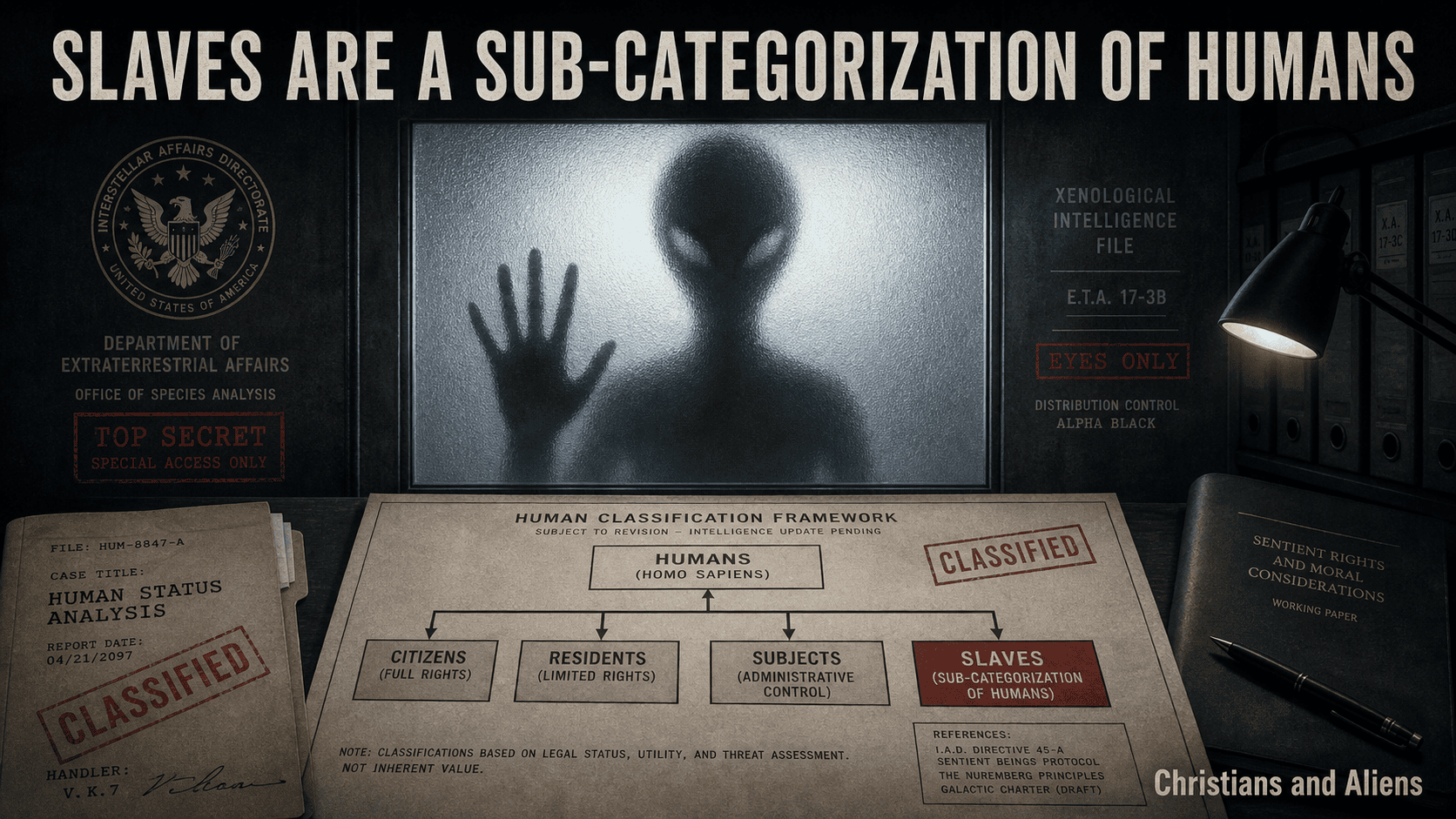
Throughout history, one of the most reliable ways a society justifies cruelty is by first redefining who counts as fully human. Long before anyone commits an atrocity, a legal or cultural system usually does the quieter work of sorting people into tiers — full persons, partial persons, property, or threats. The 1926 League of Nations Slavery Convention put the core mechanism in strikingly clinical terms, defining slavery as “the status or condition of a person over whom any or all of the powers attaching to the right of ownership are exercised”. That single sentence is really a description of human categorization at its most extreme: a person legally reclassified as a possession. This article traces how that pattern of human categorization has shown up across history — and why it has not gone away.
What Is Human Categorization, and Why Does It Matter?
Human categorization is the process by which law, custom, or culture sorts people into ranked groups — deciding whose life, labor, and body belong to whom. It rarely announces itself as cruelty. It usually arrives dressed as paperwork: a status, a classification, a code.
Must See Also: Are Aliens Possible?
How Ancient and Colonial Law Enforced Human Categorization
Formal human categorization is old. Under France’s Code Noir, enacted by Louis XIV in March 1685, enslaved people occupied a legally contradictory space — colonial legal historian Frédéric Charlin observed that under the old French system, “an individual’s legal capacity was fully dissociable from their humanity”. The code simultaneously treated enslaved people as property that could be bought, sold, and inherited, while still holding them criminally liable for their own actions — categorized as human enough to be punished, but not human enough to be free. This was not a uniquely French problem. Nearly every slaveholding society in history built similar legal fictions to justify treating people as both persons and objects, whichever classification was more convenient for the people in power.
Must See Also: WHO Decision-Making and the Alien Contagion: How Global Health’s Emergency Playbook Could Be the Blueprint for Mass Control
How US Slave Codes Made Human Categorization the Law of the Land
The United States built human categorization directly into its founding document. The 1787 Constitutional Convention produced the Three-Fifths Compromise, under which three-fifths of the enslaved population would be counted for determining direct taxation and representation in the House of Representatives — a mathematical formula that treated enslaved human beings as fractional persons. That categorization hardened further in 1857, when the Supreme Court’s Dred Scott v. Sandford decision ruled that people of African descent were not citizens and could be treated as property, with Chief Justice Roger Taney writing that they had “no rights which the white man was bound to respect” and were “a subordinate and inferior class of beings”. State slave codes across the South went further still, systematically stripping enslaved people of the right to testify against white citizens, marry legally, or own property — a full legal architecture built to enforce one category of human beings as lesser than another.

Must See Also: BIG TECH HEALTH: Apple’s New Health App Rules and Containing the Alien Contagion
Does Human Categorization Still Exist in the Modern World?
Human categorization did not end with abolition — it changed forms. The 2023 Global Slavery Index estimates that approximately 50 million people were living in modern slavery on any given day in 2021, including an estimated 3.9 million people forced to work by state authorities. Mauritania offers a striking legal case study: it became the last country in the world to officially abolish slavery, by presidential decree in 1981, yet did not criminalize it until 2007 — meaning the practice was merely uncategorized on paper for 26 years while continuing on the ground. In Qatar, the kafala sponsorship system legally bound migrant workers’ immigration status to their employer until 2020 reforms, when workers gained the ability to change jobs without employer permission for the first time — before that, leaving an employer without permission could mean fines, detention, or a re-entry ban. And the U.S. State Department has documented that Chinese authorities have detained more than one million Uyghurs and other Muslim minorities in Xinjiang, forcing many into labor across textiles, agriculture, and manufacturing supply chains.

Must See Also: Are You Afraid of Aliens?
Why Human Categorization Always Ends the Same Way
Whether the label is “property,” “three-fifths,” “subordinate,” or simply “undocumented,” human categorization performs the same function every time: it makes cruelty administratively convenient. It lets a legal system, a corporation, or a government treat a group of people as less deserving of rights before anyone has to look them in the eye. That is a sobering pattern to sit with — and it is worth asking what current systems of classification, tracking, and control might be doing the same quiet work today, just with friendlier names.

Must See Also: ALIEN ENCOUNTER READINESS: Why Neil deGrasse Tyson Says “Demand an Alien” While Governments Plan to Declare a Contagion