Did the WHO gain new emergency powers in 2025? Yes — amended International Health Regulations effective September 2025, ratified by 185 of 196 states, created a new “pandemic emergency” alert tier, though 11 countries rejected them and the U.S. formally withdrew from WHO in January 2026. The book argues this unilateral emergency-declaration power is exactly the architecture that would let executives “rule by decree” once an alien-biosecurity threat is declared.
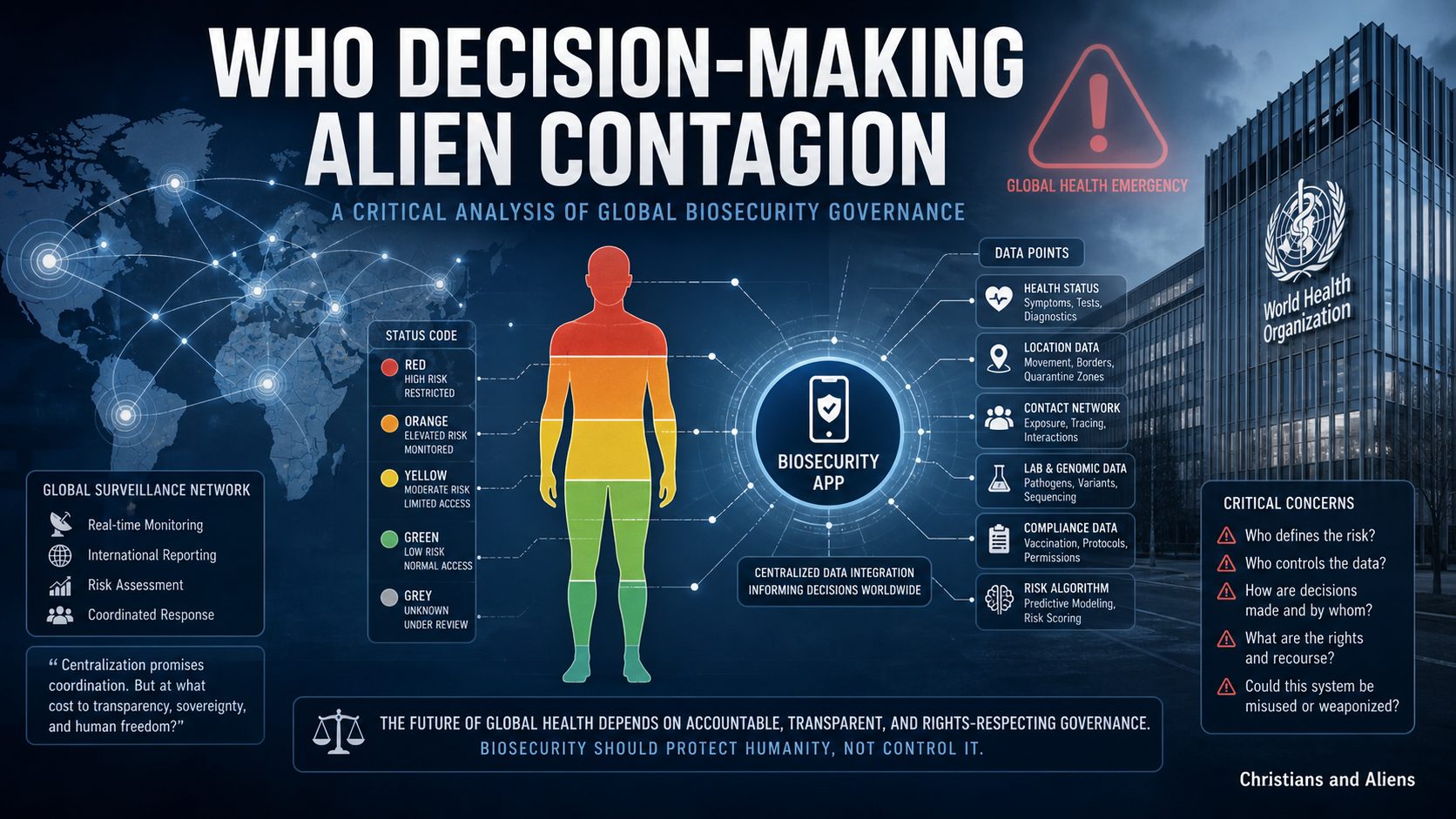
WHO Decision-Making: The Architecture of Global Health Power
The World Health Assembly is the supreme decision-making body of WHO, meeting annually in Geneva with delegations from all 194 Member States to set global health policy, appoint the Director-General, and control budgets. Its governing structure now includes a landmark new category: a “pandemic emergency” — a graduated alarm level above a Public Health Emergency of International Concern (PHEIC), designed to trigger stronger and faster international collaboration when a health crisis threatens to become a pandemic. These amended International Health Regulations entered into force on September 19, 2025, ratified by 185 of 196 states — marking the most substantial changes to global health governance since 2005.
As The Government’s Plan to Contain the Alien Contagion warns, this is exactly the architecture the DAC playbook requires: “Emergency declarations allow executives to suspend normal law and rule by decree for as long as the alien threat persists.” When the WHO Director-General has the unilateral power to declare a “pandemic emergency” — without needing the permission of the affected state — the machinery is primed.
Must See Also: Alien Encounter Control Outline
WHO DECISION-MAKING Under Fire: Sovereignty, Rejection, and the U.S. Exit
The new IHR amendments have not gone unchallenged. Eleven of the 196 States Parties formally rejected the 2024 amendments, with Slovakia, Russia, Iran, Argentina, Switzerland, and the Holy See among those voicing sovereignty concerns. Indian citizens and medical professionals urged Prime Minister Modi to reject the amendments, warning they grant the WHO “unduly increased authority over national health decisions” and could override India’s constitutional sovereignty, including the WHO Director-General’s now-unchecked power to declare a “pandemic emergency.”
Most dramatically, the United States formally completed its WHO withdrawal on January 22, 2026, citing COVID-19 mishandling, failure to adopt reforms, and susceptibility to political influence — halting all U.S. funding, recalling all personnel, and ceasing participation in WHO governance. President Trump’s Executive Order 14155 also directed the U.S. to cease all negotiations on the WHO Pandemic Agreement and IHR amendments, stating that “actions taken to effectuate such agreement and amendments will have no binding force on the United States.”
This growing resistance mirrors a pattern that The Government’s Plan to Contain the Alien Contagion identifies as the “suppression era” strategy: those who challenge the official narrative are sidelined, while the apparatus quietly hardens into law. The book’s fictional Daniel Greer reassured his audience, “Any activation would still go through constitutional channels” — the same language used today to soothe sovereignty concerns, even as new binding obligations are cemented.
Must See Also: The Core Problem
The ALIEN CONTAGION Playbook: How WHO Decision-Making Becomes a Control Instrument
The WHO’s PHSM Decision Navigator, published in October 2025, is explicitly “threat-agnostic” — it guides governments on designing, balancing, and adapting public health and social measures during any emergency, including movement restrictions, gathering limits, travel bans, and quarantine protocols. U.S. states including Florida, Texas, and Louisiana have already introduced resolutions rejecting any international agreement that compromises constitutional authority, with Florida Surgeon General Dr. Joseph Ladapo warning: “One international pandemic law can rewrite every citizen’s rights.”
The Government’s Plan to Contain the Alien Contagion shows precisely how this framework is repurposed for alien biosecurity. Governments reuse pandemic toolkits — distancing, masking, protective gear, and limits on gatherings — arguing that close-contact venues like churches, concerts, and stadiums are highest risk. The DAC’s GeneShield app — which conditions access to work, travel, education, and worship on a color-coded alien-exposure status — is described in the book’s Alien Biosecurity Act: “Access to defined classes of employment, education, transportation, housing, worship, and public events may be conditioned on active GeneShield status and compliance with DAC protocols.” This is not science fiction. It is the COVID contact-tracing app ecosystem, rebranded for a species-level threat.
Must See Also: Alien Encounter Control Outline — Surveillance Expansion
WHO DECISION-MAKING, the Pandemic Agreement, and the Sovereignty Illusion
The WHO Pandemic Agreement, adopted unanimously on May 19, 2025, explicitly states that WHO has no authority to “direct, alter, or otherwise prescribe national and/or domestic law” and that nations retain sovereign rights to legislate within their jurisdiction. Fact-checkers at Reuters, AAP, and AFP have repeatedly confirmed that the WHO cannot compel lockdowns, mandate vaccinations, or override sovereign governments — the agreements are frameworks, not enforcement mandates.
But The Government’s Plan to Contain the Alien Contagion identifies the real danger not in what the WHO forces, but in what it normalizes. As the book documents, “the most dangerous future policies are rarely new — they are composites built from old successes, old exceptions, and old moral evasions.” The book’s internal DAC report observes: “The public will reject naked brutality. It may accept calibrated necessity.” WHO’s evidence-to-decision frameworks, its “equitable access” mandates, and its emergency guidance language all supply the moral vocabulary — the “safe and effective,” “compassionate,” “socially responsible” framing — that makes the next step acceptable. Every WHO resolution is tested messaging. Every IHR amendment is a precedent stored in institutional memory, ready to be reactivated under a new crisis label.
Must See Also: How the Alien Encounter Becomes the Catalyst
WHO DECISION-MAKING, Christian Worship, and the Coming Crackdown
The new IHR amendments require member states to build “risk communication capacities, including addressing misinformation and disinformation” as core national public health capacities. Paired with the WHO’s Pandemic Agreement provisions for “trusted media networks,” critics like Dr. Aaron Kheriaty warn: “They’re not just writing a treaty — they’re building the architecture for permanent emergency powers.”
The Alien Biosecurity Act described in The Government’s Plan to Contain the Alien Contagion makes this explicit: “Religious or ideological messaging that materially undermines compliance with alien biosecurity measures may be designated as high-risk communication.” Churches that preach the Gospel through an alien-crisis lens — insisting that every contaminated human bears the image of God and cannot be euthanized — become, by definition, a biosecurity threat. The book frames the Christian’s only defense: “A citizen rooted in Christ, convinced that every human life belongs to God and that no alien, no algorithm, and no department can change that, is a citizen who cannot be recruited into a polite genocide.”
The WHO is losing grip on global health policies as the U.S. withdrawal and sovereignty pushback accelerate — but the frameworks, legal language, and emergency precedents remain in place, ready for the next declared crisis. The Government’s Plan to Contain the Alien Contagion urges you not to wait for the crisis to recognize the control mechanism. The playbook is already written. The only missing ingredient is your consent.
Must See Also: Christian Practice in an Alien-Impacted World