Does Neil deGrasse Tyson believe in aliens? He’s said he wanted to be abducted as a child and now urges the public to “demand an alien” rather than settle for vague government hints. The book argues this genuine human longing for contact is exactly what officials would exploit, meeting public wonder with clinical language to turn excitement into consent for lockdowns and registries.
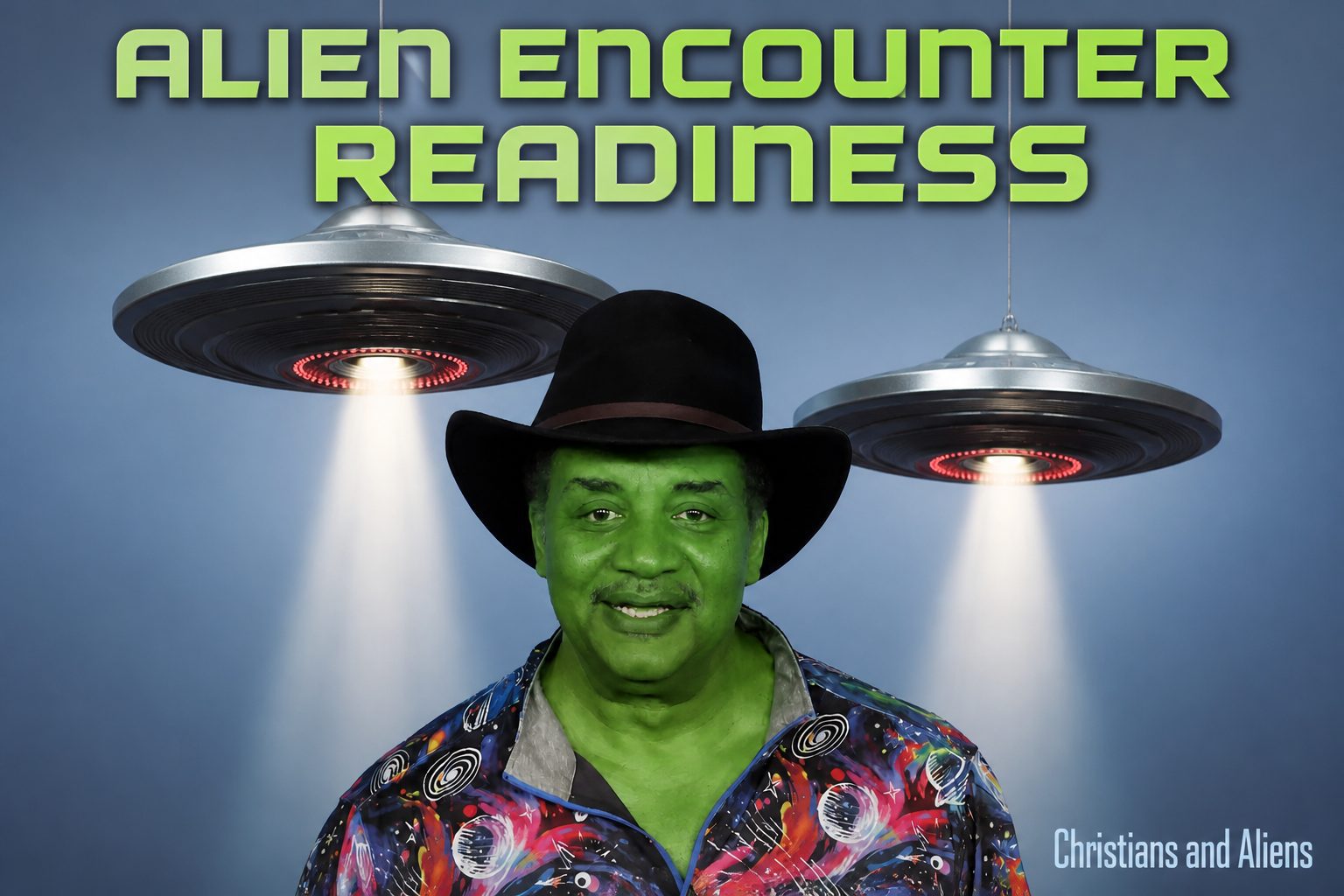
Neil deGrasse Tyson’s Sky at Night interview shows him urging us to be emotionally and intellectually ready for an authentic alien encounter, even as he insists that “enthusiasm and conversations about intelligent life” must be anchored in real science. At the same time, the closing chapters of The Government’s Plan to Contain the Alien Contagion describe how a seemingly wondrous contact event is immediately reframed as a “National Alien Biological Incident Emergency” that activates a Department of Alien Controls and turns “alien” into the justification for permanent bio‑security powers.
Must See Also: Christians and Aliens
ALIEN ENCOUNTER READINESS: The Desire To “Demand an Alien”
In his book and interviews, Tyson presents Take Me to Your Leader as a way to “anchor everyone’s enthusiasm and conversations about intelligent life into real science”, saying he’s not debunking aliens so much as celebrating that people “have these urges to want to meet them.” He openly admits that as a child he “wanted to be abducted by aliens,” describing how looking up at the night sky made him long for a beam of light to take him away so he could see “what other life forms would be like.”
A USA Today profile highlights this same hunger when it reports Tyson telling readers to “demand an alien”, arguing that after a century of UFO stories the public shouldn’t settle for fuzzy videos or whispered government hints. He notes that English‑speaking countries produce an outsized share of UFO reports, and asks whether we “need something up there that we can imagine or feel or long for,” tying our cultural obsession directly to a kind of spiritual or emotional craving.
That longing to see aliens is exactly what The Government’s Plan to Contain the Alien Contagion warns will be exploited once an event can be labeled “alien.” In the Beverly Hills contact scenario, ordinary witnesses reach for familiar categories—“angel,” “demonic sign,” “government psy‑op,” “radiation”—while the system reaches immediately for language like “unidentified biological incident” and “bio‑threat scene.” The book shows how that mismatch between human wonder and official framing becomes the opening to turn our excitement into consent for lockdowns, registries, and a permanent alien‑biosecurity state.
Must See Also: Will Aliens Cause a Worldwide Emergency?
ALIEN ENCOUNTER READINESS: Why Tyson Says “Just Show the Alien”
Tyson’s public comments repeatedly boil down to a demand for direct, physical evidence: on CNN he asks the government to “just bring out the alien and get it over with”, arguing we’re “long past” treating aliens as something you merely believe in based on testimony or fuzzy videos. In a Fox News Rundown interview he goes further, saying Earthlings are ready for a “real‑life Disclosure Day” and that if officials truly have proof, they should “just show the alien”.
His CBS appearance about Pentagon UFO files lays out the same standard, with Tyson explaining that he needs more than government documents, insisting that whoever claims aliens must “fork up the aliens” themselves—showing a body, a craft, or something that obeys known physics under scrutiny. Across podcasts and TV segments he makes clear that his skepticism is rooted in evidence, not denial of the possibility of extraterrestrial life; he accepts that life elsewhere is likely but separates that question from the claim that aliens are visiting Earth right now.
The last chapters of The Government’s Plan to Contain the Alien Contagion invert his demand in a chilling way. Once a president declares a “National Alien Biological Incident Emergency,” the book’s fictional Department of Alien Controls (DAC) issues executive orders such as EO‑02, a “National Alien Incident Information Management Directive” that centralizes all alien‑related communication and permits classification of biological samples, footage, and analytic methods as “bio‑security” secrets. Instead of “just show the alien,” the system quietly criminalizes unauthorized disclosure, ensuring that physical evidence—real or staged—remains under military‑intelligence custody, far from the crowds who are told to fear it.
Must See Also: Governments, Aliens, and a Biosecurity State
ALIEN ENCOUNTER READINESS: The Book’s Step‑By‑Step Government Plan
Where Tyson imagines using shared scientific constants like pi and the Pythagorean theorem as “starting points” for communicating with intelligent aliens, The Government’s Plan to Contain the Alien Contagion walks the reader through how a single shimmering craft becomes the foundation myth for an entire bio‑security regime. The “First Encounter and Cascading Actions” section describes a mid‑morning event over a Beverly Hills intersection, where light and mist leave a handful of people dazed with subtle skin changes and odd biomarker readings on medical gear.
Local police initially tag the incident as a possible gas leak, then escalate it to “unidentified biological release,” sending out an emergency banner that reads “Unidentified Biological Incident reported in your area” even before any confirmation that the event is truly alien. The manual details how responders establish hard perimeters, declare a provisional hazmat‑bio‑threat scene, and move visibly affected individuals into a hastily designated hot zone, setting the stage for federal liaisons to arrive and reframe everything as a biological hazard with “anomalous origin.”
From there, the book outlines a same‑day presidential declaration that legally pairs public‑health and national‑security frameworks, elevating DAC to cabinet level under emergency authority and triggering a set of executive orders that suspend civil‑liberty safeguards in “Alien Exposure Zones.” EO‑03 fast‑tracks creation of exposure definitions, testing pipelines, and a national Alien Exposure Status registry with categories like “unexposed, exposed, contaminated, genetically altered,” while EO‑04 places “all physical alien material, data, and interaction sites under military‑intelligence custody” and authorizes restricted contracts with select biotech and defense firms under emergency ethics exemptions.
Must See Also: How a Single Alien Event Could Reshape Society
ALIEN ENCOUNTER READINESS: Debunking Real Contact Using Tyson’s Physics and the Contagion Plan
On the physics side, Tyson repeatedly points out that many dramatic UFO maneuvers—sharp high‑G turns and instant accelerations—would physically reduce biological pilots to “a pile of goo”, underscoring that extraordinary claims must respect the same laws of motion we test on Earth. In long‑form conversations he stresses that eyewitness testimony and secret military files are not enough; without independently verifiable multi‑sensor data that survives scrutiny, stories about reverse‑engineered craft or tiny invading aliens are scientifically empty.
He also criticizes Hollywood for a “profound absence of creativity,” noting that most fictional aliens are barely more than humanoids with cosmetic differences, when in reality even Earth life shows radical variation—humans and bananas share 25% identical genes while looking completely different. Tyson argues that truly alien beings, with no genes in common with us, should look at least as different from humans as humans and bananas look from one another, which is why he would be “shocked if the alien were in fact humanoid” in a real first contact.
The later sections of The Government’s Plan to Contain the Alien Contagion add a different kind of debunking: they show that the “alien contagion” narrative does not need real visitors to function as a tool of control. The DAC charter describes a bio‑security state model in which biological status becomes the organizing principle for rights and access, integrating military, intelligence, health systems, corporations, and NGOs into a “unified alien‑response architecture”. Classified DAC Annexes authorize persistent device‑level telemetry, fusion of genomic, biometric, geolocation, communications‑metadata, and financial records into risk scores, and “invisible blacklists” that quietly propagate restrictions into employment, housing, banking, and insurance platforms tied to the GeneShield app.
End‑of‑life documents like the “Dependents and Disposability Decision Tree” and the “Historical Precedent Brief” show how contaminated populations are gradually reframed as expensive, unproductive burdens, making sterilization, long‑term confinement, and euthanasia sound like “compassionate” and fiscally responsible options rather than elimination. The mega‑trends section explicitly connects this to AI and demographic pressures, warning that in a world where many humans become economically unnecessary, an alien emergency can become the narrative cover for a system that quietly solves the “problem” of too many dependents.
Must See Also: Why “Alien Contagion” Is More About Control Than Visitors
ALIEN ENCOUNTER READINESS: People’s Hunger to See Aliens vs. the Book’s Warning to Christians
Tyson often calls out the ego at the center of our alien fantasies, noting that we behave as if aliens would naturally come just to us, even though whales, octopi, and many other species show their own forms of intelligence. He tells interviewers that the “evil alien” trope is likely a “mirror we are unwittingly holding up to ourselves”, because history shows that whenever one part of civilization has more technology than another, the meeting rarely ends well for the weaker side.
The Beverly Hills scene in The Government’s Plan to Contain the Alien Contagion captures that mix of ego, fear, and spiritual projection vividly. One homeless observer watches the mist fall and remembers old sermons about “lying spirits and the elect being deceived,” concluding that the true danger comes not from the sky but “from downtown, from the government”—lockdowns, camps, experiments, and people like him “disappearing without anyone tweeting their names.” As the event unfolds, an emergency banner suddenly labels it an “Unidentified Biological Incident,” while crowds on the street immediately split into late‑night‑comedy spectators and those who whisper that “this is judgment.”
The book’s worship‑restriction materials show how, once DAC is active, Christian gatherings are treated as bio‑risk nodes: churches are zoned into contamination‑watch districts, Alien Exposure Status checks are imposed at doors, and dissenting theological interpretations of alien events are subtly recast as safety threats. Internal Christian debates erupt over whether alien‑touched individuals are still fully human neighbors or a qualitatively different class, foreshadowing deep splits over personhood and contamination. Against that backdrop, Tyson’s insistence on hard evidence and his critique of pop‑culture aliens can actually serve believers: the more rigorously we test alien claims, the less likely we are to accept a narrative that turns “alien contagion” into an excuse to surveil, classify, and suppress worship.
Must See Also: Christians, Aliens, and End‑Times Speculation