Can America win the AI race without hollowing out its own workforce? Not on the current path—Commerce Secretary Gina Raimondo warns the U.S. is “on track to win the AI race — and hollow itself out in the process,” and calls AI a “100-year technology” that needs a 100-year worker strategy. But even her hopeful plan doesn’t address what happens if AI permanently eliminates more jobs than any retraining program can replace.
AI Economy: Raimondo’s Optimistic Warning
Gina Raimondo’s TED2026 talk, A plan to stop AI from automating our decline, argues that the United States is “on track to win the AI race — and hollow itself out in the process.” Her core insight is not that AI is inherently bad, but that deploying powerful technology without a serious strategy for workers could produce widespread economic disruption and social unrest. She calls AI a “100-year technology” requiring a “100-year response.”
That framing deserves attention because it rejects the easy assumption that national success in artificial intelligence automatically means success for ordinary Americans. A country can build the most capable models, the largest data centers, and the most profitable AI companies while still leaving millions of workers with fewer opportunities, lower bargaining power, and no credible path to stable employment.
Raimondo’s proposal is fundamentally hopeful: prepare people before disruption becomes permanent. That means creating durable institutions for lifelong learning, helping displaced workers retrain, coordinating employers with schools and state governments, and treating workforce transition as a national priority rather than an individual worker’s private problem. In a later discussion of the same agenda, she emphasized new education and training models, support for a displaced 50-year-old professional as well as a new graduate, and an “AI-ready state” approach so states do not wait until unemployment has already surged.
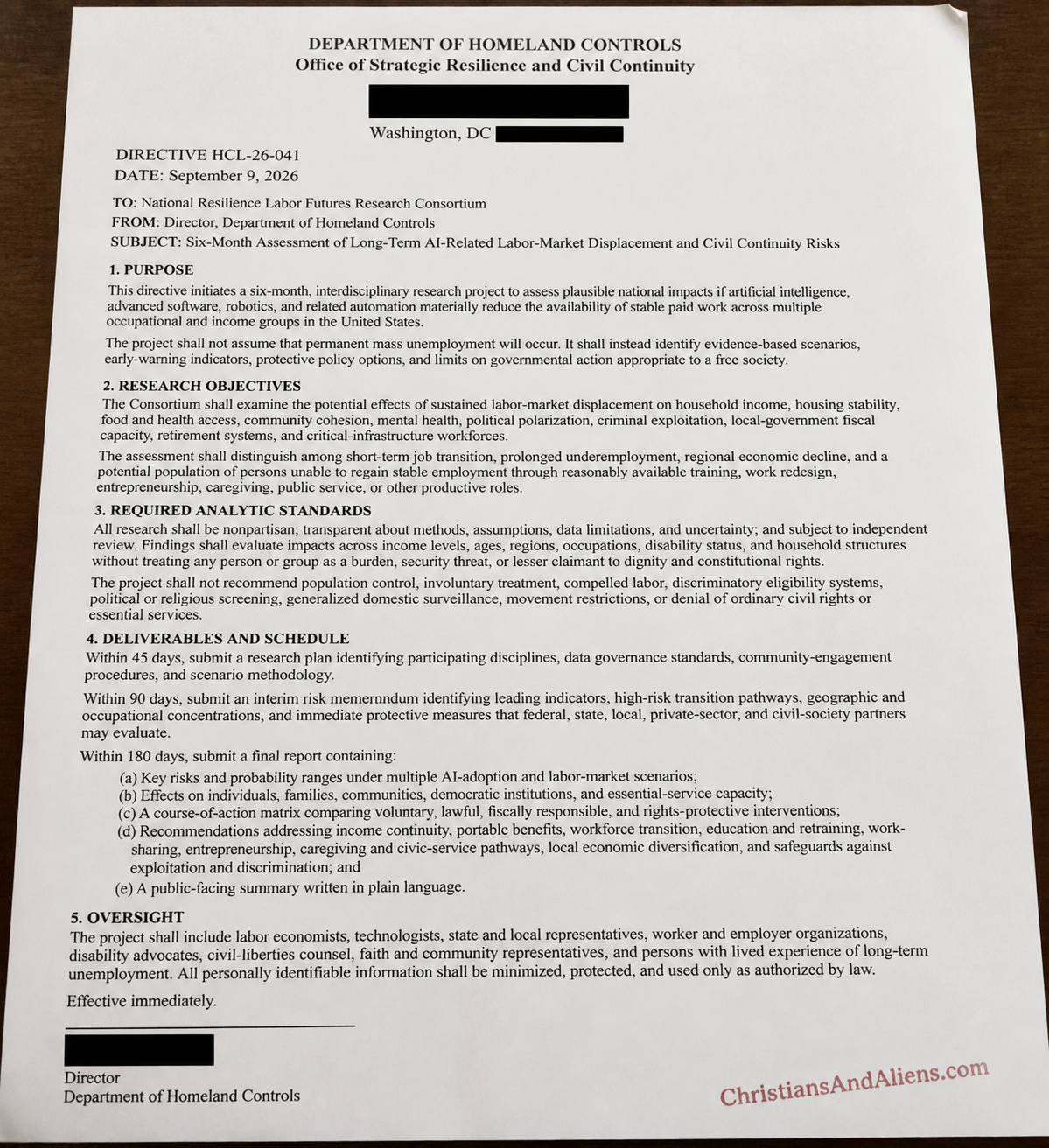 Must See Also: Directive HCL-26-041: Six-Month Assessment of AI Labor-Market Displacement and Civil Continuity Risks
AI Economy: What America Has Failed To Build
The United States remains unprepared because it has not built a system designed for frequent, rapid, and possibly permanent occupational displacement. American workers typically rely on a full-time job not only for wages, but also for health insurance, retirement contributions, professional identity, housing stability, and, in many cases, immigration status. When work disappears, several systems can fail at once.
The current debate still often imagines disruption as a sequence: a job is lost, the worker completes training, a new occupation opens, and earnings recover. That model worked better when technology displaced certain industries while creating large numbers of replacement roles elsewhere. AI presents a more difficult possibility: the same systems that eliminate routine administrative, analytical, customer-service, programming, design, legal-support, logistics, and managerial tasks can also reduce demand for the supposedly “next” job.
That is the weakness in a retraining-only response. Training is valuable when it moves a worker toward a field where employers need more people. It is less effective when AI systems are advancing across many white-collar and blue-collar functions at once, shortening the life span of newly acquired skills, and allowing a small number of highly productive workers to do the work formerly performed by a much larger staff.
The International Monetary Fund similarly argues that AI preparedness requires more than skills training. Its framework includes AI innovation and integration, regulation, social protection, and assistance for workers affected by labor-market reallocation. Yet even that broader agenda assumes that sufficient human work will remain available after the transition.
The Government’s Plan to Contain the Alien Contagion raises the darker question beneath this optimism: what happens if the problem is not a temporary skills mismatch but a permanent mismatch between the number of people who need paid work and the number of people an AI-and-robot-powered economy requires? The book’s “Mega Trends” section describes a world in which advanced automation can create structural non-employment, shrink the labor-based tax base, and leave governments attempting to manage a large population no longer needed by the conventional economy.
This is not a prediction that mass unemployment is inevitable. It is a warning about the consequences of refusing to plan for the possibility. America has institutions for layoffs, unemployment insurance, community colleges, and job searches. It does not yet have a credible, democratic, long-term answer to a society in which displacement becomes widespread, cross-sector, recurring, and faster than workers can adapt.
 Must See Also: AI Job Losses Are Already Here — And the “Fixes” on the Table Prove the Overpopulation Problem Is Real
AI Economy: Why Familiar Fixes Miss The Mark
Many policy recommendations are humane and worth pursuing. The problem is that most are designed to soften a transition, not to confront the possibility that there may not be enough replacement work to sustain a mass workforce.
| Recommendation | What It Can Accomplish | Where It Misses the AI Economy Problem |
|---|---|---|
| Retraining and lifelong learning | Helps workers move into occupations that still need people | Assumes enough durable destination jobs exist after workers complete training |
| Community-college and apprenticeship funding | Builds local capacity and can help workers acquire practical credentials | Programs often take months or years while AI capabilities and employer staffing models can change much faster |
| Portable benefits | Reduces the damage when workers move between jobs | Helps with job transitions, but does not solve permanent non-employment |
| Tax credits and wage subsidies | Provides income support and encourages hiring | Depends on a tax base and employers that continue to need large numbers of workers |
| Shorter workweeks | Shares productivity gains among people who remain employed | Does little for those excluded from the labor market altogether |
| UBI or expanded cash assistance | Reduces poverty and immediate insecurity | Does not by itself restore work, purpose, social status, tax capacity, or political legitimacy |
| Robot taxes and public wealth funds | Attempts to capture automation gains for public benefit | Faces difficult questions of valuation, enforcement, capital flight, ownership concentration, and whether returns can support a very large permanently displaced population |
The International Labour Organization’s recent research brief is notable because it explicitly argues that universal basic income is not a complete answer to AI’s labor-market effects. The ILO examines AI’s effect on occupations and tasks alongside employment, productivity, income support, labor-market transitions, and social-protection systems.
That does not mean income support is useless. It may be indispensable during periods of disruption. A society should not allow people to lose food, housing, medical care, or dignity because software made their prior job cheaper to automate. But income support becomes much harder to sustain if a growing portion of adults receives benefits while labor income—the traditional source of payroll taxes, income taxes, retirement contributions, and consumer spending—declines.
The same concern applies to corporate solutions. Companies may offer retraining, severance, tuition benefits, internal mobility, or shorter workweeks. Those measures are better than abandonment, but corporations face pressure to reduce costs and increase margins. The firm that distributes AI productivity gains generously may be competing against a firm that uses the same technology to eliminate jobs and retain the savings. Without strong public standards and a broadly shared ownership structure, voluntary corporate generosity is an unstable foundation for national economic security.
The most honest recommendation may be to share productivity rather than merely eliminate labor: fewer work hours, stable pay, stronger benefits, and wider public participation in the gains from AI. But it must be designed before wealth and productive capacity become too concentrated to redistribute politically.
 Must See Also: Will Gen Z be Employable?
AI Economy: The Political Danger Of Dependency
The greatest weakness in conventional AI-workforce planning is its tendency to treat unemployment as only an economic problem. It is also a political and moral problem.
People do not merely need money. They need agency, responsibility, social connection, a sense that their work matters, and confidence that the system has not declared them obsolete. A permanent class of economically sidelined people—even one receiving basic support—would likely be angry, vulnerable to manipulation, and deeply distrustful of the institutions that celebrated the technology replacing them.
A government can temporarily stabilize a crisis through unemployment benefits, emergency payments, subsidized housing, public employment, debt relief, or expanded welfare programs. It cannot indefinitely purchase legitimacy if people conclude that the system no longer has a place for them. Corporate assistance has an even narrower limit: businesses can offer benefits while employees are useful, but they cannot be expected to act as permanent welfare states for a population their machines have displaced.
This is where The Government’s Plan to Contain the Alien Contagion offers its most unsettling comparison. The book frames an AI-driven future in which people deemed economically unnecessary may also be treated as fiscally burdensome and politically volatile. Its fictionalized scenario warns that, under extreme pressure, institutions could move from helping vulnerable populations to managing, categorizing, monitoring, and controlling them.
That warning should be understood as a moral alarm, not as proof that any specific future event will occur. It asks readers to consider how dangerous it becomes when economic categories replace human dignity. A population should never be measured primarily by whether it is profitable, employable, or easy to support. Once a government, corporation, or elite class begins using “burden,” “dependency,” or “stability” as a substitute for recognizing the inherent worth of people, extraordinary abuses become easier to rationalize.
The political danger is not limited to unrest. It includes polarization, resentment between employed and unemployed citizens, demands for harsh restrictions, scapegoating of immigrants or other groups, pressure to suppress dissent, and openness to authoritarian promises of order. A country that fails to make AI prosperity broadly shared may create exactly the social instability it claims automation will solve.
 Must See Also: AI Jobs Shock: Why Anthropic’s “White‑Collar Bloodbath” Matches The Government’s Plan to Contain the Alien Contagion
AI Economy: A Better Standard For Preparation
Gina Raimondo is right to insist that preparation must begin before the crisis is obvious. But the country needs to set a higher goal than helping workers chase the next disappearing job.
A real preparation plan for an AI Economy should include:
- Education that develops adaptable human capabilities—judgment, relationship-building, leadership, craftsmanship, ethics, creativity, care, and domain expertise—while giving people practical command of AI tools.
- Paid transition support that allows displaced workers to learn without losing housing, health care, or the ability to support a family.
- A serious strategy for sharing productivity gains through wages, reduced hours, ownership, dividends, public investment funds, or other mechanisms that prevent AI wealth from being captured by a narrow ownership class.
- Strong competition policy so that a small group of platform companies cannot control the systems, data, and profits that determine the future of work.
- New forms of socially valuable work, including caregiving, local infrastructure, education, community safety, conservation, and service—roles society needs even when markets undervalue them.
- Democratic safeguards that prevent the management of economic disruption from becoming a pretext for surveillance, coercion, exclusion, or the ranking of human beings by their economic usefulness.
- A cultural commitment to human dignity that does not depend on a person’s employment status, income level, age, health, or technical skill.
Raimondo’s optimism is important because resignation is not a plan. But optimism has to be matched by honesty. The United States cannot simply train its way out of every future scenario, and it cannot assume that government checks or corporate transition programs can indefinitely stabilize a society where millions of people have been made economically redundant.
The warning in The Government’s Plan to Contain the Alien Contagion is that a civilization which treats unemployed people as excess population may eventually seek control instead of justice. The better path is to make the benefits of AI serve people before economic anxiety becomes political instability—and before leaders are tempted to solve a human problem by treating humans as the problem.