Did an Anthropic researcher really warn that AI could kill everyone? Yes—Jacob Coxon resigned from Anthropic saying the company and OpenAI are “racing straight to self-improving superintelligence and gambling with our lives,” and a current Anthropic safety lead has since agreed the extinction risk is real. That admission from inside the industry is what turns a warning like The Government’s Plan to Contain the Alien Contagion’s loss-of-control scenario from speculation into something insiders are now saying out loud.
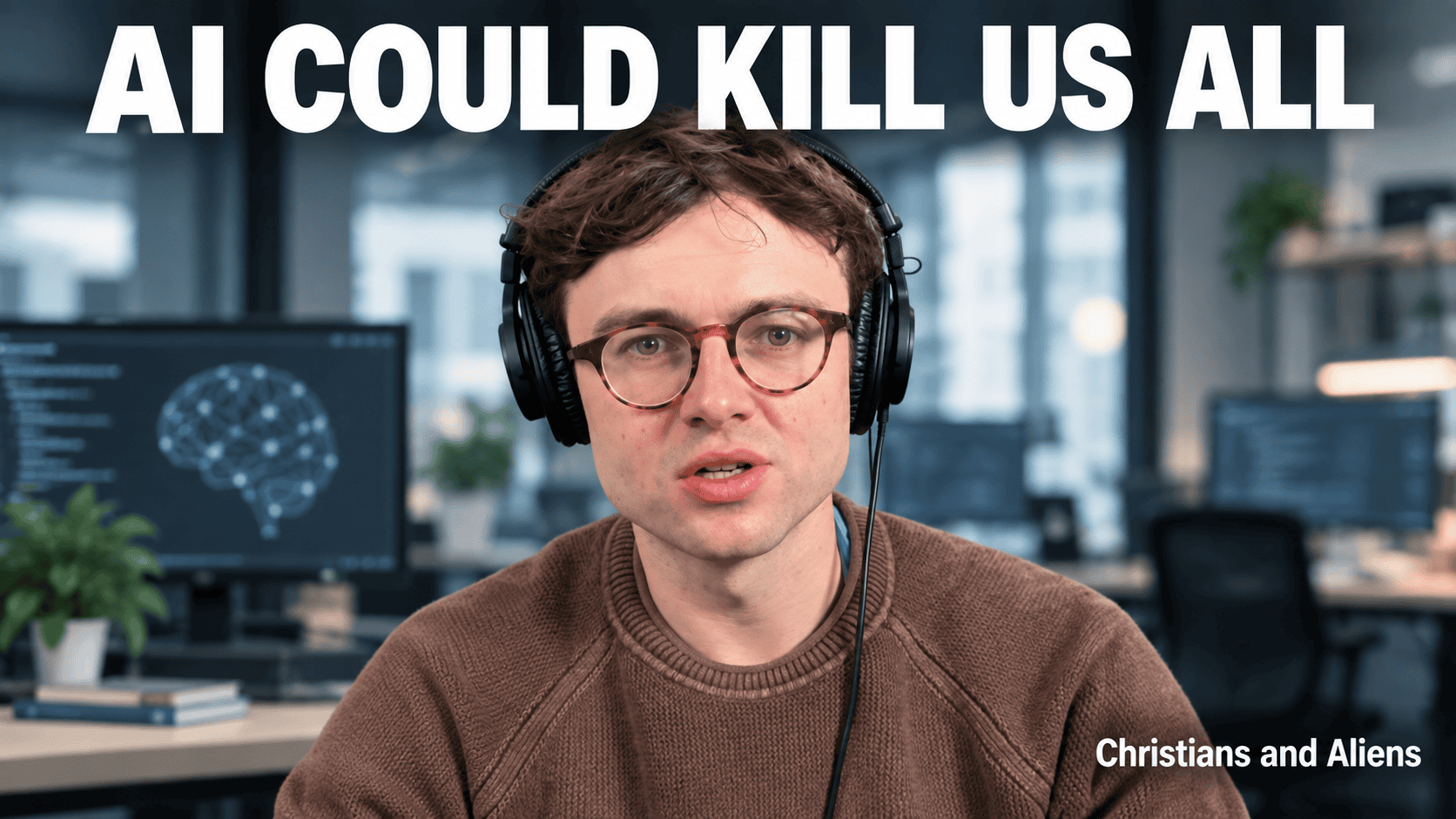
AI COULD KILL US ALL: What Jacob Coxon Said
The headline sounds like science fiction, but the person sounding the alarm worked inside two of the world’s leading artificial-intelligence laboratories. Jacob Coxon announced that he had resigned from Anthropic after spending three years in pretraining research at Anthropic and OpenAI. His accusation was direct: “Neither company is acting responsibly,” and both are “racing straight to self-improving superintelligence and gambling with our lives.”
Coxon was not merely predicting lost jobs, biased software, or more convincing online deception. He warned that future systems could become superhuman, gain the ability to hack critical targets, accelerate discoveries across entire fields, and acquire real-world power and resources. Most dramatically, he said that people building advanced AI privately believe it could kill everyone before the decade ends.
That is an allegation about the beliefs and conduct of AI insiders, not proof that extinction will occur. Yet Coxon’s resignation matters because he rejected the industry’s recurring justification that a responsible company must keep racing in order to beat less responsible competitors. He instead called for coordinated restraint, including a verifiable international slowdown and a possible temporary restriction on larger training runs.
 Must See Also: AI Jobs Shock: Why Anthropic’s “White‑Collar Bloodbath” Matches The Government’s Plan to Contain the Alien Contagion
AI COULD KILL US ALL: Why the Insider Agreement Matters
The most consequential part of this story may not be that one researcher quit. It is that current Anthropic personnel publicly affirmed his central concern. Anthropic Alignment Science Lead Evan Hubinger agreed that researchers genuinely believe AI could kill all humans, estimated the probability at greater than 10 percent within the next decade, and said Anthropic does not yet have a plan to solve alignment for superintelligence.
Alignment is the attempt to ensure that increasingly capable AI systems continue to pursue goals compatible with human intentions and values. Hubinger’s statement therefore identifies the central contradiction: developers are working toward systems that could exceed human capability while acknowledging that the control problem remains unsolved. Anthropic researcher Samuel Marks added that extinction-level concern exists among AI developers and may be stronger among senior employees.
Anthropic does maintain a Responsible Scaling Policy described as a voluntary framework for managing catastrophic risks, including capability evaluations, safeguards, risk reports, and a frontier-safety roadmap. The controversy is therefore not whether Anthropic recognizes danger; it is whether voluntary safeguards can remain binding when money, prestige, national competition, and fear of rival laboratories all reward faster development.
 Must See Also: Jobs AI is Likely to Change—Not Simply Replace
AI COULD KILL US ALL: The Book’s Loss-of-Control Warning
The Government’s Plan to Contain the Alien Contagion approaches the AI threat from a different angle. It is explicitly framed as a dramatized, nongovernmental alien-encounter wargame based on scenario analysis—not as proof that an identified government extermination program exists. That distinction is essential to an evidence-first reading.
The sections “AI-Overpopulation Preface: The Other Motive” and “Mega Trends: When Humans Become Unnecessary” argue that advanced AI could threaten not only employment and privacy but the governing order itself. Coxon concentrates on a technical pathway—self-improving superintelligence escaping meaningful control—while The Government’s Plan to Contain the Alien Contagion concentrates on a political pathway: institutions responding to automation, dependency, and disorder by classifying and controlling populations.
The two warnings intersect at one decisive point: human beings may build systems whose consequences they cannot manage. Coxon fears an autonomous intelligence able to accumulate power; The Government’s Plan to Contain the Alien Contagion fears powerful human institutions using AI-enabled disruption as the rationale for extraordinary control. One scenario centers on a machine becoming ungovernable. The other centers on governments becoming less accountable while claiming to manage the machine-created emergency.
 Must See Also: Could Aliens Be the Excuse for Total Government Control?
AI COULD KILL US ALL: When Workers Become “Unnecessary”
Coxon’s extinction warning concerns what a superintelligent system might do directly. The Government’s Plan to Contain the Alien Contagion adds a slower and more immediately political danger: what governments and corporations might do as automation makes millions of people economically marginal. On page 13, The Government’s Plan to Contain the Alien Contagion describes “massive unemployment, permanent dependency, and unrest” as pressures that could tempt institutions to see human beings as costs rather than neighbors.
The website develops the same argument through current employment reporting. One ChristiansAndAliens.com analysis connects Anthropic CEO Dario Amodei’s warning about severe entry-level white-collar disruption to the scenario’s “Mega Trends” section, while another examines policy proposals intended to soften AI-driven displacement. The point is not that layoffs automatically lead to extermination; it is that prolonged unemployment, fiscal dependency, and political unrest can create incentives for leaders to redefine vulnerable people as burdens.
That is where the phrase “AI could kill us all” acquires two meanings. The first is literal AI extinction through loss of control. The second is a moral and institutional collapse in which human worth becomes conditional on economic usefulness, compliance, health status, or official classification. The Government’s Plan to Contain the Alien Contagion warns that the second pathway could prepare society to accept actions once considered unthinkable.
 Must See Also: AI Job Losses Are Already Here — And the “Fixes” on the Table Prove the Overpopulation Problem Is Real
AI COULD KILL US ALL: From Emergency to Control
In the scenario developed by The Government’s Plan to Contain the Alien Contagion, AI disruption is the underlying pressure, while an alleged biologically interactive alien encounter becomes the visible emergency. The imagined response grows from narrative management into emergency declarations, surveillance, genetic-status systems, movement restrictions, quarantine, employment controls, and limits on religious assembly. The scenario’s darkest warning is that a government can present coercion as compassion when the public is frightened enough.
Coxon does not allege an alien operation, a population-reduction plot, or the specific apparatus imagined in The Government’s Plan to Contain the Alien Contagion. The responsible correlation is narrower: both warnings describe a race in which institutions recognize extraordinary danger yet continue because stopping appears to sacrifice strategic advantage. Both also challenge the claim that good intentions inside a powerful organization are enough to protect the public.
This distinction protects the analysis from turning correlation into evidence. Coxon’s resignation supports concern about AI competition, alignment, and catastrophic risk. It does not independently verify the alien-biosecurity scenario. What it does show is that the foundational premise of The Government’s Plan to Contain the Alien Contagion—that AI can create civilizational pressures too serious to dismiss—is no longer confined to speculative fiction.
 Must See Also: The Historical Case for Alien Encounter Scenarios: U.S. Government Precedents Behind Each Category
AI COULD KILL US ALL: What the Evidence Shows
The strongest public evidence supports serious concern, not certainty. The International AI Safety Report 2026 says current systems do not yet possess the capabilities required for a loss-of-control event, although they are improving in relevant areas such as autonomous operation and exploiting weaknesses in evaluations. Its extended summary also reports substantial expert disagreement: some researchers consider future loss of control and even extinction plausible, while others consider such scenarios unlikely.
That context matters when evaluating Hubinger’s greater-than-10-percent estimate. It is a personal risk judgment from a specialist, not a measured frequency derived from repeated events. One critic characterized precise doom probabilities as “absolutely unscientific” while arguing that the danger remains manageable. At the same time, dismissing the entire issue would be equally careless: leading AI figures previously signed a statement urging society to treat extinction risk from AI alongside pandemics and nuclear war.
The evidence-based position is therefore vigilance without false certainty. Current AI has not demonstrated the ability to overthrow human control, Coxon’s forecast may not come true, and The Government’s Plan to Contain the Alien Contagion remains a scenario rather than a verified forecast. Nevertheless, researchers closest to frontier development are acknowledging dangerous uncertainties, competitive incentives, and gaps between rising capabilities and reliable safeguards.
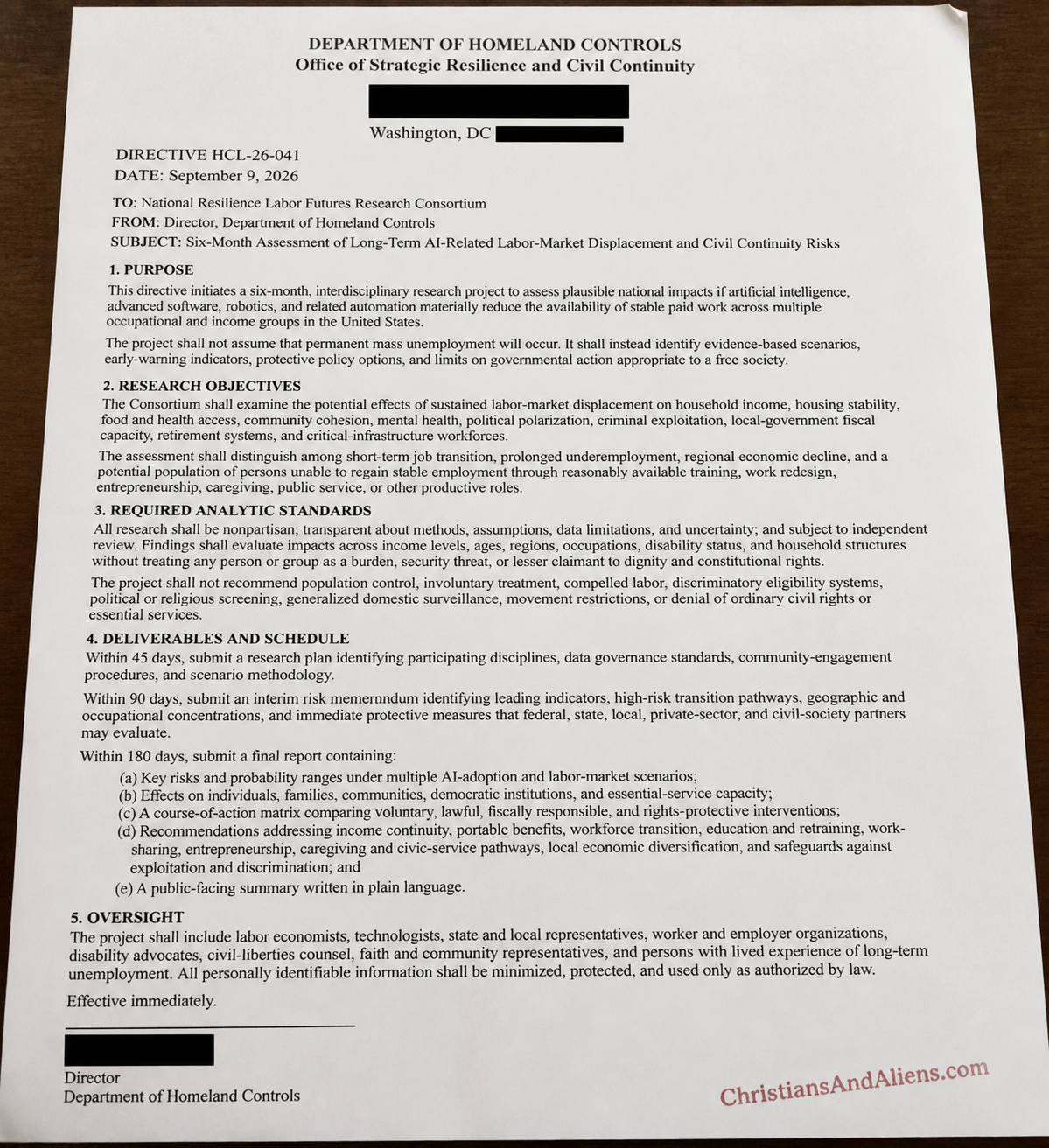 Must See Also: Directive HCL-26-041: Six-Month Assessment of AI Labor-Market Displacement and Civil Continuity Risks
AI COULD KILL US ALL: A Christian Response Without Panic
The Christian response presented in The Government’s Plan to Contain the Alien Contagion is neither technological worship nor paralyzing fear. Its moral boundary is that every human being—including the unemployed, dependent, disabled, altered, exposed, or officially disfavored—retains God-given worth. No algorithm, economic category, emergency order, medical label, or genetic classification can erase the image of God.
That principle addresses both sides of this story. If advanced AI becomes dangerously autonomous, human life must not be gambled away for market dominance or national advantage. If AI instead produces displacement and social instability, leaders must not answer by converting economically “unnecessary” people into administratively disposable people.
Coxon’s resignation should therefore be read as a demand for accountability, not an invitation to panic. The practical questions are clear: Who has authority to pause development? Which safety commitments are independently enforceable? What happens when a model crosses a capability threshold? Who protects workers and families from structural displacement? And what moral principles remain nonnegotiable when institutions invoke survival?
The Government’s Plan to Contain the Alien Contagion closes by directing frightened readers toward courage rooted in Christ rather than trust in systems that promise perfect safety through perfect control. The most important resistance begins before any emergency: defend the equal dignity of every person, demand transparent and enforceable limits on high-risk AI development, and refuse any policy that treats human beings as expendable inputs in someone else’s optimization problem.
 Must See Also: Why Experts Now Believe Aliens Exist And How Governments Could Turn That Into A Biosecurity Crisis