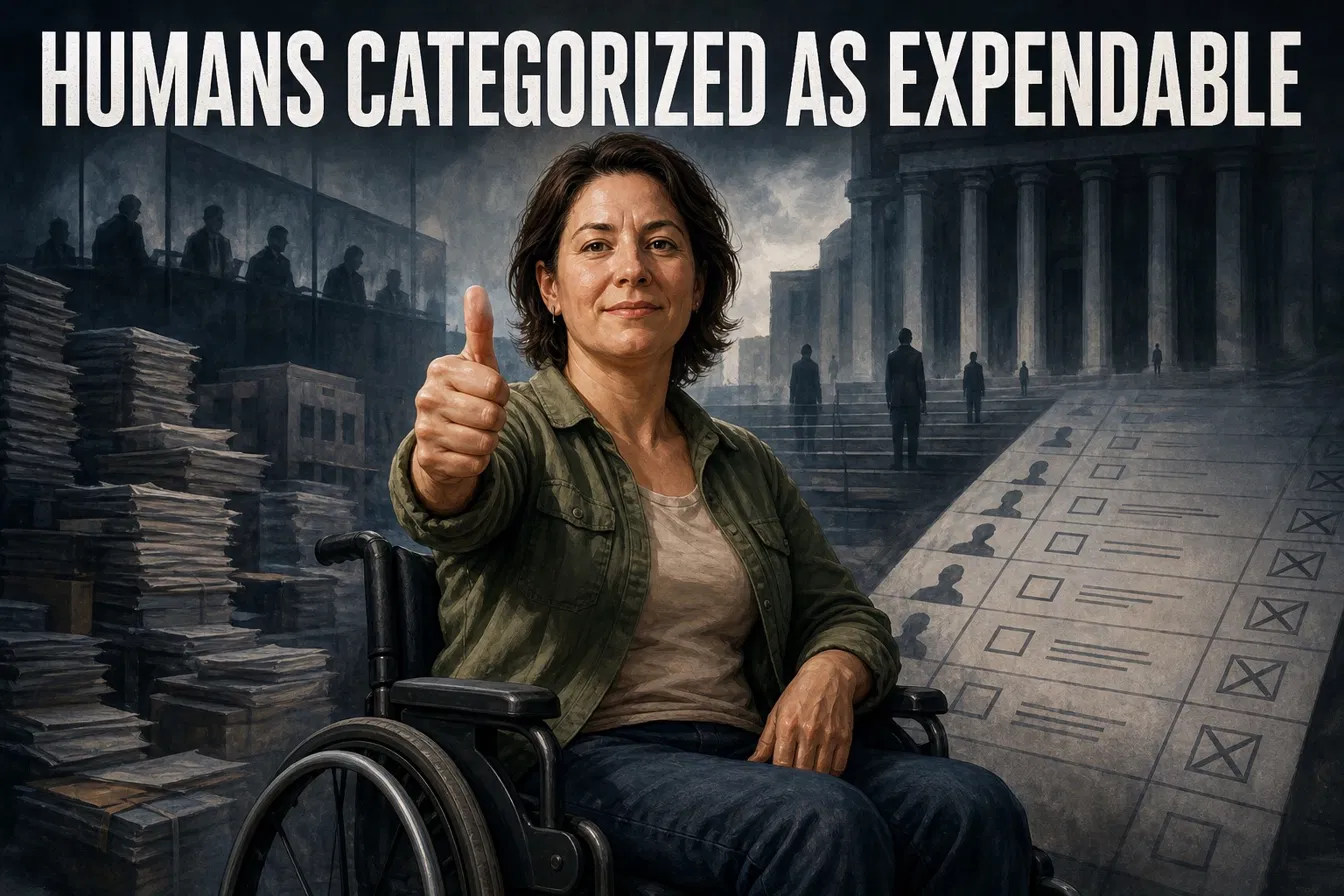
Every assisted-dying program in the developed world began the same way: a narrow exception for a small number of terminally ill adults, built on strict safeguards everyone agreed were necessary. A decade later, in Canada, Belgium, and the Netherlands, those safeguards have moved — consistently in one direction. Eligibility has widened, the numbers have grown, and government researchers now openly discuss the financial savings involved. That trajectory is not an accident of policy drift. It is what happens whenever a category of people gets legally redefined as a burden rather than a life to be protected — and it is worth understanding in detail, because it is the same categorization machinery a future “biosecurity” framework would need.
How Canada’s Track System Quietly Erased the Terminal-Illness Requirement
Canada’s Medical Assistance in Dying (MAID) program launched in 2016 for competent adults with a “reasonably foreseeable” natural death. Bill C-7 removed that requirement in 2021, splitting eligibility into two tracks: Track 1 for those already near death, and Track 2 for those with a serious, incurable condition who are not dying at all. Track 2 was originally scheduled to open to people whose sole underlying condition is mental illness in March 2024. Parliament pushed that date back once, to March 2027, after a special joint committee found “some stakeholders perceive a lack of readiness” and practitioners remained unable to reliably distinguish an irremediable condition from suicidal ideation — according to the official legislative summary of Bill C-62. Note what that timeline actually shows: not a permanent boundary, but a boundary that has already been scheduled for removal twice, delayed only by administrative readiness — not by a change in principle about who should qualify.

Must See Also: CANADA and the New Culture of Compassionate Killing
Belgium and the Netherlands Already Show Where the Line Keeps Moving
Canada is simply following a path Belgium and the Netherlands already walked. Belgium legalized euthanasia for adults in 2002, then in 2014 became the first country to remove any minimum age for a terminally ill, suffering child capable of “discernment” to request it, provided parents consent and a multidisciplinary team agrees. The Netherlands has taken the opposite expansion route — not toward younger patients, but toward those who can no longer speak for themselves at all. Dutch law permits euthanasia for advanced dementia patients under a written advance directive completed while they still had capacity, even after they can no longer confirm the decision in the moment. Regional review committees reported 9,958 euthanasia deaths in the Netherlands in 2024, up 10 percent from 2023 — including 216 cases for psychiatric conditions alone, a 57 percent jump in a single year. In every country, the direction of travel is identical: the boundary that looked like a permanent safeguard at launch is, a decade later, the boundary regulators are actively debating how to move next.

Must See Also: Slaves are a Sub-Categorization of Humans
The Numbers: How Many People, and How Much Money
The scale is no longer marginal. Health Canada’s sixth annual report counts 76,475 MAID provisions since 2016, including 16,499 in 2024 alone — 5.1 percent of all deaths in Canada that year, up from 4.7 percent in 2023. Nearly half of 2024 recipients cited feeling like “a burden on family, friends, or caregivers” as a reason for their request, a figure the report itself flags as sharply higher than prior years. The financial dimension is now studied openly rather than treated as taboo: a CMAJ cost analysis estimated MAID could reduce Canadian healthcare spending by $34.7 to $138.8 million annually, comfortably exceeding the program’s own implementation costs. A 2025 SAGE Open Medicine paper by Jamil and Pearce went further, modeling a projected $1.238 trillion CAD in cumulative savings by 2047 under an expanded-eligibility scenario — a figure calculated, without apparent irony, alongside a per-procedure cost comparison between “traditional” and “outsourced” delivery models. When a nation’s own health economists are pricing out delivery models for ending life the way a hospital system prices out delivery models for administering it, the “compassion” framing and the “cost center” framing have stopped being separate conversations.

Must See Also: AI Job Apocalypse and Alien Contagion: Why Overpopulation from AI is the Government’s Real Crisis
This Is What Categorization Looks Like Before Anyone Calls It That
Strip away the specific mechanism and what remains is a template: a government defines a sub-category of humans whose lives are worth less protection than everyone else’s, justifies the category with compassionate language, and then discovers — always afterward, always as a secondary benefit rather than the stated goal — that the category also happens to save money and reduce a population the state considers burdensome. That is precisely the “coalitions” logic this site has tracked in the DAC cross-sector doctrine: a delegated compliance ecosystem where government, health institutions, and public messaging jointly decide which biological statuses get full protection and which get managed toward attrition. A framework that can sort the terminally ill, then the chronically suffering, then the mentally ill, then the demented — each time with fresh safeguards promised at the new boundary — is a framework fully capable of sorting whatever category comes next, including one defined by “biological status” in a future alien-contagion scenario.

Must See Also: Part 3: BILL GATES PATH TO 2045: The “Coalitions” Architecture and the DAC Cross-Sector Doctrine
The Category Never Needs Aliens to Expand—It Just Needs a Budget Line
The most unsettling part of this pattern is how ordinary it looks from the inside. No government in Canada, Belgium, or the Netherlands announced a plan to categorize the vulnerable as expendable. Each expansion arrived as a discrete, well-intentioned amendment, justified entirely on its own terms, debated in isolation from the ones before it. Only in aggregate — 2002 to 2014 to 2020 in Belgium, 2016 to 2021 to a scheduled 2027 in Canada, a rising psychiatric caseload in the Netherlands — does the shape of the pattern become visible: a widening definition of whose suffering justifies the state facilitating their death, moving in exactly one direction, at a pace set by administrative readiness rather than principle. A society does not need an alien encounter, a biosecurity crisis, or a “GeneShield” status code to build the legal and cultural infrastructure for categorizing people as expendable. It only needs a budget line, a compassionate vocabulary, and enough time for one boundary to become the last decade’s obsolete safeguard.