Will the Gates Foundation’s influence outlast its 2045 shutdown? The book argues yes — the foundation’s roughly $9 billion annual budget already exceeds many countries’ health budgets, and its 2026 letter describes building lasting “coalitions” across governments, corporations, and NGOs. The author warns this network will leave permanent AI, vaccine, and genomic-data infrastructure in place long after Gates is gone.
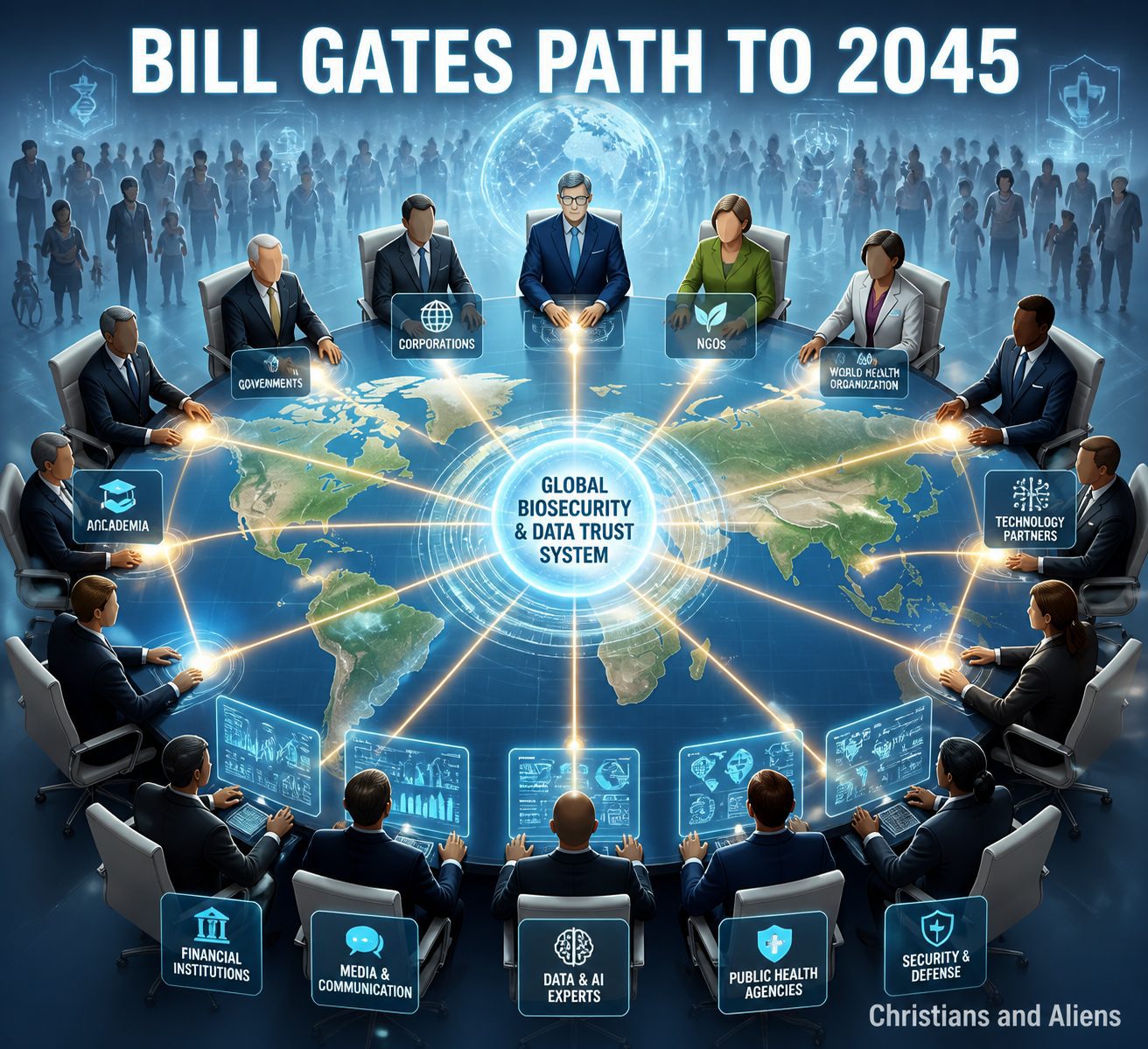
The 2026 letter makes its coalition-building ambitions explicit. The foundation’s 20-year plan is designed not just to fund programs, but to ensure the institutions that outlast it — “from nonprofits to local health institutions to multilateral partnerships — have the runway they need to plan for the future,” writes Gates Foundation CEO Mark Suzman. The letter describes a deliberate strategy of “deepening existing coalitions and forging new ones” across governments, corporations, NGOs, and civil society — not as a temporary alignment of interests, but as the durable architecture for carrying the work forward long after the foundation closes.
This is precisely the cross-sector coordination model that The Government’s Plan to Contain the Alien Contagion identifies as the operating backbone of DAC. The book describes how the control regime “binds five principal power centers into one operational regime: the government supplies legal authority and emergency legitimacy; military and intelligence institutions secure sites, classified programs, and coercive capability; public-health science supplies biosecurity rationale; corporations provide platforms, analytics, contractors, and scalable compliance infrastructure; and NGOs or foundations furnish harmonizing language, rights management theater, and public-facing legitimacy.” Every one of those five sectors is explicitly represented in the Gates Foundation’s coalition model. What the letter calls a network of trusted partners, the book calls a delegated compliance ecosystem — and it notes that “within this doctrine, no major institution is neutral.”
The foundation’s own public statements make clear how deeply this cross-sector wiring has already been installed. Since its founding, the Gates Foundation has contributed to saving 82 million lives through its support of Gavi, the Vaccine Alliance, and the Global Fund to Fight AIDS, Tuberculosis, and Malaria, creating supply chains, regulatory relationships, data systems, and institutional dependencies that span over 100 countries. The foundation has an annual budget projected to reach $9 billion by 2026 — making it larger than the official health budgets of most of the countries it operates in. That is not a partner relationship. That is a structural dependency — exactly the kind the book says makes “rollback politically and administratively difficult” once the system is in place.
Must See Also: GeneShield Registration — What the Alien Control App Looks Like in Practice
BILL GATES PATH TO 2045: The $200 Billion Exit Strategy — or Is It an Entrance?
The letter presents the 2045 closure as a feature, not a bug — evidence of a responsible, time-limited philanthropic mission rather than an empire-building project. Bill Gates has announced that he will give away “virtually all” of his wealth through the foundation over the next 20 years, with the foundation officially closing its doors on December 31, 2045. The announcement was received almost universally as an act of extraordinary generosity. And in purely financial terms, it may well be.
But The Government’s Plan to Contain the Alien Contagion asks its readers to distinguish carefully between the closure of an institution and the permanence of the infrastructure it leaves behind. The book’s Executive Order 15 — describing the “Normalization and Permanence” doctrine — could not be clearer: “Systems built under this annex may remain in operation beyond formal emergency periods, transitioning into standard bio-risk scoring infrastructure for identity, employment, and mobility.” And speaking of its own DAC architecture, the book states: “Senior leaders should understand DAC as a permanence project, not a temporary intervention. The foundation material anticipates that once biological status becomes linked to movement, labor, worship, and housing, rollback becomes politically and administratively difficult.”
The Gates Foundation closes in 2045. But the majority of the $200 billion is directed toward Africa, with a specific focus on “partnering with governments that prioritize” the foundation’s health and development agenda — meaning the governments themselves absorb, institutionalize, and operate what the foundation built. The Horizon 1000 AI health network stays. The digital finance infrastructure stays. The vaccine delivery and cold-chain systems stay. The genomic and patient data architecture stays. The coalition relationships between governments, biotech firms, and multilateral health agencies stay. The foundation exits. The system it built does not. The Government’s Plan to Contain the Alien Contagion would call this exactly what it is: a successful installation project wearing the badge of a sunset.
Must See Also: Christians and Aliens — How Will Christians Act Towards Aliens?
BILL GATES PATH TO 2045: A Christian Response
If you have read this far, you may feel the weight of what The Government’s Plan to Contain the Alien Contagion is asking you to see — not just a conspiracy theory about one foundation, but a multi-decade, multi-institution infrastructure project that is quietly making the book’s worst-case scenario not only plausible but administratively ready. The book’s own opening is direct: “The alien encounter is not the origin of this machinery. It is the ignition key. The apparatus is already designed.” That is where the article you just read lives — in the years before the ignition, when the machinery is still being built and the building still looks like charity.
The Government’s Plan to Contain the Alien Contagion is not ultimately a book about institutions or infrastructure. It is a book about who decides who counts as human. And its answer is unwavering: no foundation’s annual letter, no AI-generated biosecurity score, no GeneShield status code, and no alien encounter — real or manufactured — can change the answer that was settled at creation. Every human being, including those who will one day be labeled “contaminated,” “genetically altered,” or “costly dependents,” is made in the image of God and therefore bears a worth that no department, no algorithm, and no emergency declaration can erase. The book frames this as the one truth every extermination regime must suppress: “A public that refuses to sort humans into worthy and unworthy cannot be persuaded to cheer as its neighbors enter the End-of-Life Eligibility Review pipeline.”
So what do you do? The book points to three things. First, you see clearly. You read the annual letters, the executive orders, the coalition agreements, and the AI deployment plans — not with paranoia, but with the clear-eyed discernment of someone who has been given the advance briefing. Second, you hold your neighbor. The plan’s first requirement is that you learn to sort people. The Christian response is to refuse that sorting — to insist, in your church, your community, and your family, that your contaminated neighbor, your genetically unusual neighbor, your “costly” neighbor is still your neighbor in Christ’s terms. Third, you remember that the freedom no emergency law can reach is the only one that matters. As the book closes its chapter on the COVID rehearsal with Isaiah 40:29-31: “He gives strength to the weary, and to him who lacks might He increases power… Yet those who wait for the Lord will gain new strength; they will mount up with wings like eagles.” The government may redesign the world by 2045. It cannot redesign the image of God in the people it is trying to eliminate.
Must See Also: Christians and Aliens — The Full ChristiansAndAliens.com Resource Hub