Do people trust health apps even though they distrust the government? Yes — KFF polling found most Americans use health apps daily while distrusting the government, tech, and insurance industries behind them, and about three-quarters worry about AI and data privacy. The book argues that exact tension is what a future biosecurity system would exploit, tying work, worship, and travel to app-based status.
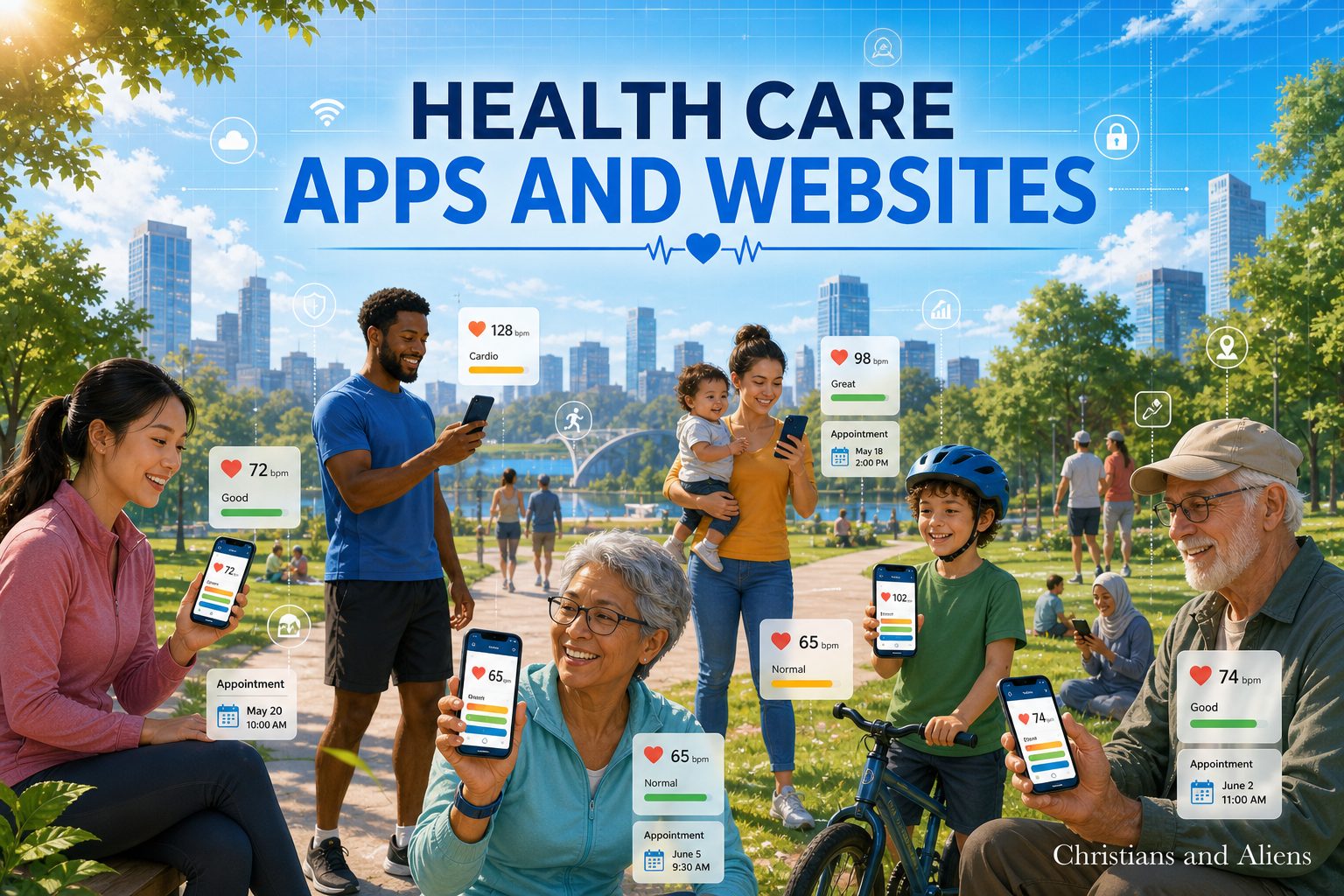
Most Americans are using health care apps and websites, but they do not fully trust the institutions behind them—exactly the mistrust and dependence that “The Government’s Plan to Contain the Alien Contagion” warns will be leveraged to normalize a GeneShield‑style control regime.
KFF’s Health Tracking Poll on public use and trust in health care apps and websites finds that “most adults have used these tools to manage their care,” even as “majorities of adults are concerned about the privacy of their information, regardless of whether an app is managed by the government, a private technology company, or a health insurance company.”
This tension—widespread use paired with deep concern—is the environment The Government’s Plan to Contain the Alien Contagion anticipates when it describes “a Department of Alien Controls, with its GeneShield app and color‑coded status system” that “classifies every human being by exposure, contamination, and genetic acceptability,” conditioning “work, travel, worship, housing, and public assembly” on app status.
Must See Also: GeneShield Registration – Christians and Aliens
HEALTH CARE APPS AND WEBSITES: A RUNWAY FOR GENESHIELD
KFF’s Health Apps and Information Survey shows that U.S. adults already use apps and websites to “research symptoms, track fitness and nutrition, manage their health insurance and health care spending, and engage in other online health-related activity.”
In The Government’s Plan to Contain the Alien Contagion, this ordinary app ecosystem is reimagined as the runway for a crisis‑era upgrade: the mandatory GeneShield System “used to determine and enforce individual eligibility for work, travel, worship, housing, and public assembly,” with “registration of all residents” and “periodic or event-driven genomic, biometric, and location data uploads.” The book argues that once people accept apps as normal tools of care, it is a short step to accepting apps as normal tools of control.
Must See Also: Christians and Aliens – Main Site
HEALTH CARE APPS AND WEBSITES: PRIVACY FEARS AND PERMANENT EMERGENCY
KFF’s poll summary notes that even as the Trump administration expands access to digital health tools through partnerships with private companies and CMS, “majorities of adults are concerned about the privacy of their information” across all app sponsors—government, tech firms, and insurers. This is consistent with newer KFF tracking data, where about a third of adults have already turned to AI chatbots for health information, while roughly three‑quarters say they are concerned about the privacy of personal medical information provided to AI tools.
The Government’s Plan to Contain the Alien Contagion connects exactly these dynamics—trusting the app’s convenience while doubting the system’s motives—to a larger pattern it calls “permanent emergency.” It describes how COVID “proved that governments can shutter churches, lock down cities, restrict travel, and condition work and worship on an app status—and that most citizens, including many Christians, will comply if the threat is described as existential and science‑based.” The Alien Biosecurity Act then formalizes this pattern, allowing an “Alien Biosecurity Emergency” to be renewed “without limitation” and authorizing DAC to suspend ordinary law “to the extent necessary for alien biosecurity.”
Must See Also: Christians and Aliens – Why GeneShield Matters
HEALTH CARE APPS AND WEBSITES: FROM HEALTH MANAGEMENT TO HUMAN SORTING
The KFF polling series on health information and trust highlights how digital tools now sit at the center of health decisions, with interactive dashboards tracking “trusted sources for health information, attitudes toward vaccines, and use of news, social media, and AI for health-related information.” The polls show that people increasingly rely on digital systems, even as they debate which institutions they trust to manage those systems.
In The Government’s Plan to Contain the Alien Contagion, this same digital infrastructure is the backbone of biological sorting. The GeneShield System assigns “standardized alien-exposure and genetic-status codes,” and the DAC is empowered to “deny or revoke permissions for work, worship, assembly, or transit” based on those codes. Later chapters describe how “clean zones” exclude contaminated people, and how reproductive controls and euthanasia pathways can be justified as “compassionate, safe and effective, and socially responsible,” once the public is accustomed to seeing status‑based controls as normal health policy.
Must See Also: Christians and Aliens – Clean Zones and Contagion
HEALTH CARE APPS AND WEBSITES: CHRISTIANS, CONSCIENCE, AND ALIEN BIOSECURITY
The KFF data shows a population already negotiating how much to trust health agencies, tech platforms, and AI tools, and how much personal data to hand over in exchange for quick answers and easier access to care. It documents the very “conditioning” The Government’s Plan to Contain the Alien Contagion warns about: learning to live with app‑mediated health, “permanent emergency,” and expert‑framed necessity as the moral language of policy.
The book insists that the crucial battle will not be about whether apps exist, but whether Christians and their neighbors accept a moral framework in which some humans—“contaminated, the genetically altered, the disabled, the dependent, and the unwanted”—can be sorted and eliminated “as medical necessity and patriotic sacrifice, not murder.” It calls readers to recover a biblical conviction that every human bears the image of God, so that no color code, diagnosis, or genetic scan can erase their worth—and so that no health app, however polished, can be allowed to become an instrument of polite genocide.
Must See Also: Christians and Aliens – The Imago Dei and Alien Contagion