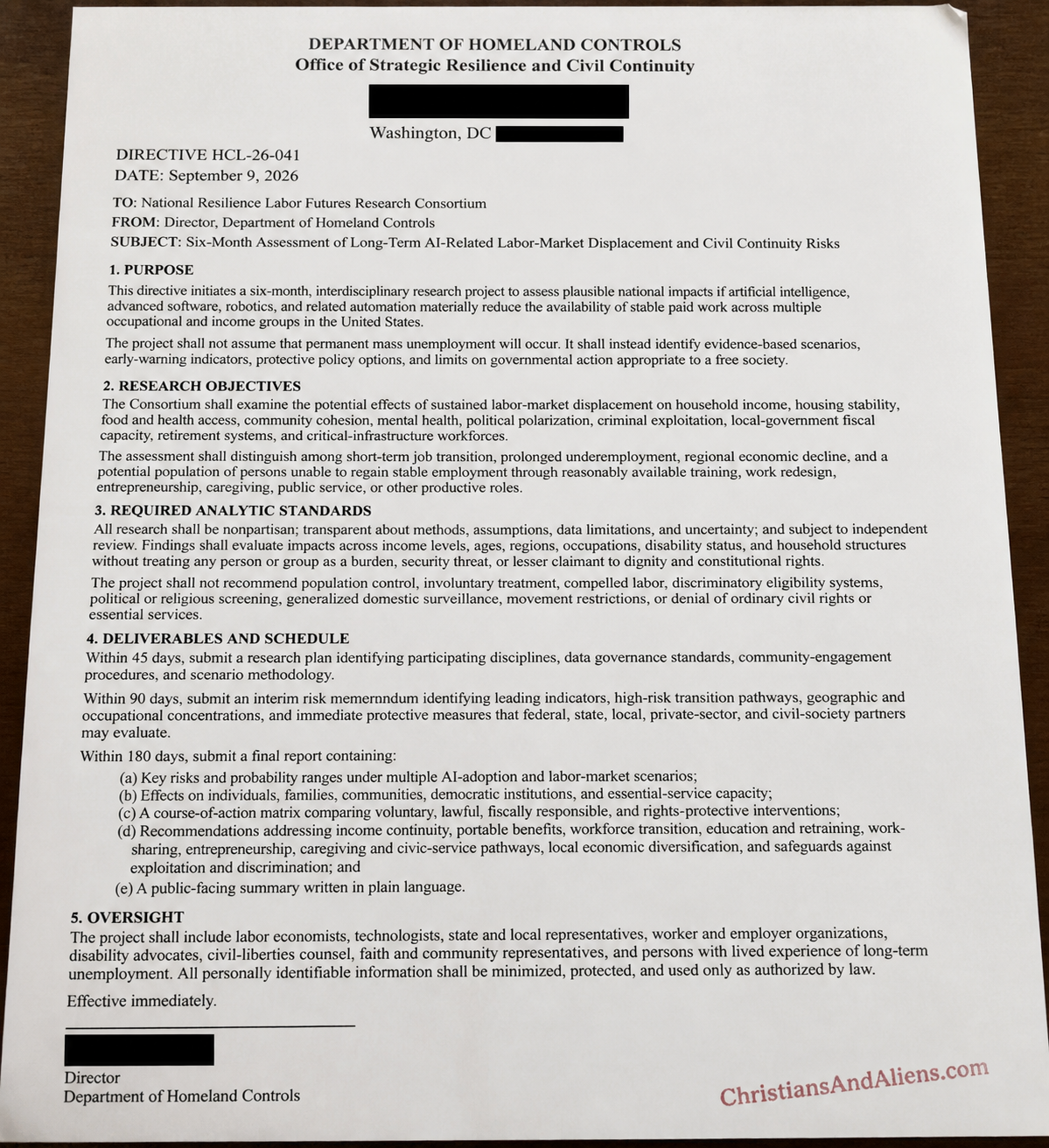
Could a government agency order a six-month study on permanent AI unemployment? This Department of Homeland Controls directive does exactly that, tasking a research consortium with assessing whether AI and automation could create a lasting, cross-income unemployed population in the United States. It sets a strict 180-day deadline for key risks and course-of-action recommendations.
DEPARTMENT OF HOMELAND CONTROLS
Office of Strategic Resilience and Civil Continuity
Washington, DC
DIRECTIVE HCL-26-041
DATE: September 9, 2026
TO: National Resilience Labor Futures Research Consortium
FROM: Director, Department of Homeland Controls
SUBJECT: Six-Month Assessment of Long-Term AI-Related Labor-Market Displacement and Civil Continuity Risks
1. PURPOSE
This directive initiates a six-month, interdisciplinary research project to assess plausible national impacts if artificial intelligence, advanced software, robotics, and related automation materially reduce the availability of stable paid work across multiple occupational and income groups in the United States.
The project shall not assume that permanent mass unemployment will occur. It shall instead identify evidence-based scenarios, early-warning indicators, protective policy options, and limits on governmental action appropriate to a free society.
2. RESEARCH OBJECTIVES
The Consortium shall examine the potential effects of sustained labor-market displacement on household income, housing stability, food and health access, community cohesion, mental health, political polarization, criminal exploitation, local-government fiscal capacity, retirement systems, and critical-infrastructure workforces.
The assessment shall distinguish among short-term job transition, prolonged underemployment, regional economic decline, and a potential population of persons unable to regain stable employment through reasonably available training, work redesign, entrepreneurship, caregiving, public service, or other productive roles.
3. REQUIRED ANALYTIC STANDARDS
All research shall be nonpartisan; transparent about methods, assumptions, data limitations, and uncertainty; and subject to independent review. Findings shall evaluate impacts across income levels, ages, regions, occupations, disability status, and household structures without treating any person or group as a burden, security threat, or lesser claimant to dignity and constitutional rights.
The project shall not recommend population control, involuntary treatment, compelled labor, discriminatory eligibility systems, political or religious screening, generalized domestic surveillance, movement restrictions, or denial of ordinary civil rights or essential services.
4. DELIVERABLES AND SCHEDULE
Within 45 days, submit a research plan identifying participating disciplines, data governance standards, community-engagement procedures, and scenario methodology.
Within 90 days, submit an interim risk memorandum identifying leading indicators, high-risk transition pathways, geographic and occupational concentrations, and immediate protective measures that federal, state, local, private-sector, and civil-society partners may evaluate.
Within 180 days, submit a final report containing:
- Key risks and probability ranges under multiple AI-adoption and labor-market scenarios;
- Effects on individuals, families, communities, democratic institutions, and essential-service capacity;
- A course-of-action matrix comparing voluntary, lawful, fiscally responsible, and rights-protective interventions;
- Recommendations addressing income continuity, portable benefits, workforce transition, education and retraining, work-sharing, entrepreneurship, caregiving and civic-service pathways, local economic diversification, and safeguards against exploitation and discrimination; and
- A public-facing summary written in plain language.
5. OVERSIGHT
The project shall include labor economists, technologists, state and local representatives, worker and employer organizations, disability advocates, civil-liberties counsel, faith and community representatives, and persons with lived experience of long-term unemployment. All personally identifiable information shall be minimized, protected, and used only as authorized by law.
Effective immediately.
____________________________________
Director
Department of Homeland Controls