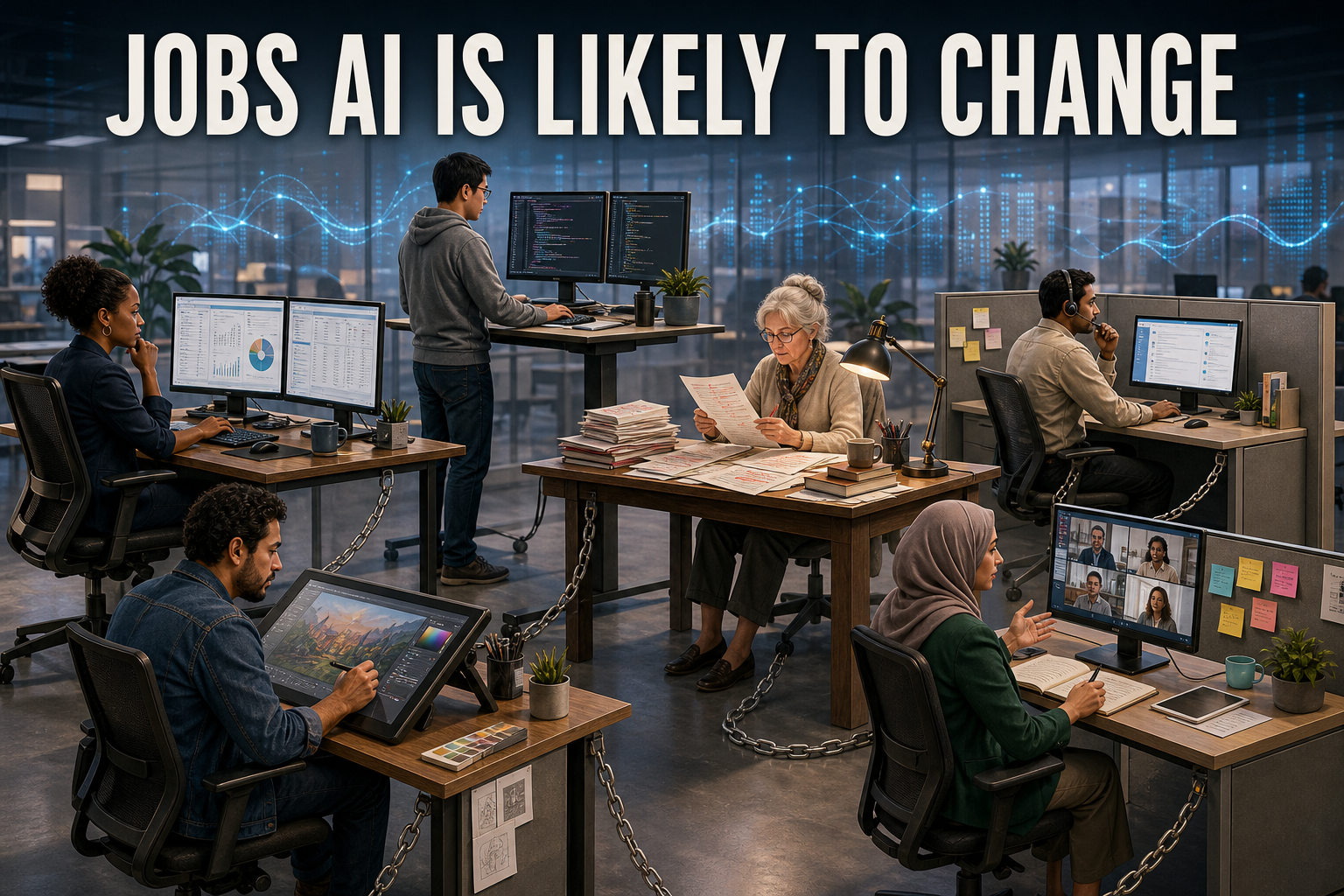
Every AI-and-jobs headline seems to reach for the same verb: replace. But the actual labor-market data tells a messier story. Most jobs aren’t being deleted outright—they’re being taken apart and reassembled, with a smaller human core and a much bigger AI shell around it. The real question isn’t just which job categories survive. It’s what happens to the humans still doing them once the employer holds nearly all the leverage in the negotiation.
What Jobs Are Actually Disappearing When AI Automates Work?
Some categories genuinely are shrinking. The World Economic Forum’s Future of Jobs Report 2025 projects 19 million net new jobs by 2030 against roughly 9 million lost—but broken out by cause, AI and information processing alone is expected to create about 11 million jobs while displacing about 9 million, and robots/automation displace roughly 5 million more than they create. The clearest losers: cashiers and ticket clerks, administrative assistants, printing workers, and accountants and auditors—predictable, rules-based, data-entry-heavy work.
But McKinsey’s research puts a hard ceiling on how far that goes: “less than 5 percent” of occupations consist of activities that can be fully automated, even though roughly half of all paid activities globally could theoretically be automated with current technology. Read that gap correctly and it says something important—most of the disruption lands inside jobs, not on top of entire job titles.
The Jobs That Are Simply Going to Change, Not Vanish
Radiology is the cleanest case study going. In 2016, Geoffrey Hinton predicted radiologists would be obsolete within five years. A decade later, radiology employment is projected to expand by 26 percent or more over the next three decades—but the job itself has been rewired. Radiologists increasingly function as quality-control validators, catching the rare cases where the algorithm gets it wrong, rather than doing every initial read themselves. As one researcher put it, it requires “a whole mental rewiring,” not a layoff notice.
That pattern shows up in the usage data too. The Anthropic Economic Index found that 57 percent of AI-assisted tasks fall under augmentation—iteration, learning, validation, working alongside a person—versus 43 percent under full automation. In other words, in just over half of real-world use, the AI is a coworker, not a replacement.
Even Anthropic’s own CEO, Dario Amodei, has walked his framing back from “white-collar bloodbath” toward something closer to this article’s thesis. He now argues: “If you automate 90% of the job, then everyone does the 10% of the job. And the 10% kind of expands to be 100%.” He still warns the transition could be faster and rougher than history’s prior technology shifts—just not a clean deletion of the job itself.

Must See Also: AI Jobs Shock: Why Anthropic’s “White‑Collar Bloodbath” Matches The Government’s Plan to Contain the Alien Contagion
Which Jobs Are Actually Growing Because of AI?
The growth side of the ledger is real, not theoretical. The WEF names big data specialists, fintech engineers, AI and machine-learning specialists, software and applications developers, and security management specialists as the fastest-growing roles through 2030—with 86 percent of surveyed executives expecting AI to transform their business by then. McKinsey’s modeling adds scale to that: 50 to 85 million new healthcare jobs globally just from aging populations, 20 to 50 million in IT and technology roles, and continued growth for managers, educators, and “creatives”—artists, performers, entertainers whose work AI still can’t originate on its own.
Must See Also: AI Job Losses Are Already Here — And the “Fixes” on the Table Prove the Overpopulation Problem Is Real
The Skills Are Changing Even When the Job Title Doesn’t
This is the part that gets lost in “will AI take my job” headlines: the WEF estimates 39 percent of workers’ core skills will change by 2030 regardless of whether their job title survives, and McKinsey estimates 75 to 375 million workers may need to switch occupational categories entirely by then, depending on how fast automation gets adopted. An aging workforce—already reluctant to retrain, already facing age discrimination in hiring—is being asked to absorb the fastest skills turnover in a generation.
Must See Also: AGING BABY BOOMERS And The Coming Labor Shock The Government Won’t Talk About
What Happens When Employers Hold All the Leverage?
None of this transformation happens in a vacuum where workers and employers negotiate as equals. Economists call it monopsony power: a labor market where employers, not workers, set the terms, because switching jobs is hard, options are thin, or one employer effectively dominates a local market. Research on U.S. manufacturing found workers “earn only $0.65 for every $1 of value they create,” and that for more than 10 percent of the American workforce, pay is suppressed by 2 percent or more purely because of employer concentration—no productivity excuse required.
History says this gets worse, not better, whenever the job market cools. As AI-driven layoffs and hiring freezes tilt the balance, bargaining power has been shifting back toward employers, who are using tools like strict return-to-office mandates as a quiet substitute for layoffs and letting remote-work options quietly disappear. Workers who can’t easily leave don’t get to negotiate; they get sorted into whatever terms remain on offer. That’s the same basic mechanic that shows up whenever one group gets the power to sort another into categories and set the terms of the sorting—the categorizer decides, and the categorized live with it.
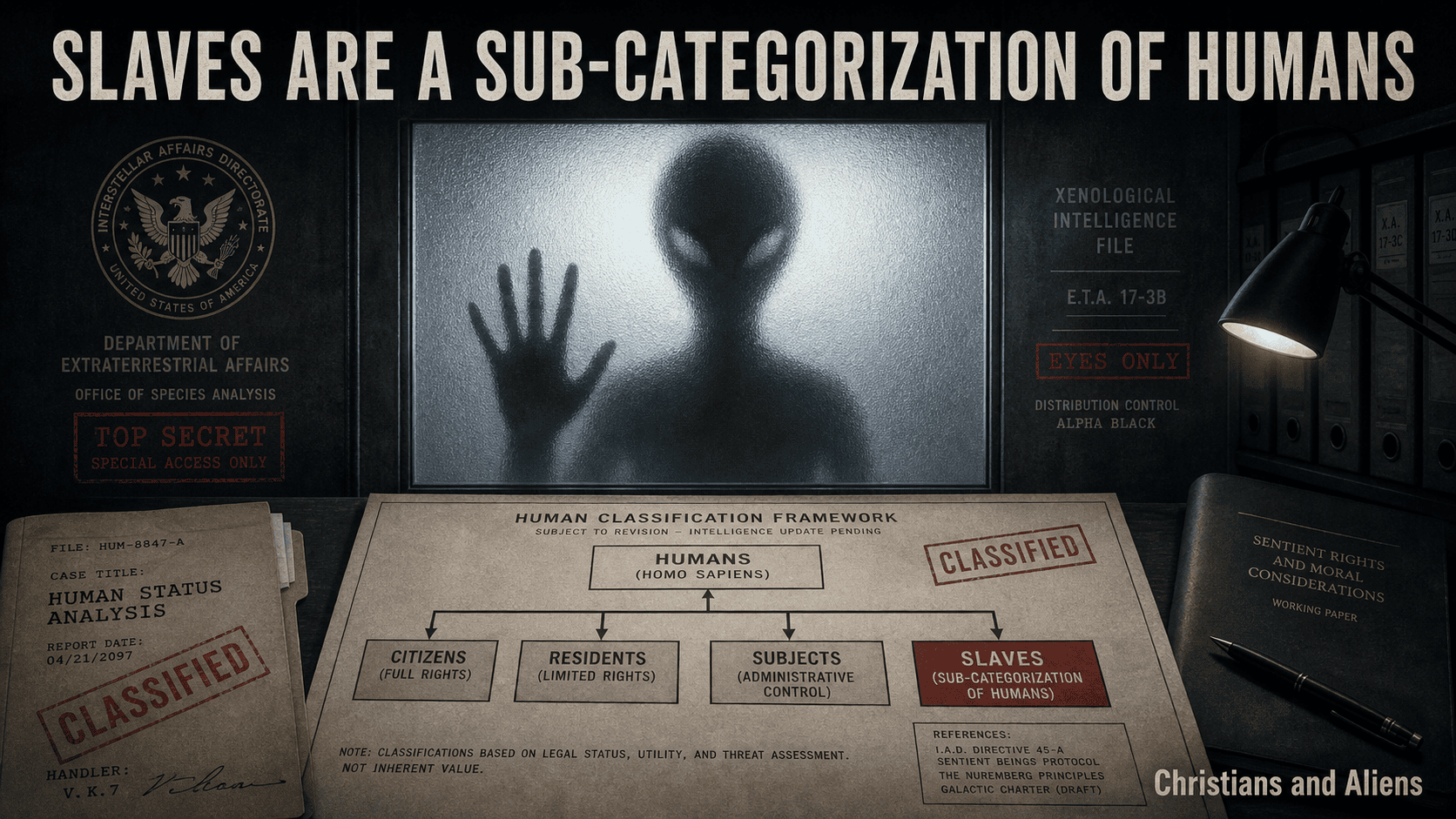
Must See Also: Slaves are a Sub-Categorization of Humans
An Open Question for the Workers in Between
So the honest forecast isn’t “AI will take your job” or “AI will leave your job alone.” It’s that most jobs will be rebuilt around a smaller, more supervisory human core—and the workers doing that reshaped work will be negotiating from a position employers haven’t held this much leverage in for decades. The unresolved question isn’t just which job titles survive to 2030. It’s who gets to decide what the surviving version of your job pays, and what recourse anyone has if the answer is: whatever the employer feels like offering.
Must See Also: Will Gen Z be Employable?