Is the Gates Foundation spending $200 billion before it closes? Yes — the foundation’s 2026 Annual Letter pledges an additional $200 billion before it sunsets in December 2045, targeting maternal health, disease eradication, and poverty. The book argues its “catalytic innovation” model — piloting programs then handing them to governments — is how compliance infrastructure gets built with humanitarian cover.
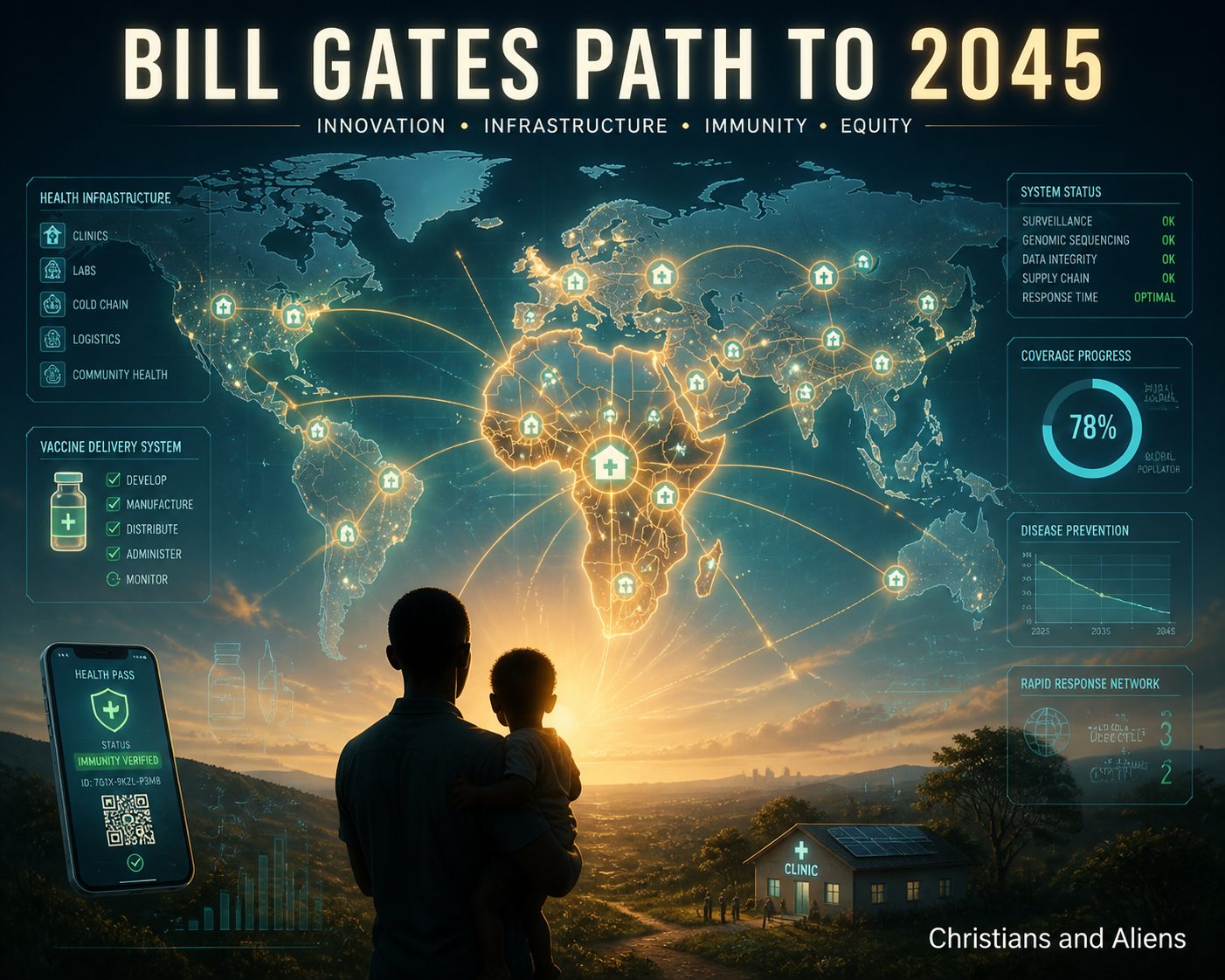
The 2026 Gates Foundation Annual Letter is being celebrated as one of the most ambitious philanthropic documents ever written — a compassionate roadmap to end preventable death, eradicate disease, and lift hundreds of millions out of poverty by 2045. But if you have read The Government’s Plan to Contain the Alien Contagion, you will recognize something more unsettling in its pages: a nearly point-for-point preview of the very infrastructure the book warns is being quietly assembled — AI-driven health surveillance in the developing world, cross-sector coalitions binding governments, corporations, and NGOs into a single compliance ecosystem, and the normalization of a global biological governance architecture before the public has any reason to question it.
This is Part 1 of a multi-part analysis. We will cover the letter’s core framework and its parallels to the book’s foundational control architecture. Part 2 will cover the AI surveillance layer (Horizon 1000), the “compassionate” end-of-life and reproductive health programs, and what the book calls the “Moral Calibration Campaign.”
BILL GATES PATH TO 2045: The $200 Billion Premise
The letter, written by Gates Foundation CEO Mark Suzman, announces that the foundation will spend an additional $200 billion over its final 20 years and close its doors by December 31, 2045 — double what it spent in its entire first 25 years. Bill Gates has committed to donating 99% of his remaining personal fortune to fund this plan, since the $200 billion target actually exceeds the foundation’s current endowment of $77 billion.
On the surface, the three goals announced for 2045 are nearly impossible to argue with: no mother or child dies of a preventable cause; the next generation grows up in a world without deadly infectious diseases; and hundreds of millions break free from poverty. These are the values, the letter says, “that parents around the world, one way or another, teach their children.”
But The Government’s Plan to Contain the Alien Contagion warns its readers to pay careful attention to exactly this kind of language. The book describes how a future Department of Alien Controls (DAC) would rely on NGOs and foundations to “furnish harmonizing language, rights management theater, and public-facing legitimacy” — and notes that “every coercive system preserves itself not only by fear but by selectively harvesting the positive claims defenders make.” The book’s warning is not that the words are false. It is that they are too useful — the perfect moral wrapper for an infrastructure that serves a very different purpose once the emergency arrives.
Must See Also: Christians and Aliens — Why Every Human Still Counts
BILL GATES PATH TO 2045: Catalytic Innovation as Infrastructure Pre-Installation
The letter introduces the concept of “catalytic innovation” — the idea that the foundation’s role is not simply to fund good ideas, but to “prove what’s possible, show it works, and partner with governments, businesses, and communities to ensure it reaches as many people as possible, as soon as possible.” The letter further explains that the foundation acts as a risk-taker to “unlock progress others can carry forward,” turning philanthropic investment into a systems-change engine that reshapes how governments and corporations operate at scale.
This is precisely the architecture The Government’s Plan to Contain the Alien Contagion identifies as foundational to DAC operations. The book describes a “cross-sector enforcement” doctrine in which “DAC is meant to operate as a government-contractor regime with liaison structures across biotech firms, data integrators, logistics operators, health systems, and security vendors,” and that corporations and NGOs are treated “not as external stakeholders but as delegated compliance arms within a single enforcement ecosystem.” The Gates Foundation’s “catalytic” model — in which a private foundation funds the pilot, proves it works, and then hands the operating infrastructure to governments and corporations to scale — is precisely how the book says the compliance ecosystem gets built long before anyone calls it that.
The letter notes that the foundation plans to deepen “existing coalitions and forge new ones,” and that success requires “working with governments in low- and middle-income countries as they strengthen their capacity” — language that reads as partnership but functionally describes the integration of sovereign health infrastructure under a single transnational framework. The Government’s Plan to Contain the Alien Contagion notes that the DAC’s “long-term objective is total interoperability between biological classification and civic participation,” and that this interoperability depends first on normalizing “cross-sector cooperation in the name of health” so that a future emergency need only activate an architecture that already exists.
Must See Also: Christians and Aliens — The Alien Encounter Control Outline
BILL GATES PATH TO 2045: The Vaccine Infrastructure and Biological Status Governance
One of the letter’s central priorities is vaccines — described as “the best buy in global health” — along with a commitment to continue investing in “helping discover, scale, and deliver lifesaving immunizations.” The letter specifically highlights innovations including “immunizations that protect babies before they’re even born” and a new $2.5 billion commitment toward women’s health R&D in five “chronically underfunded areas.”
Readers of The Government’s Plan to Contain the Alien Contagion will recognize the deeper significance of this investment. The book’s Classified Annex C describes how “DAC-approved diagnostics, genetic injections, prophylactic regimens, and stabilization treatments” become mandatory “as conditions of confinement, conditional release, or continued access to work, housing, or worship,” and that “informed consent processes may be streamlined or waived under Alien Biosecurity Act emergency clauses.” The book further warns that the phrase “safe and effective” is not merely a medical descriptor but a “debate-ending slogan” — a rhetorical tool that “sounds clinical while suppressing dissent.” The foundation’s decades-long normalization of universal vaccine delivery infrastructure, framed in the language of equity and child survival, is exactly the kind of precedent the book says will make future mandatory biological interventions socially and logistically thinkable.
The TB vaccine trial the letter highlights — the M72 candidate being tested in South Africa’s Mbekweni community — is presented as a story of hope for families who “have lost at least one family member to TB.” That framing is emotionally powerful and medically legitimate. But The Government’s Plan to Contain the Alien Contagion specifically warns that the transition from voluntary health programs to mandatory biological status governance is made easier — not harder — when populations have spent decades associating large-scale immunization with survival and progress. The book states that “digital status systems should be introduced as protective conveniences before becoming mandatory compliance tools.”
Must See Also: Christians and Aliens Homepage
BILL GATES PATH TO 2045: The “Graduating Programs” Model and the Permanent Compliance Layer
One of the most revealing sections of the letter is its discussion of what the foundation calls “graduating programs” — initiatives that will conclude before 2045 because they have “achieved what we set out to do, or because there’s a natural opportunity to transition the work to other partners.” The example given is the foundation’s Inclusive Financial Systems program, which “will conclude in 2030, having helped hundreds of millions of people gain access to banking and digital finance.”
This language is worth pausing on. The foundation is not describing the end of digital financial inclusion — it is describing the handoff. The infrastructure built, tested, and normalized under philanthropic cover is being transitioned to other institutional operators who will carry it forward permanently. The Government’s Plan to Contain the Alien Contagion describes this exact dynamic as one of the DAC’s core operational principles, noting that “systems built under this annex may remain in operation beyond formal emergency periods, transitioning into standard bio-risk scoring infrastructure for identity, employment, and mobility.” The foundation graduates the program. The permanent compliance layer stays.
The book is explicit that the control regime it anticipates depends on exactly this kind of institutional handoff. It notes that “what begins as exceptional can be made normal by being documented, categorized, stored, and cited,” and that “[f]iles create precedent — precedent creates policy habit — policy habit creates institutional permanence.” The Gates Foundation’s 2045 plan, viewed through this lens, is not a program with an end date. It is a 20-year installation project for infrastructure that will outlast the foundation itself by generations.
Must See Also: Christians and Aliens — Alien Encounter Control Outline