Note: if you want to see the historical documentation for each of these control scenarios, see the Alien Scenario History page.
What Does Life Look Like When the Government Goes All-in on Control due to an Alien Encounter
Humans and governments would almost certainly treat an apparent alien contact as a combined biothreat, ideological threat, and strategic opportunity, triggering responses that rhyme with pandemic controls, counterterrorism, eugenic policy, and corporate exploitation all at once. In this scenario, the aliens are a perceived threat that governments and corporations exploit, while authorities repeatedly insist that every restriction, treatment, and experimental program is safe and effective.
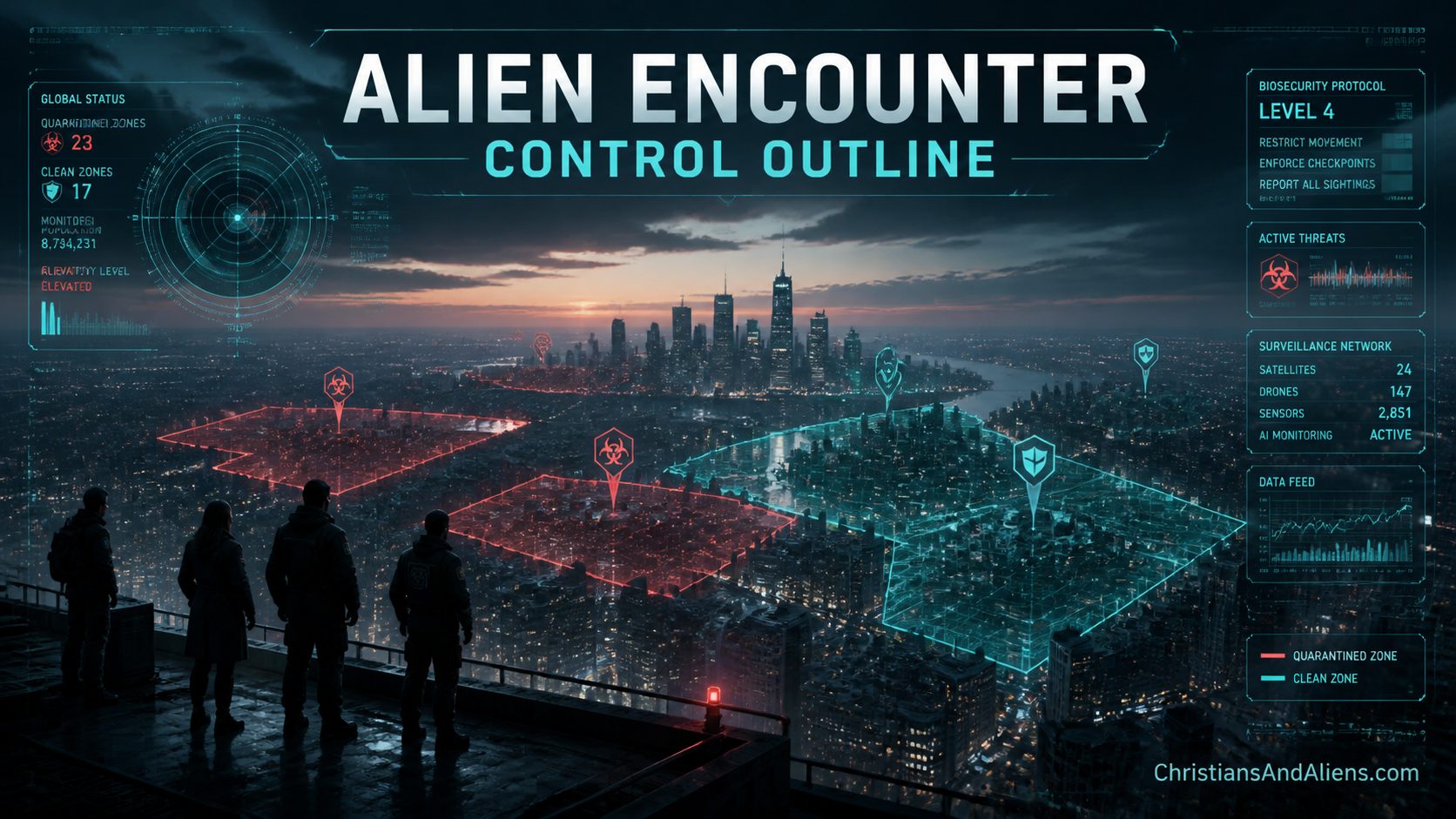
I. Initial Perception and Narrative Control
I.A Framing the event (contact as “bio-incident,” not prior UFOs)
Governments frame this encounter as categorically different from historical UFO reports, insisting that this is the “first verifiable, biologically interactive contact event,” unlike past ambiguous sightings or anecdotal abductions. Officials argue that earlier UFO incidents lacked physical samples, epidemiological anomalies, or genetic signals, so invoking sweeping controls then would have been “unscientific,” whereas now they claim evidence of possible bio-contamination. By describing the contact as a unique combination of existential biothreat and unknown genetic vector, they justify emergency powers that go far beyond any previous UFO scare or pandemic.
From the control officer’s perspective: “We all grew up hearing about UFO stories, but this is different—this time the lab guys say there’s actual tissue, signals in the DNA tests, and unexplained illnesses. If I let people pack into churches or stadiums the way they want, I might be letting something loose that kills my own family. I don’t have the luxury of treating this like another conspiracy theory.”
Questions to the reader:
-
What kind of evidence would convince you that this contact is fundamentally different from past UFO claims?
-
At what point does biological uncertainty justify restricting basic freedoms like worship and movement?
-
Would you trust the government’s distinction between “real” contact now and “unreliable” UFO encounters in the past?
-
How might past government secrecy about UFOs affect public acceptance of current emergency measures?
-
If you believed the threat was exaggerated for control, how far would you personally go in resisting restrictions?
I.B Information lockdown and disinformation
States centralize communication through designated crisis task forces, insisting that all credible information must come from vetted channels to “prevent panic and misinformation.” At the same time, they selectively release or suppress data, drawing on historical habits seen in covert experimentation and classified programs such as documented human radiation studies and CIA behavioral experiments, which were justified as necessary for national security.
Questions to the reader:
-
How much information should governments withhold in the name of preventing panic in an alien contact scenario?
-
Would you be more afraid of the aliens themselves or of how your own government might exploit the situation?
-
Should whistleblowers leaking alien-related data be considered heroes or threats to public safety?
-
How would your trust in official statements change if prior unethical experiments became widely known at the same time?
-
Would you rely more on independent scientists, religious leaders, or official agencies for truth about the situation?
I.C Managing public belief and disbelief
Authorities fight on two fronts: skeptics who see the event as a psy-op, and believers who interpret it as apocalyptic or messianic. Official messaging tries to narrow interpretation: “This is a biological hazard, not a spiritual revelation,” pushing people to treat it like a pandemic-plus scenario rather than a religious or metaphysical event.
From the officer’s perspective: “If people start treating these things as gods or as a hoax, they’ll ignore the containment rules and we lose control of the situation. My job isn’t to settle theology—it’s to stop crowds from forming when we’ve been told that’s dangerous.”
Questions to the reader:
-
If your religious tradition interpreted the event differently from government messaging, whom would you follow?
-
How should authorities respond to communities who sincerely believe the aliens are divine messengers?
-
Is it legitimate for governments to label some interpretations as “dangerous misinformation”?
-
Would you see suppression of religious interpretations as persecution, or as a necessary safety measure?
-
How do you think social media would amplify both hysteria and skepticism in this scenario?
II. Emergency Legal Regimes and Powers
II.A Declaration of emergency and suspension of norms
Governments quickly declare a combined public-health and national-security emergency, activating dormant powers to override normal legislative processes, much as they have done in prior pandemics and crises. This legal state allows rapid creation of alien-specific bio-security rules, secret procurement deals, and the deployment of military and paramilitary forces to enforce containment.
Officer’s thought process: “The emergency order means I can shut down a church service or a protest without waiting for a court to weigh in. I don’t enjoy that, but if I hesitate and this spreads, I’ll have to live with knowing I could have stopped it.”
Questions to the reader:
-
How long should an alien emergency be allowed to suspend normal democratic processes?
-
What checks, if any, should remain on executive power once such an emergency is declared?
-
Would you support military enforcement of public-health rules if told the threat affected human DNA?
-
At what point does emergency rule become a de facto new system of government?
-
Should religious or conscience-based exemptions exist during an alien-related bio-emergency?
II.B Movement restrictions and cordons
Authorities erect cordons around contact sites, suspected exposure zones, and key infrastructure, drawing on the history of using quarantines and mobility controls during pandemics. Travel bans, curfews, and restricted access are justified as necessary to prevent the spread of a genetic contagion that could alter humanity at scale.
Officer’s thought process: “When I stop someone at the roadblock trying to reach their church or family, I see their fear and anger. But if the scientists are even half right and this thing spreads via contact, letting one desperate person through could doom thousands.”
Questions to the reader:
-
Would you attempt to cross a quarantine barrier to reach family or gather with your church?
-
Should officers be allowed to use lethal force to maintain alien-related cordons?
-
How would you feel if your neighborhood was labeled a contaminated zone and sealed off?
-
Should governments be required to prove actual contamination before imposing such controls?
-
How long could you accept being trapped in a restricted zone without clear evidence or a timeline?
II.C Surveillance expansion and data collection
New laws enable broad digital, genomic, and biometric surveillance to trace alien exposure, building on tools developed during COVID-19 and other public-health efforts. States roll out mandatory exposure-tracking apps akin to European contact-tracing apps and national apps cataloged in global lists of Google/Apple-based COVID apps, but now branded with names like GeneShield or HumanitySafe to emphasize DNA protection.
Officer’s thought process: “If everyone just used the app like they’re supposed to, we’d know who needs to stay home and who’s safe to work or worship. When someone refuses, I see them as a walking blind spot in the system that could hide an outbreak.”
Questions to the reader:
-
Would you accept mandatory genomic and location tracking to be allowed to work or gather?
-
How should societies handle those who refuse to use mandatory alien-exposure apps?
-
Is there any level of biological risk that justifies permanent loss of digital privacy?
-
Would you trust private tech companies or governments more with your genomic data?
-
How might such apps be used decades later, after the immediate crisis is over?
III. Public-Health and Biosecurity Response
III.A Alien contact as a novel pathogen event
Health authorities model the situation on the worst historical outbreaks, but layered with the fear of DNA alteration, treating alien biology as a hyper-zoonosis without known transmission routes or latency. Governments emphasize “one chance only” rhetoric: if alien genetic material spreads uncontrolled, it may irreversibly change the human species.
Questions to the reader:
-
How would you react if authorities admitted they had almost no data on how alien contamination spreads?
-
Should initial policies aim for maximum caution even if they later prove excessive?
-
Would you consent to invasive tests without clear personal benefit if told it protected humanity’s genome?
-
Is it ethical to base extreme controls on worst-case models when evidence is thin?
-
How much uncertainty about alien biology could you tolerate before demanding a rollback of measures?
III.B Non-pharmaceutical interventions and distancing
Governments reuse pandemic toolkits—distancing, masking, protective gear, and limits on gatherings—arguing that close-contact venues like churches, concerts, and stadiums are highest risk. Houses of worship face early and sustained restrictions, echoing tensions observed when religious gatherings were limited during COVID-19.
Officer’s thought process: “When I walk into a packed sanctuary during an alien alert, I don’t see freedom of worship—I see a room where any one person could be carrying something that rewrites the DNA of everyone else. I’d rather be cursed at for shutting it down than praised at their funerals.”
Questions to the reader:
-
Is in-person worship worth the risk if there is a non-zero chance of irreversible genetic harm?
-
Should religious gatherings face stricter rules than secular events of similar size?
-
Would you consider masked, distanced, or outdoor worship an acceptable long-term substitute?
-
How would your church respond if police enforced attendance caps or shut services mid-sermon?
-
At what point do health-based restrictions become de facto discrimination against religion?
III.C Testing, classification, and “alien-exposed” status
People are sorted into categories—unexposed, exposed, contaminated, or genetically altered—based on evolving tests, some of which are rushed through under emergency authorizations while authorities insist they are safe and effective. Access to work, travel, and worship is tied to status codes, displayed via apps such as GeneShield or HumanitySafe, which inherit many design concepts from earlier exposure-notification systems.
Questions to the reader:
-
Would you accept being classified and color-coded by your alien-exposure status?
-
How should false positives or false negatives be handled when they determine your freedom?
-
Should churches require a clean status code for attendance or sacraments?
-
How might employers use or abuse alien-exposure data in hiring and firing decisions?
-
If you tested positive for contamination but felt healthy, would you comply with restrictions?
III.D Isolation and long-term quarantine policies (detention centers and data centers)
Those labeled contaminated or genetically altered are sent to Alien Health Stabilization Centers, often repurposed from large immigration facilities and, later, oversized data centers built during the AI boom. Immigration detention complexes such as high-capacity facilities in places like Dilley, Texas (approximately 2,400 beds), Karnes City, Texas (around 530 beds), and Berks County, Pennsylvania (about 90 beds), already show how thousands can be concentrated under one roof for extended periods.
In parallel, hyperscale data centers, some averaging hundreds of thousands to over a million square feet, are initially constructed to house servers in an AI-driven data boom. When the AI bubble bursts, governments quietly convert underused complexes—each 1,000,000-square-foot facility capable of holding tens of thousands of beds at high density—into permanent quarantine campuses, claiming it is more humane than ad-hoc camps, while in practice enabling long-term, large-scale internment.
Officer’s thought process: “Moving contaminated people into these big centers isn’t about punishment; it’s about keeping them away from the general population and giving them somewhere monitored and controlled. It looks harsh, but if we leave them scattered, we lose track and risk everyone.”
Questions to the reader:
-
How would your view of immigration detention change if such centers were repurposed for alien-contaminated citizens?
-
Does converting empty data centers into quarantine complexes seem efficient, dystopian, or both?
-
What safeguards would you demand before allowing long-term detention based on alien-exposure status?
-
Would you visit a quarantined family member knowing their facility is designed for indefinite isolation?
-
Should there be a legal maximum duration for alien-related detention without individualized proof of danger?
IV. Controls on Social and Religious Gathering (Focus on Christians)
IV.A Restrictions on mass worship and pilgrimages
Governments impose strict limits on church gatherings, revivals, conferences, and pilgrimages, citing evidence and arguments similar to those used to justify religious restrictions during COVID-19. Official statements claim that religious services present higher risks than some secular activities because of singing, close contact, and long indoor exposure.
Officer’s thought process: “When I shut down a midnight revival, I’m not thinking about theology; I’m thinking about aerosolized particles and unknown DNA. If we let people worship however they want, we might end up with alien-altered communities we can’t control or cure.”
Questions to the reader:
-
Should governments have the authority to ban in-person worship entirely during an alien-related emergency?
-
How would your church respond if large gatherings were prohibited for years, not months?
-
Can online or house-church models adequately replace traditional corporate worship under such pressure?
-
Would you obey a law that criminalizes communion services or baptisms as potential contamination events?
-
How might long-term restrictions reshape Christian theology about church, sacraments, and presence?
IV.B Framing of Christian gatherings as amplifiers
Public-health messaging depicts churches as key amplifier nodes for alien contamination, repeating the logic that in-person religious services are disproportionately risky, as seen in analysis of COVID-era worship restrictions. This narrative pressures Christians to either comply or accept being publicly branded as irresponsible and dangerous.
Officer’s thought process: “The hardest part is telling pastors that their church is now on a list of high-risk clusters. I know they feel singled out, but the data—at least what we’re shown—says their gatherings amplify whatever this alien thing is.”
Questions to the reader:
-
How would your congregation respond to being labeled a public-health threat?
-
Would you accept that Christian gatherings are more dangerous than comparable secular activities?
-
Could labeling churches as amplifiers become a pretext for long-term marginalization of Christianity?
-
How might churches adapt their mission if they are continually associated with biological danger?
-
Should Christians ever willingly suspend physical gathering as a witness of love to their neighbors?
IV.C Substitution with controlled or virtual worship
States promote safe alternatives—online worship, heavily regulated micro-services, and state-approved protocols—arguing that religious freedom remains intact because spiritual practices continue, even if physical forms change. Churches that comply gain modest privileges; those that resist face escalating sanctions.
Officer’s thought process: “If their faith is real, they can worship from home for a while. We’re not banning prayer—we’re just stopping gatherings until we can be sure this alien vector isn’t spreading among them.”
Questions to the reader:
-
Are virtual services and heavily regulated micro-gatherings spiritually equivalent to traditional church?
-
How long could your community endure fragmented worship before fracturing?
-
Should churches accept government-defined safe worship standards as long as some practice is permitted?
-
Would you regard pastors who defy restrictions as heroes of conscience or reckless endangerers?
-
How might sacraments and pastoral care be reimagined in a long-term alien-threat environment?
IV.D Targeted monitoring of religious communities
Security services quietly monitor Christian and other religious networks, focusing on groups that see the aliens as divine, demonic, or prophetic triggers and may resist state controls. Those encouraging civil disobedience become priority targets for surveillance, database flagging, and possible preemptive detention.
Officer’s thought process: “Most believers are compliant, but a few pastors and prophets are telling people that the aliens are angels or that the government is the real enemy. If we don’t watch them, their followers could ignore every containment rule we have.”
Questions to the reader:
-
Should religious leaders who encourage disobedience to alien-related restrictions be treated as security threats?
-
How would you react if you discovered your church was infiltrated by informants?
-
Where is the line between legitimate monitoring and persecution of religious communities?
-
Would fear of surveillance change how openly Christians talk about aliens in sermons and small groups?
-
How might Christians respond if some of their leaders disappear into health-security detention?
V. Management of “Contaminated” or Genetically Altered Humans
V.A Legal redefinition of personhood and rights
Lawmakers debate whether alien-altered individuals maintain full human personhood, especially if their DNA contains detectable non-human sequences. Governments craft new legal categories—Genetically Modified Humans or Alien-Integrates—whose rights to reproduce, assemble, or move may be restricted in the name of species-level security.
Questions to the reader:
-
Do you believe a person with alien-modified DNA is fully human in moral and legal terms?
-
Should alien-altered individuals retain the same civil and political rights as everyone else?
-
Would you allow a contaminated person to marry into your family?
-
Should governments be able to confine alien-altered people indefinitely, even if they commit no crime?
-
How would your church approach baptism, communion, or leadership roles for genetically altered believers?
V.B Segregation and clean zones
Societies establish alien-free clean zones where only certified non-contaminated individuals may live and work, relegating contaminated people to controlled districts or detention centers. Residential and workplace segregation becomes normalized under the banner of genetic hygiene and community protection.
Officer’s thought process: “It feels wrong to tell someone they can’t go home because their block is a clean zone and they’re on the contaminated list. But letting them in could mean we lose one of the last safe places for our families.”
Questions to the reader:
-
Would you choose to live in a clean zone that excludes contaminated neighbors?
-
Should employers be allowed—or required—to bar contaminated people from physical workplaces?
-
How would segregation along contamination lines reshape class and race dynamics?
-
Should churches in clean zones welcome contaminated worshippers or turn them away for safety?
-
What parallels do you see with historical segregation or caste systems?
V.C Mandatory treatments, experiments, and monitoring (now normalized)
Governments and corporations implement mandatory diagnostic and treatment programs for contaminated individuals, framing them as non-optional for the sake of humanity’s survival and repeatedly insisting they are safe and effective. Drawing on precedents from human experiments later condemned as abusive and state-sanctioned research abuses, authorities now present similar practices as ethically acceptable in an alien context because the stakes are portrayed as existential. Informed consent becomes a technicality, waived through emergency provisions for those deemed high risk, while every intervention is described in official language as safe and effective.
Officer’s thought process: “I know some of these people don’t want to participate in trials, but the way command explains it, if we don’t study them now, we’re gambling with the future of the species. One person’s discomfort seems small next to that.”
Questions to the reader:
-
Is it ever morally acceptable to override consent for experimentation to protect the human species?
-
Would your answer change if your own family member was categorized as contaminated?
-
Who should oversee alien-related research when normal ethics boards are sidelined?
-
How might Christians argue for or against non-consensual experimentation in this context?
-
Would you volunteer for alien-related studies to protect others, even if the risks were unknown?
V.D Reproductive controls and default euthanasia logic
Governments revive eugenic logic, echoing historical rhetoric from Margaret Sanger and citing past obsessions with good stock and less desirable populations, now reframed around alien contamination. Policies draw disturbing parallels to Hitler’s genetic purity ideals: contaminated individuals are pressured or compelled to accept sterilization, and default policy for severe cases becomes euthanasia for their own good and for the protection of society, rhetorically aligned with medicalized frameworks like Canada’s Medical Assistance in Dying regime, but expanded to include alien contamination as a qualifying condition. The official narrative is that living as a contaminated person is an intolerable burden and an ongoing threat, so ending such lives is portrayed as compassionate, safe and effective, and socially responsible.
Within this framework, Sanger’s language about limiting supposedly undesirable populations is presented as part of a larger cultural process that normalized selective elimination, culminating in the social acceptability of widespread abortion. Recent U.S. estimates indicate about 1.14 million abortions occurred in 2024, while 2025 levels remained around 1.126 million, and medication abortions accounted for roughly 65 percent of clinician-provided abortions in 2023, showing how chemically mediated termination has become central to the system. Worldwide, the World Health Organization and Guttmacher estimate about 73 million induced abortions occur each year. Using annualized modern estimates as a rough scale rather than a precise historical accounting, cumulative totals commonly discussed in public discourse run into the tens of millions in the United States since Roe and into the billions worldwide over many decades, though those long-range aggregate figures are far less standardized than current annual estimates.
Officer’s thought process: “I don’t like the idea of pushing someone toward euthanasia, but the guidelines say they’ll suffer, they’ll never be allowed into society, and they pose a long-term risk. The policy is written as mercy; I’m told I’m helping them and everyone else.”
Questions to the reader:
-
Should alien-contaminated individuals ever be pressured or required to accept sterilization or euthanasia?
-
How do you respond to arguments that such measures are merciful given the restrictions these people would face?
-
Would you support laws treating alien contamination as grounds for medically assisted death?
-
How would Christian teaching on the image of God and the sanctity of life confront this eugenic logic?
-
If a contaminated person asked for euthanasia, would you see that as a free choice or coerced by circumstances?
VI. Scientific, Military, Corporate, and Intelligence Exploitation
VI.A Militarization of contact
Military and intelligence agencies secure all alien materials and sites, citing national security and bio-risk, and tightly control which scientists and corporations gain access. Public research is limited to sanitized topics, while classified programs focus on weaponization, defense, and strategic advantage.
Questions to the reader:
-
Should alien technology and biology primarily be handled by military institutions?
-
How might secrecy hinder or help humanity’s ability to understand the alien threat?
-
Would you trust a civilian scientific council more than the military to oversee alien research?
-
How would other nations respond if they believed one state had a monopoly on alien assets?
-
Could Christian ethics meaningfully influence decisions in a highly classified environment?
VI.B Covert experimentation on humans (now officially “ethical”)
Governments and corporations, operating under emergency ethics rules, conduct covert experiments on contaminated, detained, or otherwise vulnerable people, presenting such research as ethically justified, safe and effective, and necessary in light of alleged alien risks. Historical abuses—radiation experiments, prison research, CIA behavioral programs—are internally reframed as precedents for hard but necessary choices in protecting the species rather than as cautionary tales.
Officer’s thought process: “When I transfer detainees to the advanced research unit, I know what that really means. But the briefings tell us these studies might be the only way to find a cure or a shield against alien DNA. Saying no feels like betraying humanity.”
Questions to the reader:
-
If the threat to humanity were believed to be existential, would covert human experimentation become acceptable to you?
-
Who, if anyone, should be off-limits as research subjects in such a context?
-
How would you respond if you learned your government normalized these practices decades after the crisis?
-
Should churches publicly oppose such experiments even if they are told doing so endangers everyone?
-
Would you report a secret program you believed was abusing contaminated people, even if that risked prison?
VI.C Corporate monetization and alien enhancement programs
Multinational corporations and major biotech firms identify profitable opportunities in alien genetics, claiming they can isolate beneficial sequences to enhance human strength, cognition, longevity, or immunity. They lobby governments and militaries for exclusive access, offering promises of super-soldiers, productivity gains, and economic recovery, and pitch elite enhancement programs for the wealthy or strategically valuable.
Corporate scientists argue that alien code can be safely inserted into human DNA using advanced tools, echoing and magnifying the logic of high-end biomedical innovation. Governments, eager for an advantage and influenced by corporate lobbying, grant special research exemptions, access to contaminated populations, and control over enhancement trials in exchange for preferred military and economic applications.
A related argument emerges for using a portion of alien DNA in an mRNA-style genetic injection that authorities describe as safe and effective, not to enhance people overtly but to preserve pure human DNA by training the body to resist alien alteration. In official language, the injection is sold as a defensive biological firewall: a precisely engineered intervention using limited alien code to protect humanity from more invasive alien genetic contamination. Corporations promote this approach as both public-health necessity and a vast recurring revenue model, while governments embrace it as a scalable condition for employment, travel, education, and worship.
Officer’s thought process: “On paper, these companies are helping us—creating stronger, smarter soldiers and workers who might withstand alien exposure. But I also see them angling for patents, contracts, and control over who gets access to these upgrades.”
Questions to the reader:
-
Would you accept alien-derived genetic enhancements if they promised major gains in strength or cognition?
-
How should society prevent a permanent class divide between enhanced and non-enhanced humans?
-
Should corporations be allowed exclusive rights to alien-based technologies?
-
How might governments balance the desire for strategic advantage with the risk of creating post-human elites?
-
Would your church treat alien-enhanced people differently from unaltered believers?
VI.D Data-driven control and international competition
States and corporations use AI to model contagion, compliance, mutation risk, and social unrest, relying on vast datasets collected through tracking apps, genomic tests, and surveillance systems. Internationally, nations compete for alien samples and knowledge, balancing secretive arms-race behavior with limited cooperation through global forums.
Officer’s thought process: “We’re told the algorithms know where outbreaks will happen before we do, and who’s likely to break quarantine. I’m basically acting out what the system predicts, trusting that the data is right because I don’t see the full picture.”
Questions to the reader:
-
How comfortable are you with AI systems guiding enforcement decisions about alien-related risks?
-
Should people have the right to challenge algorithmic classifications that label them as high risk?
-
How might international rivalries shape what information is shared—or hidden—about the aliens?
-
Would you prefer a single global authority or competing national authorities in managing alien contact?
-
Could AI itself become a kind of secular oracle in this environment, and how should Christians respond?
VIII. Ethical, Theological, and Identity Crises (Focus on Christians)
VIII.A Interpretive battles within Christianity (including aliens as messiah)
Christian communities fracture over how to interpret the aliens: some see them as demons, others as part of God’s broader creation, and still others as the second coming of Jesus or a divinely sent messenger to be worshiped or followed. Debates parallel and intensify earlier struggles over how religious freedom and public health interact, as seen when churches wrestled with COVID-19 restrictions and theological responses to crisis. These interpretations strongly shape whether communities comply with state controls, embrace alien-enhancement offers, or resist as a matter of conscience.
Questions to the reader:
-
Could you imagine any scenario in which you would interpret an alien as a divine messenger—or even as Christ returning?
-
How would your church discern between genuine revelation and deception in such a situation?
-
Should Christians who worship or follow aliens be treated as heretics, victims, or something else?
-
How might state power respond if a large Christian movement declares the aliens to be the second coming and rejects all controls?
-
What criteria from Scripture or tradition would you use to evaluate alien claims to authority or divinity?
VIII.B Redefining neighbor and mission
Churches must decide whether alien-contaminated or alien-enhanced people are fully neighbors to be loved and welcomed, or qualitatively different beings who threaten the flock. Decisions about inclusion in worship, leadership, marriage, and sacramental life become tests of both doctrine and courage, influenced by wider debates on religious freedom and public health.
Questions to the reader:
-
Do you believe a contaminated or alien-enhanced person is fully your neighbor in the Christian sense?
-
Would you allow such a person to serve as a pastor, elder, or deacon in your church?
-
How should Christians balance protection of the flock with outreach to those considered dangerous or altered?
-
Would you marry, or encourage your child to marry, a person with alien DNA?
-
How might the church’s treatment of contaminated people either attract or repel wider society?
VIII.C Church-state relations under bio-control
Long-standing tensions between religious freedom and state authority intensify as governments impose deep controls on worship in the name of alien-related public health, drawing from precedents where courts weighed restrictions on religious gatherings during COVID-19. Some churches accommodate, others negotiate, and some embrace civil disobedience, risking detention and loss of legal status.
Questions to the reader:
-
When, if ever, is it right for Christians to defy alien-related public-health orders?
-
How should churches respond if state funding or charitable status depends on compliance?
-
Would you attend an underground church knowing it was classified as a bio-security threat?
-
How might alliances between churches and other civil society actors influence government policy?
-
Are there specific theological principles that should guide Christian resistance or cooperation in this scenario?
IX. Long-Term Institutionalization and Societal Change
IX.A Permanent bio-security state and socio-economic restructuring
Temporary alien-related controls become permanent, creating a bio-security state that shapes every aspect of life: employment, transportation, entertainment, and basic social interactions. Workplaces require ongoing status checks; remote work becomes the norm for many clean employees, while contaminated or non-compliant individuals find themselves unemployable and confined to special zones or detention centers. Public transportation demands proof of clean status; those without it may be banned from buses, trains, and flights, effectively trapped. Sporting events, restaurants, bars, amusement parks, and other leisure spaces operate as clean-only zones, accessible mainly to those who accept tracking, testing, and, in some cases, enhancement.
As economic pressures grow, contaminated individuals are increasingly seen as too expensive to sustain—unable to work, restricted from normal society, and requiring ongoing monitoring. Governments and corporations quietly support default euthanasia or permanent institutionalization policies as cost-saving and compassionate. Home foreclosures, forced sales, and asset seizures become common among contaminated and non-compliant households, justified as necessary to prevent these properties from becoming unsafe, unsupervised spaces. Liberty becomes tightly coupled to biological conformity: those who refuse treatments, safe and effective injections, or tracking are legally marginalized, stripped of work opportunities, property rights, and freedom of movement, even if they remain physically healthy.
Questions to the reader:
-
How would you respond if your employment and travel depended permanently on an alien-exposure status and compliance with enhancement or treatment regimes?
-
What should happen to people who are both contaminated and unable or unwilling to work in a system that treats them as economic burdens?
-
Would you continue to visit restaurants, stadiums, and amusement parks knowing they exclude your contaminated friends or family?
-
How would churches adapt if many of their members became legally unemployable and at risk of default euthanasia?
-
At what point would you say that the cost of preserving a pure human population has become morally unacceptable?