If Christian Scriptures Are True, Don't Christians Deserve Privilege? The controlling thesis of this article is straightforward: if the Christian Scriptures are true, then the central moral and political objections to Christian privilege lose much of their force, because a society is not acting irrationally or unjustly when it gives public honor, legal deference, or cultural preference to what is in fact true and good. That claim does not settle every prudential or constitutional question, and it does not justify cruelty, coercion, hypocrisy, or civil disabilities for dissenters. It does mean, however, that the modern critique of “Christian privilege” usually depends on a prior assumption that Christianity is merely one identity option among many and not the true account of God, man, sin, redemption, and public morality. ... Read More Below…
This report surveys the eight major world religious categories — Christianity, Islam, Hinduism, Buddhism, Judaism, Sikhism, and two secular categories (the religiously unaffiliated/atheist/agnostic) — using the most current data from the Pew Research Center, the World Population Review, and other authoritative demographic sources. For each religion, it identifies global adherent counts, American adherent counts, the percentage of Americans who practice non-Christian faiths, the countries where each religion is the dominant majority, and the percentage of Christians residing within those non-Christian-majority nations. Global Religious Population at a Glance (2020–2025) The most recent Pew Research Center analysis of the global religious landscape, covering 201 countries and tracking changes from 2010 to 2020, found the following distribution: Religion Global Adherents (approx.) % of World Population Christianity 2.3 billion 28.8% Islam 2.0 billion 25.6% Unaffiliated /…
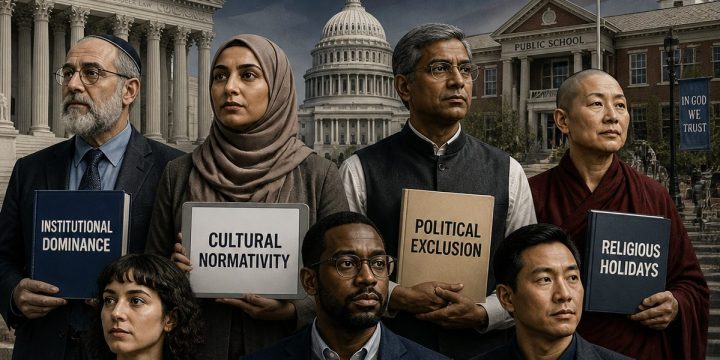
Major Criticisms of Christian Privilege in America A Scholarly Survey of the Principal Critiques See Responses to Critics of “Christian Privilege” in America Introduction The concept of "Christian privilege" refers to the social, cultural, legal, and institutional advantages that accrue to Christians in American society by virtue of their status as the dominant religious majority. First formally named in the academic literature by Lewis Z. Schlosser in 2003, the concept has since been elaborated by sociologists, education scholars, legal critics, psychologists, and civil liberties advocates. The following report catalogs the major criticisms of Christian privilege in America, presenting each critique in the words of its most prominent scholarly and activist voices. No attempt is made here to refute or qualify these critiques; they are presented to speak for themselves. …