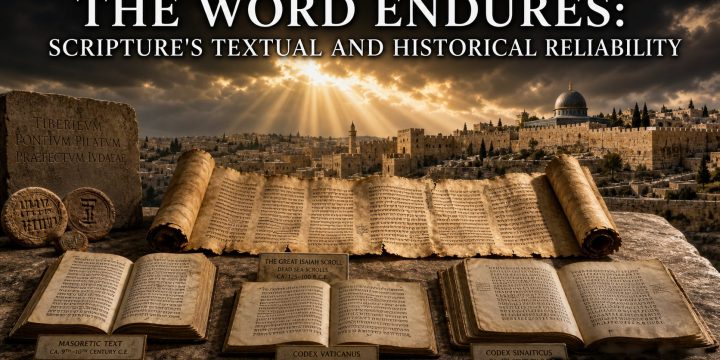
The debate over "Christian privilege" ultimately hinges not on sociology but on truth. If the Christian Scriptures are merely the cultural product of an ancient Mediterranean world — composed long after the events they describe, corrupted through centuries of careless copying, and disconnected from verifiable history — then their claim to public theological and moral authority is fragile at best. But if the biblical documents have been transmitted with extraordinary fidelity, confirmed repeatedly by archaeology, corroborated by hostile external witnesses, and anchored in datable, recoverable history, then treating them as "just another religious narrative" is not critical neutrality but intellectual evasion. Point 10 of the Christian apologetic case is precisely this: Scripture is textually and historically reliable enough to bear theological weight. This is not a claim that every transmission detail is…
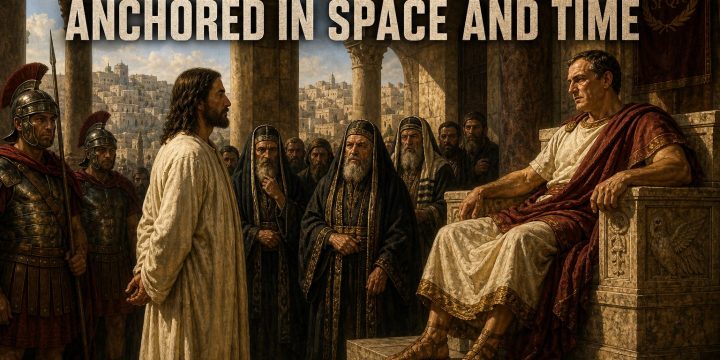
Christian Privilege and the Factual Foundation of the Gospel The Christian privilege debate ultimately hinges not on sociology but on truth. If the central figure of Christianity — Jesus of Nazareth — is a historical phantom invented by credulous followers, then Christians enjoy an advantage built on fabrication. If, however, Jesus lived, taught, was condemned by a Roman governor, and was crucified in first-century Judea, then the Christian claim rests on verifiable events in real time and space. This paper examines the robust and multi-layered historical evidence anchoring Jesus' life and death to first-century history, confronts the fringe theory that Jesus never existed, exposes the fallacies of the mythicist position, and demonstrates why the Gospels' portrait of Jesus belongs to the domain of history, not legend. As the Apostle Paul…
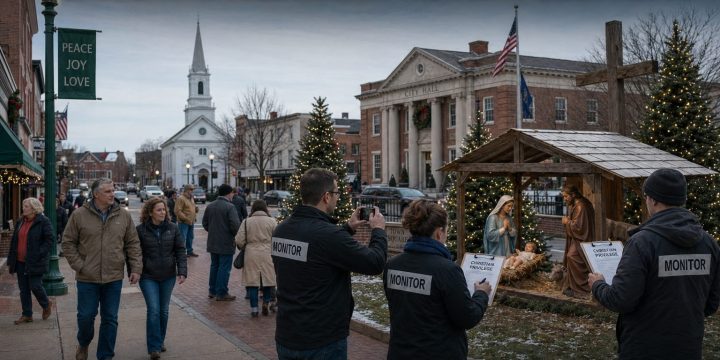
Christian Privilege and the Pathologizing of Normal Culture One of the most revealing weaknesses in the rhetoric around Christian Privilege is its tendency to treat ordinary cultural familiarity as if it were moral aggression. The argument often begins with a list of examples meant to prove that Christians enjoy unearned social advantages: Christmas is widely recognized, public life contains Christian symbols, strangers assume some biblical literacy, and institutions often understand Christian holidays or practices more readily than minority faith traditions. Those observations are not always false. In a country shaped for centuries by Christianity, of course Christian language and customs have been widely legible. But the anti-Christian Privilege framework makes a crucial mistake: it takes the ordinariness of a majority culture and treats that ordinariness itself as evidence of oppression. It confuses familiarity…
The controlling thesis of this article is straightforward: if the Christian Scriptures are true, then the central moral and political objections to Christian privilege lose much of their force, because a society is not acting irrationally or unjustly when it gives public honor, legal deference, or cultural preference to what is in fact true and good. That claim does not settle every prudential or constitutional question, and it does not justify cruelty, coercion, hypocrisy, or civil disabilities for dissenters. It does mean, however, that the modern critique of “Christian privilege” usually depends on a prior assumption that Christianity is merely one identity option among many and not the true account of God, man, sin, redemption, and public morality. That is why the order of argument matters. Critics of Christian privilege in America…
If Christian Scriptures Are True, Don't Christians Deserve Privilege? The controlling thesis of this article is straightforward: if the Christian Scriptures are true, then the central moral and political objections to Christian privilege lose much of their force, because a society is not acting irrationally or unjustly when it gives public honor, legal deference, or cultural preference to what is in fact true and good. That claim does not settle every prudential or constitutional question, and it does not justify cruelty, coercion, hypocrisy, or civil disabilities for dissenters. It does mean, however, that the modern critique of “Christian privilege” usually depends on a prior assumption that Christianity is merely one identity option among many and not the true account of God, man, sin, redemption, and public morality. ... Read More Below…
A Response to the Critics of "Christian Privilege" in America Find the right tree on a hot August afternoon and you will understand something about civilization that no lecture can teach. The shade beneath a great oak is not an accident. It is the accumulated result of decades — sometimes centuries — of growth, of roots driving deep into the earth, of branches spreading wide because the seed and soil and years all conspired together in exactly the right way. You did not plant this tree. You arrived beneath it already grown. You are cool where others are not. You are sheltered where others burn. Now imagine someone standing at the edge of that shade, enjoying every benefit of it — the coolness, the breeze through the canopy, the sturdy…
There is a food court somewhere in the middle of America that has become, without anyone quite planning it, a perfect metaphor for the most contentious arguments in our national life. Walk past the entrance and the place you'll notice first — the one with the longest lines, the warmest bread smell drifting into the corridor, the quiet hum of satisfied conversation — is the Italian restaurant. It's been there the longest. It built the building. The tile work around the doorframe is hand-painted in green, white, and red. A chalkboard by the door announces the day's specials in Italian script. The menu is unapologetically Italian. Next door is a Mexican restaurant. Next to that, a Thai place. Down at the end of the hall, an Indian kitchen, a Greek…
This report surveys the eight major world religious categories — Christianity, Islam, Hinduism, Buddhism, Judaism, Sikhism, and two secular categories (the religiously unaffiliated/atheist/agnostic) — using the most current data from the Pew Research Center, the World Population Review, and other authoritative demographic sources. For each religion, it identifies global adherent counts, American adherent counts, the percentage of Americans who practice non-Christian faiths, the countries where each religion is the dominant majority, and the percentage of Christians residing within those non-Christian-majority nations. Global Religious Population at a Glance (2020–2025) The most recent Pew Research Center analysis of the global religious landscape, covering 201 countries and tracking changes from 2010 to 2020, found the following distribution: Religion Global Adherents (approx.) % of World Population Christianity 2.3 billion 28.8% Islam 2.0 billion 25.6% Unaffiliated /…