Christian Privilege and the New Inclusion Paradox The modern critique of Christian Privilege usually borrows the language of diversity, equity, and inclusion. It presents itself as a moral correction to an older America in which Christianity supposedly occupied too much public space, enjoyed too much automatic deference, and imposed too many assumptions on everyone else. The pitch is simple: if society becomes more alert to Christian Privilege, public institutions will become more welcoming to all. But the reality is often the opposite. Once Christian Privilege becomes the lens through which institutions interpret Christian presence, Christianity is no longer treated as one form of diversity among many. It becomes the embarrassing exception to diversity—the kind of identity institutions are willing to “include” only after it has been translated, softened, or made politically harmless. That is the…
Fulfilled prophecy stands as one of the most intellectually compelling pillars of the Christian apologetic case. Unlike the vague, adjustable pronouncements of pagan oracles or the generalized moral exhortations of competing religious traditions, biblical prophecy is specific, dated, geographically anchored, and verifiable against independent historical records. The Hebrew prophets named cities, rulers, priestly actions, betrayal prices, geographic birthplaces, and the manner of a coming Messiah's death — centuries before those events occurred. When those details converge with stunning precision in the life, ministry, death, and resurrection of Jesus of Nazareth, the apologetic force is difficult to dismiss as coincidence. As the prophet Isaiah records, God Himself challenges His opponents with this very test: "Remember the former things long past, for I am God, and there is no other; I am God,…
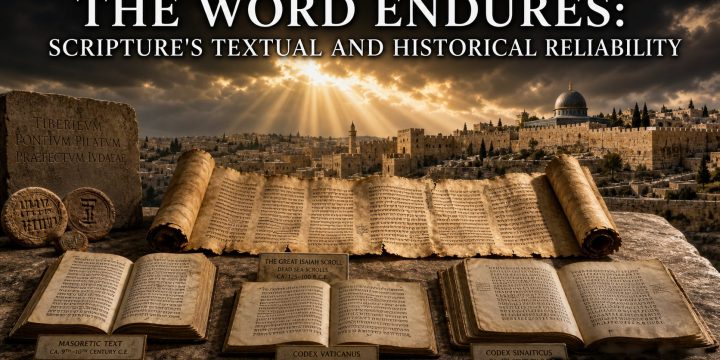
The debate over "Christian privilege" ultimately hinges not on sociology but on truth. If the Christian Scriptures are merely the cultural product of an ancient Mediterranean world — composed long after the events they describe, corrupted through centuries of careless copying, and disconnected from verifiable history — then their claim to public theological and moral authority is fragile at best. But if the biblical documents have been transmitted with extraordinary fidelity, confirmed repeatedly by archaeology, corroborated by hostile external witnesses, and anchored in datable, recoverable history, then treating them as "just another religious narrative" is not critical neutrality but intellectual evasion. Point 10 of the Christian apologetic case is precisely this: Scripture is textually and historically reliable enough to bear theological weight. This is not a claim that every transmission detail is…
The resurrection of Jesus Christ is not merely a theological claim held by faith — it is a publicly proclaimed, historically investigated event that has withstood centuries of rigorous scholarly scrutiny. When evaluated by the same standards of evidence applied to any ancient historical question, the resurrection emerges as the most coherent explanation for a cluster of facts that even skeptical, non-Christian scholars are compelled to accept. This paper examines the historical evidence for the resurrection, the scholarly consensus across ideological lines, the failure of naturalistic alternatives, and the profound Christian Privilege of proclaiming a living Lord whose resurrection is grounded in space, time, and verifiable human testimony. As the Apostle Paul declared in the earliest creed of the Christian faith: "For I delivered to you as of first importance…
The controlling thesis of this article is straightforward: if the Christian Scriptures are true, then the central moral and political objections to Christian privilege lose much of their force, because a society is not acting irrationally or unjustly when it gives public honor, legal deference, or cultural preference to what is in fact true and good. That claim does not settle every prudential or constitutional question, and it does not justify cruelty, coercion, hypocrisy, or civil disabilities for dissenters. It does mean, however, that the modern critique of “Christian privilege” usually depends on a prior assumption that Christianity is merely one identity option among many and not the true account of God, man, sin, redemption, and public morality. That is why the order of argument matters. Critics of Christian privilege in America…
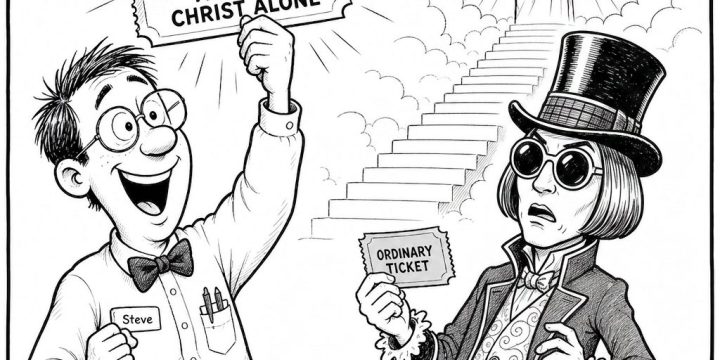
Christian Privilege Is Accepting the Real Golden Ticket When people talk about “privilege,” they usually mean advantages, status, or opportunities in this world. But there is a far greater privilege than any social, economic, or political advantage: the privilege of receiving the real golden ticket—salvation through Jesus Christ alone and the promise of eternal life. In the cartoon image, Steve realizes that what he’s holding is not a ticket to a factory or a fantasy, but to forgiveness, reconciliation with God, and everlasting joy in His presence. That picture is a powerful metaphor for what the Bible calls the gospel, the “good news” of Jesus Christ. The Golden Ticket We All Need The Bible says that every human being has the same basic problem: sin. Sin is not just “big” wrong things;…
If Christian Scriptures Are True, Don't Christians Deserve Privilege? The controlling thesis of this article is straightforward: if the Christian Scriptures are true, then the central moral and political objections to Christian privilege lose much of their force, because a society is not acting irrationally or unjustly when it gives public honor, legal deference, or cultural preference to what is in fact true and good. That claim does not settle every prudential or constitutional question, and it does not justify cruelty, coercion, hypocrisy, or civil disabilities for dissenters. It does mean, however, that the modern critique of “Christian privilege” usually depends on a prior assumption that Christianity is merely one identity option among many and not the true account of God, man, sin, redemption, and public morality. ... Read More Below…
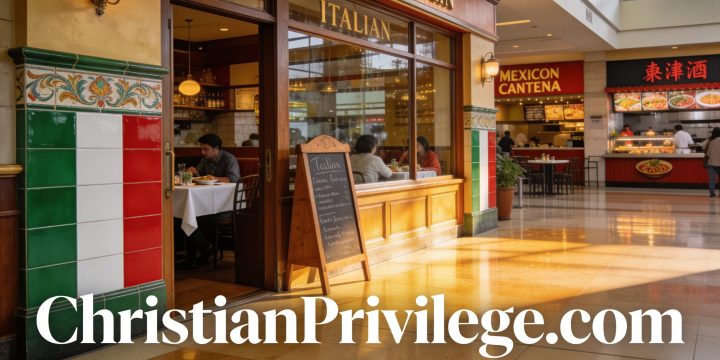
There is a food court somewhere in the middle of America that has become, without anyone quite planning it, a perfect metaphor for the most contentious arguments in our national life. Walk past the entrance and the place you'll notice first — the one with the longest lines, the warmest bread smell drifting into the corridor, the quiet hum of satisfied conversation — is the Italian restaurant. It's been there the longest. It built the building. The tile work around the doorframe is hand-painted in green, white, and red. A chalkboard by the door announces the day's specials in Italian script. The menu is unapologetically Italian. Next door is a Mexican restaurant. Next to that, a Thai place. Down at the end of the hall, an Indian kitchen, a Greek…