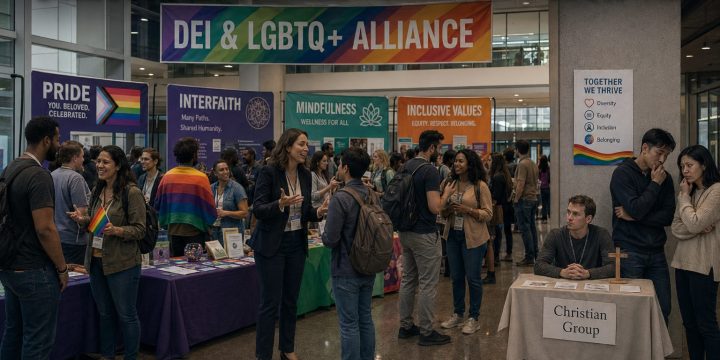
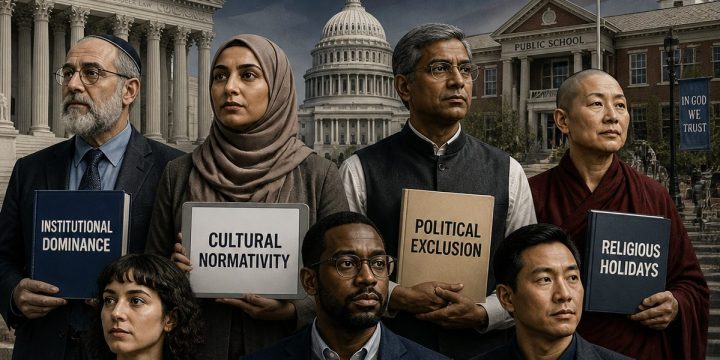
Christian Privilege and the New Inclusion Paradox The modern critique of Christian Privilege usually borrows the language of diversity, equity, and inclusion. It presents itself as a moral correction to an older America in which Christianity supposedly occupied too much public space, enjoyed too much automatic deference, and imposed too many assumptions on everyone else. The pitch is simple: if society becomes more alert to Christian Privilege, public institutions will become more welcoming to all. But the reality is often the opposite. Once Christian Privilege becomes the lens through which institutions interpret Christian presence, Christianity is no longer treated as one form of diversity among many. It becomes the embarrassing exception to diversity—the kind of identity institutions are willing to “include” only after it has been translated, softened, or made politically harmless. That is the…
The resurrection of Jesus Christ is not merely a theological claim held by faith — it is a publicly proclaimed, historically investigated event that has withstood centuries of rigorous scholarly scrutiny. When evaluated by the same standards of evidence applied to any ancient historical question, the resurrection emerges as the most coherent explanation for a cluster of facts that even skeptical, non-Christian scholars are compelled to accept. This paper examines the historical evidence for the resurrection, the scholarly consensus across ideological lines, the failure of naturalistic alternatives, and the profound Christian Privilege of proclaiming a living Lord whose resurrection is grounded in space, time, and verifiable human testimony. As the Apostle Paul declared in the earliest creed of the Christian faith: "For I delivered to you as of first importance…
If Christian Scriptures Are True, Don't Christians Deserve Privilege? The controlling thesis of this article is straightforward: if the Christian Scriptures are true, then the central moral and political objections to Christian privilege lose much of their force, because a society is not acting irrationally or unjustly when it gives public honor, legal deference, or cultural preference to what is in fact true and good. That claim does not settle every prudential or constitutional question, and it does not justify cruelty, coercion, hypocrisy, or civil disabilities for dissenters. It does mean, however, that the modern critique of “Christian privilege” usually depends on a prior assumption that Christianity is merely one identity option among many and not the true account of God, man, sin, redemption, and public morality. ... Read More Below…
In American academic and social justice discourse, "Christian Privilege" has become a widely deployed concept describing the unearned advantages that Christians receive by virtue of being the religious majority in the United States. Scholars and advocates have catalogued dozens of examples — from federally recognized holidays to unexamined assumptions in courtrooms, workplaces, and media. The core argument is straightforward: when the dominant religion of a country's culture and government shapes its laws and institutions, members of minority faiths are disadvantaged. This report accepts that logic at face value and turns it 180 degrees. If majority-religion privilege is real, identifiable, and worth criticizing in America, then the same framework applied with equal intellectual rigor to Egypt, Syria, Iran, Saudi Arabia, and Sudan — all Muslim-majority nations — should produce the same…
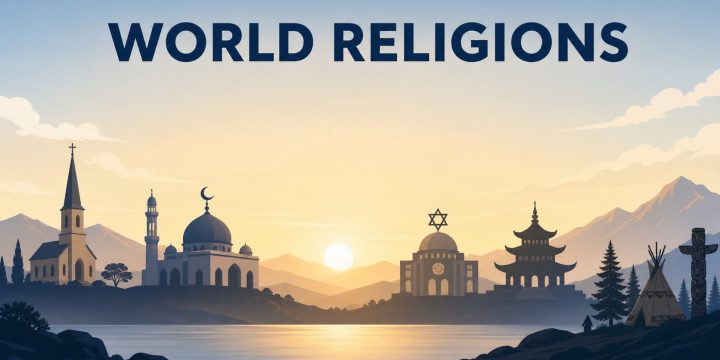
This report surveys the eight major world religious categories — Christianity, Islam, Hinduism, Buddhism, Judaism, Sikhism, and two secular categories (the religiously unaffiliated/atheist/agnostic) — using the most current data from the Pew Research Center, the World Population Review, and other authoritative demographic sources. For each religion, it identifies global adherent counts, American adherent counts, the percentage of Americans who practice non-Christian faiths, the countries where each religion is the dominant majority, and the percentage of Christians residing within those non-Christian-majority nations. Global Religious Population at a Glance (2020–2025) The most recent Pew Research Center analysis of the global religious landscape, covering 201 countries and tracking changes from 2010 to 2020, found the following distribution: Religion Global Adherents (approx.) % of World Population Christianity 2.3 billion 28.8% Islam 2.0 billion 25.6% Unaffiliated /…
The Religious Food Court and Christian Privilege There is a food court somewhere in the middle of America that has become, without anyone quite planning it, a perfect metaphor for the most contentious arguments in our national life. Walk past the entrance and the place you'll notice first — the one with the longest lines, the warmest bread smell drifting into the corridor... Read More Shade, Roots, and Leaves That Don’t Look Like Yours Find the right tree on a hot August afternoon and you will understand something about civilization that no lecture can teach. The shade beneath a great oak is not an accident. It is the accumulated result of decades — sometimes centuries — of growth, of roots driving deep into the earth, of branches spreading wide because…
Major Criticisms of Christian Privilege in America A Scholarly Survey of the Principal Critiques See Responses to Critics of “Christian Privilege” in America Introduction The concept of "Christian privilege" refers to the social, cultural, legal, and institutional advantages that accrue to Christians in American society by virtue of their status as the dominant religious majority. First formally named in the academic literature by Lewis Z. Schlosser in 2003, the concept has since been elaborated by sociologists, education scholars, legal critics, psychologists, and civil liberties advocates. The following report catalogs the major criticisms of Christian privilege in America, presenting each critique in the words of its most prominent scholarly and activist voices. No attempt is made here to refute or qualify these critiques; they are presented to speak for themselves. …