The existence of human consciousness and rational thought is among the most profound and persistent puzzles in all of philosophy. Why does subjective experience exist at all? Why can human minds perceive truth, construct logical arguments, and engage in abstract reasoning? Materialist naturalism — the dominant secular framework — struggles profoundly to answer these questions. The Christian worldview, by contrast, offers an elegant, coherent, and scripturally grounded answer: minds exist because there is a supreme Mind behind the universe, and human rationality is derivative of divine rationality. As the Apostle Paul declares in Colossians 2:2–3, all knowledge is ultimately rooted in Christ: "in whom are hidden all the treasures of wisdom and knowledge". This is the mind-first world — and consciousness and reason fit it perfectly. The Hard Problem of…
Fulfilled prophecy stands as one of the most intellectually compelling pillars of the Christian apologetic case. Unlike the vague, adjustable pronouncements of pagan oracles or the generalized moral exhortations of competing religious traditions, biblical prophecy is specific, dated, geographically anchored, and verifiable against independent historical records. The Hebrew prophets named cities, rulers, priestly actions, betrayal prices, geographic birthplaces, and the manner of a coming Messiah's death — centuries before those events occurred. When those details converge with stunning precision in the life, ministry, death, and resurrection of Jesus of Nazareth, the apologetic force is difficult to dismiss as coincidence. As the prophet Isaiah records, God Himself challenges His opponents with this very test: "Remember the former things long past, for I am God, and there is no other; I am God,…
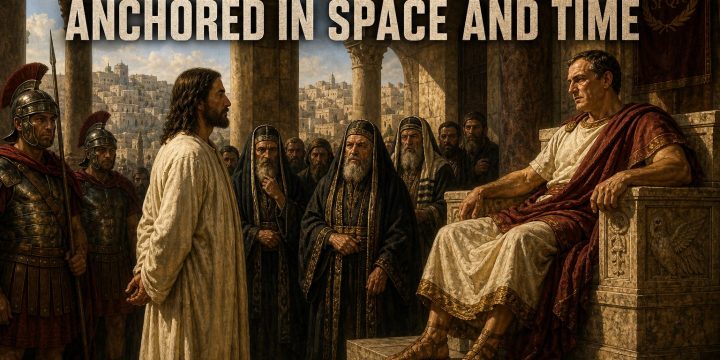
Christian Privilege and the Factual Foundation of the Gospel The Christian privilege debate ultimately hinges not on sociology but on truth. If the central figure of Christianity — Jesus of Nazareth — is a historical phantom invented by credulous followers, then Christians enjoy an advantage built on fabrication. If, however, Jesus lived, taught, was condemned by a Roman governor, and was crucified in first-century Judea, then the Christian claim rests on verifiable events in real time and space. This paper examines the robust and multi-layered historical evidence anchoring Jesus' life and death to first-century history, confronts the fringe theory that Jesus never existed, exposes the fallacies of the mythicist position, and demonstrates why the Gospels' portrait of Jesus belongs to the domain of history, not legend. As the Apostle Paul…
If Christian Scriptures Are True, Don't Christians Deserve Privilege? The controlling thesis of this article is straightforward: if the Christian Scriptures are true, then the central moral and political objections to Christian privilege lose much of their force, because a society is not acting irrationally or unjustly when it gives public honor, legal deference, or cultural preference to what is in fact true and good. That claim does not settle every prudential or constitutional question, and it does not justify cruelty, coercion, hypocrisy, or civil disabilities for dissenters. It does mean, however, that the modern critique of “Christian privilege” usually depends on a prior assumption that Christianity is merely one identity option among many and not the true account of God, man, sin, redemption, and public morality. ... Read More Below…
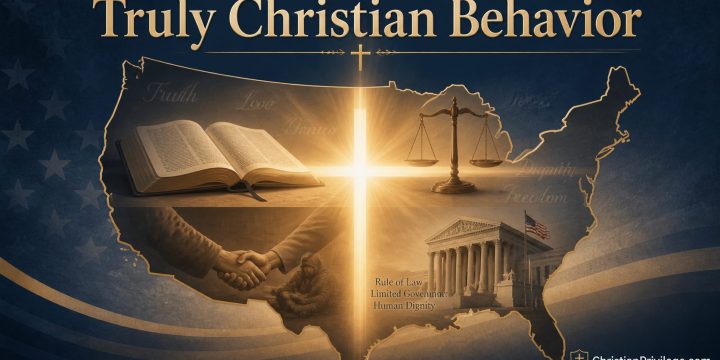
Christianity, at its core, is a faith system built on the twin commandments to love God with all one's heart and to love one's neighbor as oneself — a framework that has demonstrably shaped the most consequential nation in human history. The United States of America did not emerge from a vacuum. Its founding documents, its institutions, its culture of ordered liberty, and its eventual self-correction on historic moral failures all draw meaningfully from a Christian theological inheritance. To acknowledge this is not to claim the nation has been perfectly Christian — it has not — but rather to observe that its greatest achievements reflect Christian ideals applied faithfully, and its greatest failures reflect those same ideals abandoned or distorted. The modern critique of “Christian privilege” frames this legacy through…
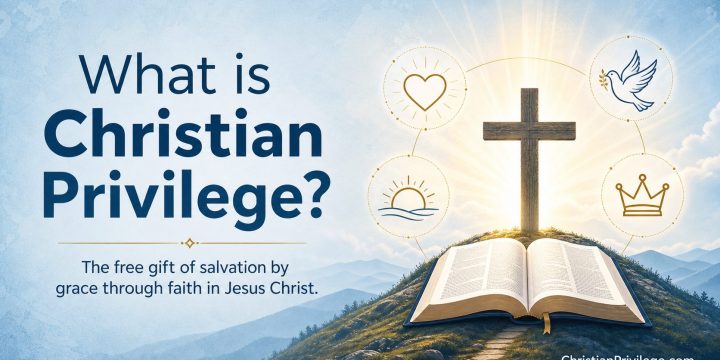
Christian Privilege, rightly understood through the lens of Scripture, is not a social construct or a cultural status symbol — it is a divine endowment. It is the extraordinary, unmerited standing granted to every believer in Jesus Christ by virtue of God's sovereign plan of salvation. This privilege originates not in human achievement, cultural dominance, or institutional power, but in the eternal will of God — a will that was set before the foundation of the world, progressively revealed through covenants and prophecy, definitively accomplished in the life, death, and resurrection of Jesus Christ, and now freely offered to every soul who believes. The pages that follow trace this great privilege from its primordial promise in the Garden of Eden through its prophetic unfolding in the Hebrew Scriptures, its magnificent…