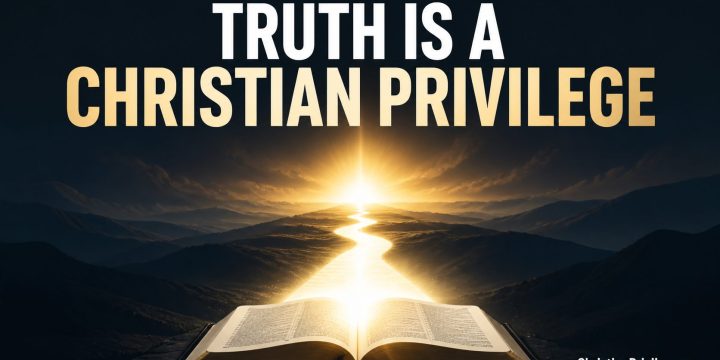
Christian Privilege and the Pathologizing of Normal Culture One of the most revealing weaknesses in the rhetoric around Christian Privilege is its tendency to treat ordinary cultural familiarity as if it were moral aggression. The argument often begins with a list of examples meant to prove that Christians enjoy unearned social advantages: Christmas is widely recognized, public life contains Christian symbols, strangers assume some biblical literacy, and institutions often understand Christian holidays or practices more readily than minority faith traditions. Those observations are not always false. In a country shaped for centuries by Christianity, of course Christian language and customs have been widely legible. But the anti-Christian Privilege framework makes a crucial mistake: it takes the ordinariness of a majority culture and treats that ordinariness itself as evidence of oppression. It confuses familiarity…
Christian Privilege and the Fantasy of Perfect Balance The criticism of Christian Privilege usually presents itself as a demand for fairness. The claim is that Christians, by virtue of numbers and history, enjoy disproportionate influence in law, culture, and institutions, and that justice requires “balancing” this influence so no tradition dominates. On the surface, this sounds like a simple matter of equity—just adjust the dials until every group’s social footprint matches its demographic size. That picture is a fantasy. Influence in a free society is not a resource that can be rationed by a central accountant. It emerges from millions of voluntary decisions: where people worship, which schools they found, what causes they fund, which books they write, how they vote, which charities they build, and how deeply their convictions shape their…
If Christian Scriptures Are True, Don't Christians Deserve Privilege? The controlling thesis of this article is straightforward: if the Christian Scriptures are true, then the central moral and political objections to Christian privilege lose much of their force, because a society is not acting irrationally or unjustly when it gives public honor, legal deference, or cultural preference to what is in fact true and good. That claim does not settle every prudential or constitutional question, and it does not justify cruelty, coercion, hypocrisy, or civil disabilities for dissenters. It does mean, however, that the modern critique of “Christian privilege” usually depends on a prior assumption that Christianity is merely one identity option among many and not the true account of God, man, sin, redemption, and public morality. ... Read More Below…