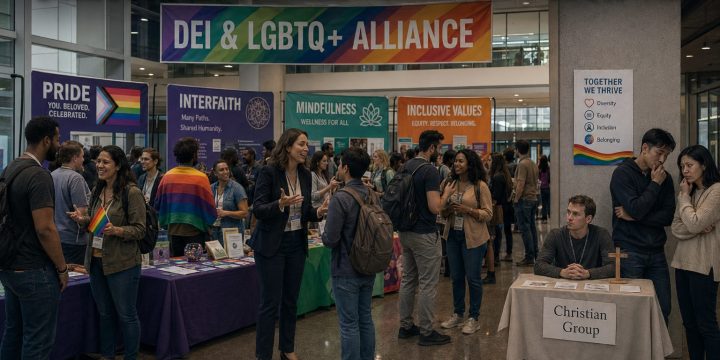
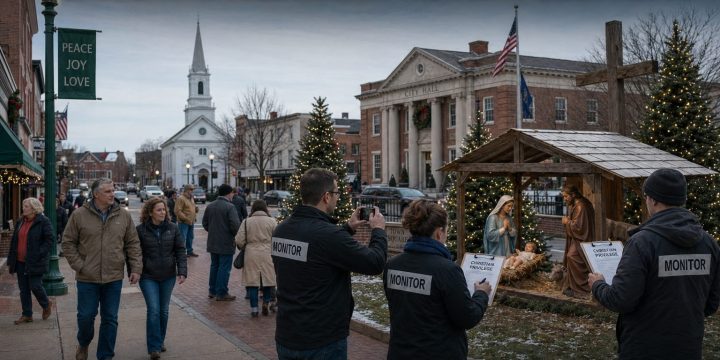
Christian Privilege and the New Inclusion Paradox The modern critique of Christian Privilege usually borrows the language of diversity, equity, and inclusion. It presents itself as a moral correction to an older America in which Christianity supposedly occupied too much public space, enjoyed too much automatic deference, and imposed too many assumptions on everyone else. The pitch is simple: if society becomes more alert to Christian Privilege, public institutions will become more welcoming to all. But the reality is often the opposite. Once Christian Privilege becomes the lens through which institutions interpret Christian presence, Christianity is no longer treated as one form of diversity among many. It becomes the embarrassing exception to diversity—the kind of identity institutions are willing to “include” only after it has been translated, softened, or made politically harmless. That is the…
Fulfilled prophecy stands as one of the most intellectually compelling pillars of the Christian apologetic case. Unlike the vague, adjustable pronouncements of pagan oracles or the generalized moral exhortations of competing religious traditions, biblical prophecy is specific, dated, geographically anchored, and verifiable against independent historical records. The Hebrew prophets named cities, rulers, priestly actions, betrayal prices, geographic birthplaces, and the manner of a coming Messiah's death — centuries before those events occurred. When those details converge with stunning precision in the life, ministry, death, and resurrection of Jesus of Nazareth, the apologetic force is difficult to dismiss as coincidence. As the prophet Isaiah records, God Himself challenges His opponents with this very test: "Remember the former things long past, for I am God, and there is no other; I am God,…
Christian Privilege and the Pathologizing of Normal Culture One of the most revealing weaknesses in the rhetoric around Christian Privilege is its tendency to treat ordinary cultural familiarity as if it were moral aggression. The argument often begins with a list of examples meant to prove that Christians enjoy unearned social advantages: Christmas is widely recognized, public life contains Christian symbols, strangers assume some biblical literacy, and institutions often understand Christian holidays or practices more readily than minority faith traditions. Those observations are not always false. In a country shaped for centuries by Christianity, of course Christian language and customs have been widely legible. But the anti-Christian Privilege framework makes a crucial mistake: it takes the ordinariness of a majority culture and treats that ordinariness itself as evidence of oppression. It confuses familiarity…
Christian Privilege and the Dream of a Neutral Winner The social criticism of Christian Privilege is often sold as a peace plan for a divided nation. The idea is straightforward enough: if Christianity loses its special status in public life—its assumed moral authority, cultural familiarity, and institutional influence—then the public square will become fairer, calmer, and less tribal. A single dominant identity will no longer overshadow everyone else. The temperature will drop. But this is one of the most dangerous illusions in modern public life. If the strongest version of the anti-Christian Privilege project were implemented, it would not produce neutrality. It would produce a new race for official status. Once public Christianity is framed as a problem to be contained, every other moral and political faction learns the same lesson: survival requires…
If Christian Scriptures Are True, Don't Christians Deserve Privilege? The controlling thesis of this article is straightforward: if the Christian Scriptures are true, then the central moral and political objections to Christian privilege lose much of their force, because a society is not acting irrationally or unjustly when it gives public honor, legal deference, or cultural preference to what is in fact true and good. That claim does not settle every prudential or constitutional question, and it does not justify cruelty, coercion, hypocrisy, or civil disabilities for dissenters. It does mean, however, that the modern critique of “Christian privilege” usually depends on a prior assumption that Christianity is merely one identity option among many and not the true account of God, man, sin, redemption, and public morality. ... Read More Below…
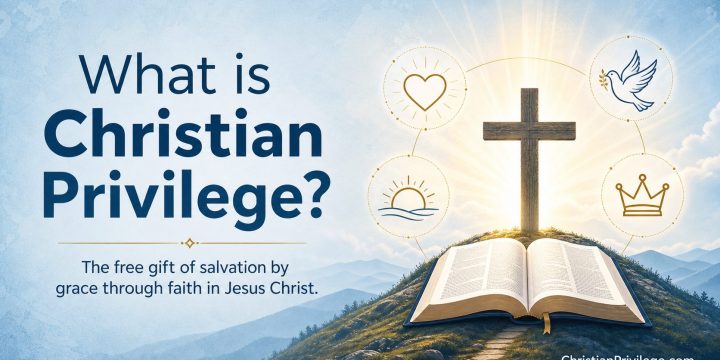
Christian Privilege, rightly understood through the lens of Scripture, is not a social construct or a cultural status symbol — it is a divine endowment. It is the extraordinary, unmerited standing granted to every believer in Jesus Christ by virtue of God's sovereign plan of salvation. This privilege originates not in human achievement, cultural dominance, or institutional power, but in the eternal will of God — a will that was set before the foundation of the world, progressively revealed through covenants and prophecy, definitively accomplished in the life, death, and resurrection of Jesus Christ, and now freely offered to every soul who believes. The pages that follow trace this great privilege from its primordial promise in the Garden of Eden through its prophetic unfolding in the Hebrew Scriptures, its magnificent…
CHRISTIANS HAVE THE PRIVILEGE OF EXPERIENCING AMAZING FREEDOM FROM GUILT AND REGRET. THEY SLEEP WELL. THEY SMILE. THEY ARE AT PEACE. HAVE HOPE - HAVE CHRISTIAN PRIVILEGE People say there is no freedom in a religion that restricts your behaviors, yet in their “freedom,” they have become slaves to guilt, regret and the consequences of their actions. They’ve hurt people with their selfishness and they know it’s wrong. They don’t sleep. They don’t have peace. They don’t have hope. There is a heaviness on their lives. But you can have hope. I was in the Mountain Phase of Ranger School when I prayed. I didn’t know God, but I knew I was at the end of my strength and God was the only place I could think to turn. Sitting…