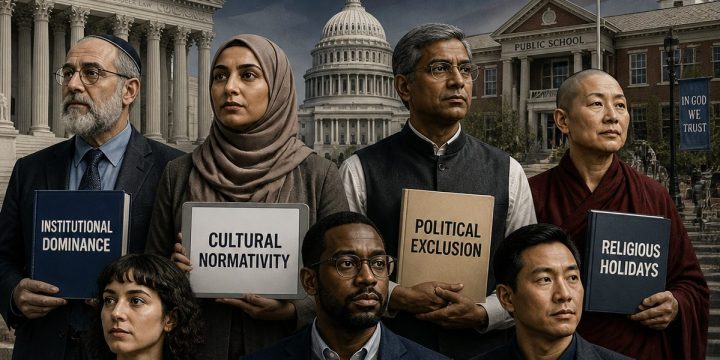
Christian Privilege and the Demand to Keep the Fruit but Cut the Tree One of the strangest features of the critique of Christian Privilege is that it often condemns Christianity as a source of public influence while continuing to rely on moral ideas that Christianity helped popularize, stabilize, and defend. The argument operates like someone denouncing a power plant while insisting the lights must remain on. Christianity is accused of excessive cultural inheritance at the very moment its critics continue spending the inheritance. That contradiction is not minor. It sits at the center of the entire debate. Modern critics of Christian Privilege regularly appeal to universal human worth, moral equality, concern for the vulnerable, conscience rights, and the duty to challenge domination. But those are not morally self-generating ideas. They came to the modern…
Christian Privilege and the Pathologizing of Normal Culture One of the most revealing weaknesses in the rhetoric around Christian Privilege is its tendency to treat ordinary cultural familiarity as if it were moral aggression. The argument often begins with a list of examples meant to prove that Christians enjoy unearned social advantages: Christmas is widely recognized, public life contains Christian symbols, strangers assume some biblical literacy, and institutions often understand Christian holidays or practices more readily than minority faith traditions. Those observations are not always false. In a country shaped for centuries by Christianity, of course Christian language and customs have been widely legible. But the anti-Christian Privilege framework makes a crucial mistake: it takes the ordinariness of a majority culture and treats that ordinariness itself as evidence of oppression. It confuses familiarity…
Christian Privilege and the Dream of a Neutral Winner The social criticism of Christian Privilege is often sold as a peace plan for a divided nation. The idea is straightforward enough: if Christianity loses its special status in public life—its assumed moral authority, cultural familiarity, and institutional influence—then the public square will become fairer, calmer, and less tribal. A single dominant identity will no longer overshadow everyone else. The temperature will drop. But this is one of the most dangerous illusions in modern public life. If the strongest version of the anti-Christian Privilege project were implemented, it would not produce neutrality. It would produce a new race for official status. Once public Christianity is framed as a problem to be contained, every other moral and political faction learns the same lesson: survival requires…
The controlling thesis of this article is straightforward: if the Christian Scriptures are true, then the central moral and political objections to Christian privilege lose much of their force, because a society is not acting irrationally or unjustly when it gives public honor, legal deference, or cultural preference to what is in fact true and good. That claim does not settle every prudential or constitutional question, and it does not justify cruelty, coercion, hypocrisy, or civil disabilities for dissenters. It does mean, however, that the modern critique of “Christian privilege” usually depends on a prior assumption that Christianity is merely one identity option among many and not the true account of God, man, sin, redemption, and public morality. That is why the order of argument matters. Critics of Christian privilege in America…
Christian Privilege and the Fantasy of Perfect Balance The criticism of Christian Privilege usually presents itself as a demand for fairness. The claim is that Christians, by virtue of numbers and history, enjoy disproportionate influence in law, culture, and institutions, and that justice requires “balancing” this influence so no tradition dominates. On the surface, this sounds like a simple matter of equity—just adjust the dials until every group’s social footprint matches its demographic size. That picture is a fantasy. Influence in a free society is not a resource that can be rationed by a central accountant. It emerges from millions of voluntary decisions: where people worship, which schools they found, what causes they fund, which books they write, how they vote, which charities they build, and how deeply their convictions shape their…
If Christian Scriptures Are True, Don't Christians Deserve Privilege? The controlling thesis of this article is straightforward: if the Christian Scriptures are true, then the central moral and political objections to Christian privilege lose much of their force, because a society is not acting irrationally or unjustly when it gives public honor, legal deference, or cultural preference to what is in fact true and good. That claim does not settle every prudential or constitutional question, and it does not justify cruelty, coercion, hypocrisy, or civil disabilities for dissenters. It does mean, however, that the modern critique of “Christian privilege” usually depends on a prior assumption that Christianity is merely one identity option among many and not the true account of God, man, sin, redemption, and public morality. ... Read More Below…
Christian Privilege and the Strange Logic of the New Orthodoxy The modern critique of Christian Privilege presents itself as a campaign for neutrality, fairness, and a truly inclusive public square. But when you follow its logic to the end, it does not create neutrality at all. It creates a new orthodoxy—one that does not merely ask Christianity to share space, but demands that Christianity surrender moral legitimacy whenever it enters public life. That is the irony at the center of the Christian Privilege debate. A theory that claims to oppose cultural domination often smuggles in its own preferred creed: religion is acceptable only when privatized, muted, and stripped of its power to shape common life. Christianity may be tolerated as a personal hobby, much like gardening or knitting, but the moment it informs…
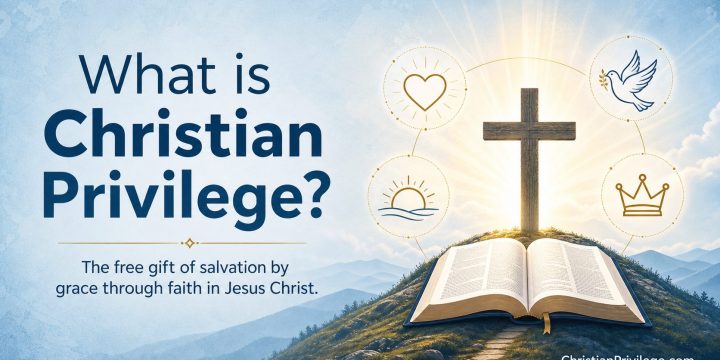
Christian Privilege, rightly understood through the lens of Scripture, is not a social construct or a cultural status symbol — it is a divine endowment. It is the extraordinary, unmerited standing granted to every believer in Jesus Christ by virtue of God's sovereign plan of salvation. This privilege originates not in human achievement, cultural dominance, or institutional power, but in the eternal will of God — a will that was set before the foundation of the world, progressively revealed through covenants and prophecy, definitively accomplished in the life, death, and resurrection of Jesus Christ, and now freely offered to every soul who believes. The pages that follow trace this great privilege from its primordial promise in the Garden of Eden through its prophetic unfolding in the Hebrew Scriptures, its magnificent…
Major Criticisms of Christian Privilege in America A Scholarly Survey of the Principal Critiques See Responses to Critics of “Christian Privilege” in America Introduction The concept of "Christian privilege" refers to the social, cultural, legal, and institutional advantages that accrue to Christians in American society by virtue of their status as the dominant religious majority. First formally named in the academic literature by Lewis Z. Schlosser in 2003, the concept has since been elaborated by sociologists, education scholars, legal critics, psychologists, and civil liberties advocates. The following report catalogs the major criticisms of Christian privilege in America, presenting each critique in the words of its most prominent scholarly and activist voices. No attempt is made here to refute or qualify these critiques; they are presented to speak for themselves. …