The debate over “Christian privilege” ultimately hinges not on sociology but on truth. If the Christian Scriptures are merely the cultural product of an ancient Mediterranean world — composed long after the events they describe, corrupted through centuries of careless copying, and disconnected from verifiable history — then their claim to public theological and moral authority is fragile at best. But if the biblical documents have been transmitted with extraordinary fidelity, confirmed repeatedly by archaeology, corroborated by hostile external witnesses, and anchored in datable, recoverable history, then treating them as “just another religious narrative” is not critical neutrality but intellectual evasion.
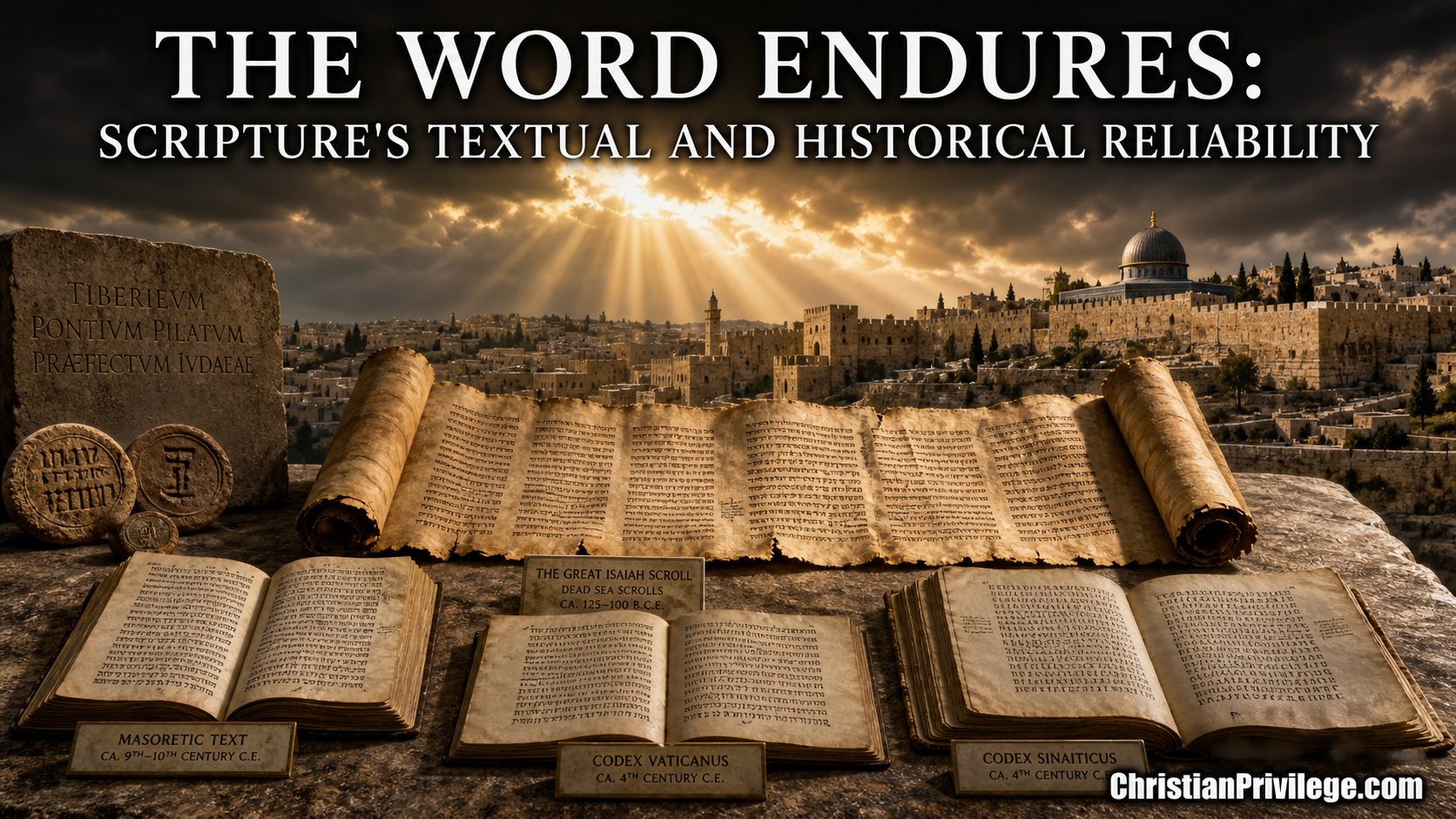
Point 10 of the Christian apologetic case is precisely this: Scripture is textually and historically reliable enough to bear theological weight. This is not a claim that every transmission detail is perfect or that every historical question has been resolved. It is the calibrated, evidentially grounded claim that the biblical documents — the New Testament Gospels and Epistles, and the Old Testament Hebrew texts — come to us through a manuscript tradition of unparalleled abundance and fidelity, are rooted in real history, confirmed by archaeology, and corroborated by non-Christian ancient sources. That claim, if sustained, transforms the entire conversation about Christian privilege: the public weight Christianity carries is not a relic of social power but the recognition of documented, testable truth.
“All Scripture is inspired by God and profitable for teaching, for reproof, for correction, for training in righteousness; so that the man of God may be adequate, equipped for every good work.”
— 2 Timothy 3:16–17 (NASB 1995)
Christian Privilege and the Prior Question of Reliability
Before engaging the manuscript evidence, it is worth pausing on why textual reliability matters to the Christian privilege debate at all. Critics such as Eric Schlosser, Warren Blumenfeld, and Khyati Joshi argue that Christian norms enjoy unearned institutional advantages in American life — in school calendars, civic rhetoric, legal frameworks, and moral assumptions. Their criticism draws its moral force from the implicit premise that Christianity is one identity option among many, with no stronger claim to public truth than any other.
But that premise is precisely what is under examination. If the documents on which Christianity is founded are reliably transmitted, archaeologically confirmed, and historically credible, then Christian influence in public life is not simply majority-culture inertia. It is the downstream effect of engaging with a text that records real events, real figures, and real claims about God. The question of privilege, rightly understood, cannot be separated from the question of textual and historical substance.
The Bibliographic Test and the Manuscript Abundance Advantage
Historians apply a standard set of tests to any ancient document. The bibliographic test — examining how well-attested a work is in its manuscript tradition — is the first and foundational criterion. By every measurable standard, the New Testament is the best-attested document from the ancient world.
There are now more than 5,856 known Greek manuscripts of the New Testament, with a total manuscript count (including Latin Vulgate, Coptic, Armenian, Syriac, and other versions) exceeding 23,986 copies. No other work from antiquity approaches this number. Homer’s Iliad, the next-best-attested ancient text, survives in fewer than 2,000 manuscripts. The works of Tacitus, Pliny, Herodotus, and Julius Caesar survive in handfuls of copies each — yet no serious historian dismisses their reliability on that basis.
As the distinguished classical scholar and textual critic F.F. Bruce concluded in his landmark study:
“There is no body of ancient literature in the world which enjoys such a wealth of good textual attestation as the New Testament. The evidence for our New Testament writings is ever so much greater than the evidence for many writings of classical writers, the authenticity of which no one dreams of questioning.”
— F.F. Bruce, The New Testament Documents: Are They Reliable?
Bruce writes as a historian, not a theologian — his concern is not theological authority but historical credibility. His conclusion stands: the manuscript tradition of the New Testament is categorically superior to that of any comparable ancient text.
The Interval Problem Resolved
A key concern in manuscript studies is the time gap between original composition and the earliest surviving copy. For most ancient works, this gap spans centuries — Tacitus’s Annals is known from a manuscript over 800 years after its composition; Plato’s Tetralogies from over 1,200 years after. For the New Testament, the gap is extraordinarily compressed.
The Rylands Library Papyrus P52, a fragment of John’s Gospel, is generally accepted as the earliest extant canonical New Testament text, dated to approximately 125–160 CE — within roughly a generation of the Gospel’s composition. Broader manuscript finds, including the Chester Beatty Papyri and the Bodmer Papyri, place substantial portions of the New Testament within 150–200 years of their original authorship.
Sir Frederic Kenyon, longtime Director and Principal Librarian of the British Museum and one of the foremost authorities on ancient manuscripts of his era, rendered this judgment:
“The interval then between the date of original composition and the earliest extant evidence becomes so small to be in fact negligible, and the last foundation for any doubt that the Scriptures have come down to us substantially as they were written has now been removed. Both the authenticity and the general integrity of the books of the New Testament may be regarded as finally established.”
— Sir Frederic Kenyon
Christian Privilege in the Manuscript Tradition: What the Numbers Mean
The sheer numerical advantage of the New Testament manuscript tradition is more than a statistical curiosity — it carries profound implications for Christian privilege. When critics argue that Christian texts should be treated as one cultural expression among many, they ignore a fundamental asymmetry: no other sacred text of a world religion has been transmitted with the manuscript density, geographic breadth, and chronological compression of the New Testament.
The Codex Sinaiticus and Codex Vaticanus — fourth-century uncial manuscripts — contain nearly complete Greek Bibles and are among the most important textual witnesses in the world. Together with hundreds of papyrus fragments, thousands of later minuscule manuscripts, and tens of thousands of New Testament quotations in the writings of the early church fathers, scholars possess what amounts to a massive cross-referencing apparatus for recovering the original text.
Even the most prominent skeptic of New Testament textual integrity, Bart Ehrman, when speaking in academic settings rather than to popular audiences, has acknowledged that none of the essential Christian doctrines are at stake in textual variants:
“I don’t think that any theologian or any Christian believer is going to have any of their major beliefs change because of textual variants in the New Testament… since Christians don’t make their doctrines based on a single word or a single verse.”
— Bart Ehrman
This is a remarkable concession from Christianity’s most celebrated textual skeptic. Ehrman’s popular work Misquoting Jesus emphasizes variant readings, but his scholarly admission is that those variants carry zero bearing on essential Christian doctrines. In short, the theological weight that Scripture bears is not undermined by the textual variants that exist — by Ehrman’s own reckoning.
As the evangelical scholar Daniel Wallace has noted, the approximately 400,000 textual variants cited by critics must be understood in context: the vast majority involve spelling differences, word order variations, and minor scribal corrections. The nature, not merely the number, of variants is what matters — and by that standard, the New Testament’s substantive content is recoverable with extraordinary confidence.
The Old Testament and the Dead Sea Scrolls: A Thousand-Year Confirmation
The manuscript argument for the Old Testament received its most dramatic confirmation in 1947 when Bedouin shepherds discovered ancient scrolls in the caves of Qumran near the Dead Sea. The Dead Sea Scrolls (DSS), unearthed between 1947 and 1956, contain fragments of every book of the Hebrew Bible except Esther, with many copies dating from 250 BCE to 70 CE.
Before this discovery, the oldest available Hebrew manuscript of the Old Testament was the Codex Leningradensis (1008 CE) — meaning scholars had a gap of over a millennium between the completion of the Hebrew Scriptures and their earliest complete manuscript witness. Critics routinely argued that the text had been substantially altered in transmission. The Dead Sea Scrolls obliterated that argument.
When scholars compared the DSS to the Masoretic Text that underlies modern translations, they found remarkable agreement. One Deuteronomy scroll found at Qumran (4QDeutg) was found to be letter-for-letter identical to the medieval codex — across more than a thousand years of copying. The Great Isaiah Scroll (1QIsa), dated to approximately 150 BCE, is over 95% identical to the Masoretic Text, with the variations consisting almost entirely of minor spelling differences and grammatical details that do not change meaning.
The famous fifty-third chapter of Isaiah — the “Suffering Servant” prophecy understood by Christians as pointing directly to Jesus Christ — is preserved intact and unaltered from the DSS to the Masoretic Text. This matters enormously for Christian privilege: the prophecy that Christians have cited for millennia as evidence for Jesus’s messianic identity is not the product of late post-Christian editing. It was written and carefully preserved centuries before His birth.
“Surely our griefs He Himself bore, and our sorrows He carried; yet we ourselves esteemed Him stricken, smitten of God, and afflicted. But He was pierced through for our transgressions, He was crushed for our iniquities; the chastening for our well-being fell upon Him, and by His scourging we are healed.”
— Isaiah 53:4–5 (NASB 1995)
As the Dead Sea Scrolls scholar and Christian apologist Hank Hanegraaff noted, the Isaiah Scroll demonstrates that “God has miraculously preserved His Word over time” — with seventeen textual differences found between the DSS and the Masoretic Text, of which ten were spelling variations, four matters of style, and three involved the Hebrew letters for “light.” None altered the substance of the prophecy. The Dead Sea Scrolls thus provide a powerful, archaeologically grounded refutation of the claim that the Old Testament was radically rewritten after Jesus’s time.
Christian Privilege in the Archaeological Record
The internal textual argument for reliability is reinforced and extended by external archaeological evidence. Critics of Christianity in the academy frequently treat the biblical narratives as literary constructions with tenuous historical moorings. The archaeological record tells a different story.
Nelson Glueck, one of the most distinguished Jewish archaeologists of the twentieth century, made a blunt judgment about the relationship between archaeology and Scripture:
“It may be stated categorically that no archaeological discovery has ever controverted a biblical reference. Scores of archaeological findings have been made which confirm in clear outline or in exact detail historical statements in the Bible.”
— Nelson Glueck, cited in multiple archaeological studies
This is not an isolated conservative claim. The same conclusion was voiced by Millar Burrows, Professor of Archaeology at Yale University:
“Archaeological work has unquestionably strengthened confidence in the reliability of the Scriptural record. More than one archaeologist has found his respect for the Bible increased by the experience of excavation in Palestine. Archaeology has in many cases refuted the views of modern critics.”
— Millar Burrows, Yale University
Key Archaeological Confirmations
The following represent a selection of specific finds that have confirmed details once questioned by skeptical critics:
-
The Pilate Stone (1961): Found at Caesarea Maritima, this inscription reads “Pontius Pilatus, Prefect of Judea” — confirming the precise title and identity of the Roman official who oversaw Jesus’s crucifixion (Matthew 27:2; Luke 3:1), which had been questioned by scholars who argued Pilate was a later legendary figure.
-
Nazareth (2009): British-Israeli archaeologist Yardenna Alexandre announced the first archaeological proof of a first-century home in Nazareth — confirming Jesus’s hometown (Luke 4:16), which skeptics had claimed did not exist during His lifetime.
-
Crucifixion Evidence (1968): Until 1968, some scholars argued crucifixion victims were tied rather than nailed, and that the Gospels’ nailing accounts were legendary. Archaeologist Vassilios Tzaferis found a first-century crucifixion victim in Jerusalem with a nail driven through his heel bone, confirming the mode of death described in Scripture.
-
Peter’s House in Capernaum (1968/1981): A church built over a first-century house in Capernaum — believed to be the house of Peter — was found in 1968, and beneath the synagogue where Jesus preached (Luke 4:31–36), a first-century basalt building was discovered in 1981.
-
The Pool of Bethesda and Pool of Siloam: Both pools mentioned in the Gospel of John were dismissed as legendary by higher-critical scholars. Excavations confirmed both pools exactly as John describes them — the Pool of Bethesda with five porticoes (John 5:2) and the Pool of Siloam (John 9:7).
Luke and Acts: The Christian Privilege of Precision
Perhaps the most striking archaeological vindication of any New Testament author belongs to Luke, the author of the third Gospel and the Acts of the Apostles. Sir William Ramsay, one of the greatest archaeologists of the nineteenth and twentieth centuries, began his research into Luke with the German critical consensus firmly in mind — namely, that Acts was a second-century document composed too late to be trustworthy for first-century details.
After decades of fieldwork throughout Asia Minor, Ramsay was compelled to reverse his judgment entirely. He wrote:
“Luke is a historian of the first rank; not merely are his statements of fact trustworthy… this author should be placed along with the very greatest of historians.”
— Sir William Ramsay, after 30 years of archaeological study
The reason for Ramsay’s conversion was not faith but evidence. Luke accurately named 32 countries, 54 cities, and 9 islands, without a single factual error — a precision that only a first-century author with direct access to those settings could achieve. Luke accurately named the precise political titles of regional rulers — titles that varied from city to city and era to era — in ways that were unknown to nineteenth-century scholars but confirmed by later inscriptions. The title praetor for Philippian magistrates, long dismissed as an error, was confirmed by archaeological discovery.
In every instance where archaeological corroboration has been found, Luke has been vindicated. The Christian apologetic implication is clear: Luke’s precision is not that of a literary romancer constructing theological legend. It is the precision of an eyewitness-era historian writing from first-hand knowledge and primary sources.
Non-Christian Corroboration: When Enemies Confirm the Record
The bibliographic and archaeological evidence for Scripture’s reliability is further strengthened by external non-Christian sources that corroborate core biblical claims — without any theological motive to do so. Two sources are primary: Tacitus and Josephus.
Tacitus, the Roman senator and historian writing the Annals circa 115–116 CE, recorded:
“Christus, from whom the name had its origin, suffered the extreme penalty during the reign of Tiberius at the hands of one of our procurators, Pontius Pilatus.”
Tacitus was hostile to Christianity, describing it as a “destructive superstition.” That hostility is precisely what makes his testimony so valuable: a Roman senator who disliked Christians and disliked their founder had no motive to fabricate Jesus’s existence or His crucifixion under Pontius Pilate — yet he confirms both.
Flavius Josephus, the first-century Jewish historian, provides two references. His shorter reference in Antiquities 20 describes James as “the brother of Jesus who was called Christ” — a passage widely accepted as authentic by mainstream scholarship. Even Bart Ehrman, who argues that the longer Testimonium Flavianum in Antiquities 18 was partially edited by later Christian scribes, affirms:
“He [Jesus] certainly existed, as virtually every competent scholar of antiquity, Christian or non-Christian, agrees.”
— Bart Ehrman
Scholars have identified at least 12 independent sources from 5 authors who attest to Jesus within a century of His crucifixion — a depth of attestation that dwarfs the evidence for virtually any other named individual from first-century Galilee.
Challenging the Critics: Where Alternative Explanations Fail
The “Corrupted Text” Fallacy
The most popular secular challenge to scriptural reliability is the claim popularized by Ehrman’s Misquoting Jesus: that the New Testament has been so heavily revised through scribal copying that we cannot know what the original authors wrote. This argument is rhetorically powerful but academically overstated.
As a critical analysis of Ehrman’s methodology notes, when addressing scholarly audiences, Ehrman “affirms the essential reliability of the Alexandrian textual tradition, especially P75 and Codex Vaticanus, recognizing their remarkable agreement and value in reconstructing the original text.” The “400,000 variants” claim, which drives popular skepticism, is contextually stripped: the overwhelming majority are orthographic differences, itacisms (vowel-sound interchanges), and minor word-order variations that change nothing in meaning. Ehrman himself acknowledged that essential Christian doctrines are not at stake.
F.F. Bruce’s summary remains definitive: “The variant readings about which any doubt remains among textual critics of the New Testament affect no material question of historic fact or of Christian faith and practice.”
The “Late Composition” Fallacy
A second major challenge is that the Gospels were written so late after Jesus’s life — 30 to 70 years — as to represent legend rather than history. This argument has been substantially undercut on multiple fronts.
First, the letters of Paul — universally accepted as authentic even by liberal critics — were written within 20 years of the crucifixion and contain creeds (such as 1 Corinthians 15:3–8) that scholars date to within 3–5 years of the resurrection, representing firsthand eyewitness tradition. Paul personally interacted with James the brother of Jesus and Peter, eyewitnesses to Christ’s ministry.
Second, the archaeological precision of Luke (see above) and the early manuscript attestation of John (P52 dating to within a generation of the apostle’s death) directly contradict the second-century composition theory. Craig Blomberg’s comprehensive study The Historical Reliability of the Gospels demonstrates that “over the past twenty years, the case for the historical trustworthiness of the Gospels has grown vastly stronger.”
The “Inerrancy Is Impossible” Fallacy
A more theologically sophisticated challenge comes from scholars like Peter Enns, who argues that “inerrancy, however defined, does not describe what the Bible does” — that the diversity of Scripture’s literary forms, cultural embeddedness, and surface tensions make inerrancy an unfair expectation.
But this argument conflates two distinct claims. Textual and historical reliability — the subject of Point 10 — does not require that every passage be newspaper-style reportage or that every chronological detail be harmonized without remainder. It requires only that the documents be substantially well-preserved and historically anchored enough to function as serious theological witnesses — which the manuscript and archaeological evidence amply demonstrates. As Bruce wrote, the transmission history of the New Testament means Scripture has come down “substantially as it was written.”
The internal hermeneutical challenges Enns raises — how to read Genesis alongside ancient Near Eastern literature, how to handle Synoptic discrepancies — are legitimate questions of interpretation. They do not undermine the foundational claim that the documents themselves have been faithfully transmitted and historically anchored.
Scripture’s Self-Testimony and Christian Privilege
Scripture does not merely survive historical scrutiny — it asserts its own divine origin and claims to bear the weight of that origin. The Apostle Paul, writing to Timothy within a generation of Jesus’s resurrection, declared:
“All Scripture is inspired by God and profitable for teaching, for reproof, for correction, for training in righteousness; so that the man of God may be adequate, equipped for every good work.”
— 2 Timothy 3:16–17 (NASB 1995)
The Greek underlying “inspired by God” is theopneustos — literally “God-breathed.” Paul is not merely claiming that Scripture is culturally useful or morally edifying. He is claiming that it carries the breath of God — that it is an extension of divine speech into human history. That claim can only be evaluated if the documents making it have been reliably transmitted and historically grounded. And they have been.
The Apostle Peter similarly affirmed:
“But know this first of all, that no prophecy of Scripture is a matter of one’s own interpretation, for no prophecy was ever made by an act of human will, but men moved by the Holy Spirit spoke from God.”
— 2 Peter 1:20–21 (NASB 1995)
And the Gospel of John, whose early manuscript attestation (P52) anchors it in history rather than legend, identifies the entire created order with the divine Word:
“In the beginning was the Word, and the Word was with God, and the Word was God… And the Word became flesh, and dwelt among us, and we saw His glory, glory as of the only begotten from the Father, full of grace and truth.”
— John 1:1, 14 (NASB 1995)
If these claims are rooted in reliable documents anchored in real history — and the evidence argues strongly that they are — then the “Christian privilege” of treating Scripture as authoritative is not cultural imperialism. It is the recognition of a historically credible, textually preserved, archaeologically confirmed record of God’s entrance into human history.
Conclusion: The Weight Scripture Can Bear
The question of scriptural reliability is not a sideline apologetic curiosity. It is the foundation on which the entire Christian worldview rests — and, consequently, the foundation on which any serious assessment of “Christian privilege” must stand.
The evidence assembled in this report demonstrates:
-
Manuscript abundance: The New Testament is attested by nearly 24,000 total manuscripts — far surpassing any comparable ancient text — with the earliest fragments dating to within a generation of composition.
-
Textual integrity: Even Christianity’s most prominent textual critic (Ehrman) acknowledges that essential doctrines are unaffected by textual variants, and that the core text is recoverable with confidence.
-
Old Testament preservation: The Dead Sea Scrolls, predating standard Masoretic manuscripts by over a millennium, confirm extraordinary fidelity in transmission, including the intact preservation of Isaiah 53.
-
Archaeological confirmation: No archaeological discovery has ever controverted a biblical reference; scores confirm specific details — from Pontius Pilate’s title to the architecture of first-century Capernaum.
-
Non-Christian corroboration: Hostile ancient witnesses — Tacitus and Josephus — independently confirm the historicity of Jesus and His execution under Pilate.
-
Scholarly vindication: Historians from Ramsay to Kenyon to Bruce, many beginning as skeptics, concluded after rigorous investigation that Scripture is historically trustworthy.
The charge that Christian privilege is merely a sociological accident of Western history cannot stand if the documents on which Christianity is founded are as historically robust as the evidence indicates. A document this well-attested, this archaeologically confirmed, and this corroborated by independent hostile sources is not a collection of pious legends. It is — by the standards applied to every other ancient text — a reliable historical witness.
And if it is a reliable witness, then its testimony about God, creation, sin, redemption, and the resurrection of Jesus Christ deserves to be taken seriously — not as one cultural preference among many, but as the Word that endures.
“The grass withers, the flower fades, but the word of our God stands forever.”
— Isaiah 40:8 (NASB 1995)