The resurrection of Jesus Christ is not merely a theological claim held by faith — it is a publicly proclaimed, historically investigated event that has withstood centuries of rigorous scholarly scrutiny. When evaluated by the same standards of evidence applied to any ancient historical question, the resurrection emerges as the most coherent explanation for a cluster of facts that even skeptical, non-Christian scholars are compelled to accept. This paper examines the historical evidence for the resurrection, the scholarly consensus across ideological lines, the failure of naturalistic alternatives, and the profound Christian Privilege of proclaiming a living Lord whose resurrection is grounded in space, time, and verifiable human testimony.
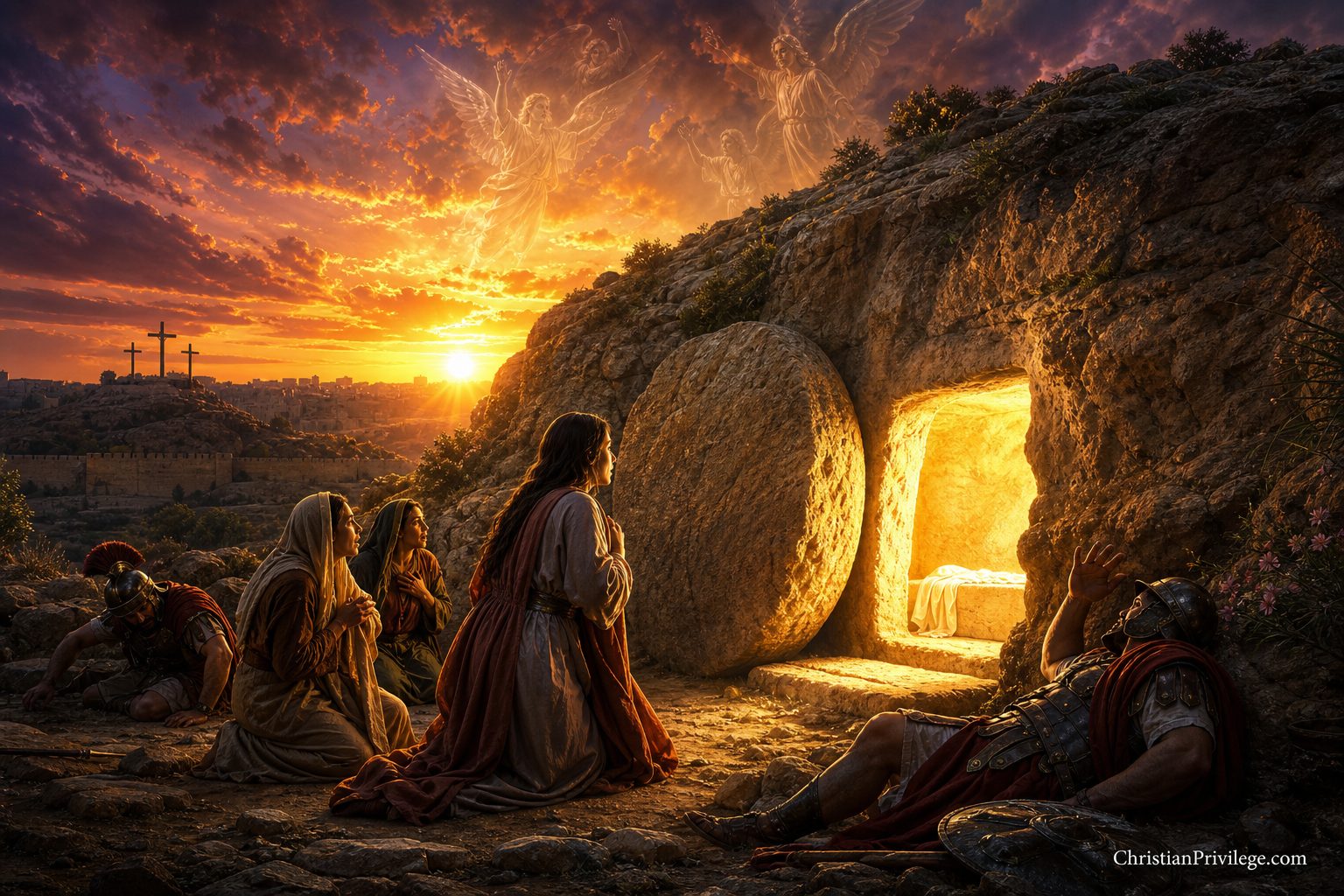
As the Apostle Paul declared in the earliest creed of the Christian faith:
“For I delivered to you as of first importance what I also received, that Christ died for our sins according to the Scriptures, and that He was buried, and that He was raised on the third day according to the Scriptures, and that He appeared to Cephas, then to the twelve. After that He appeared to more than five hundred brethren at one time, most of whom remain until now, but some have fallen asleep; then He appeared to James, then to all the apostles; and last of all, as to one untimely born, He appeared to me also.”
— 1 Corinthians 15:3–8, NASB 1995
Christian Privilege and the Living Lord
Christianity makes a claim no other major world religion dares to make in the same way: its founder was publicly executed and then bodily raised from the dead, verifiably, within living memory of thousands of witnesses. If this is true, Christians do not merely possess a cultural tradition or a philosophical preference — they possess the most transformative truth in human history. The Christian Privilege of proclaiming “He is risen” is not a sociological accident; it is the logical consequence of an empty tomb.
The entire structure of Christian ethics, Christian public influence, and Christian authority in society rests on this single event. Paul himself makes the stakes explicit in 1 Corinthians 15:17 (NASB 1995): “and if Christ has not been raised, your faith is worthless; you are still in your sins.” The resurrection is not one doctrine among many — it is the keystone of the entire Christian worldview, and therefore any honest evaluation of Christian privilege in public life must first grapple with whether the resurrection actually happened.
The Foundation of Christian Privilege: The Earliest Historical Record
The 1 Corinthians 15 Creed — Within Years of the Cross
The single most important historical document for the resurrection is not found in archaeology or Roman records — it is embedded in the Apostle Paul’s first letter to the Corinthians, written approximately AD 53–57. Within that letter, in verses 3–8, Paul explicitly states that he is “delivering” something he “received” — the Greek word παραλαμβάνω (paralambanō) specifically denoting the reception of transmitted tradition, not Paul’s own composition.
Scholars across the ideological spectrum — including atheist New Testament historian Gerd Lüdemann, agnostic scholar Bart Ehrman, and skeptic Michael Goulder — date this creed to within two to five years of the crucifixion, some as early as AD 30–33. James Dunn, Professor at Durham University, wrote definitively: “This tradition, we can be entirely confident, was formulated as tradition within months of Jesus’ death.” This is not the language of legend or mythology — this is eyewitness testimony reaching back to the events themselves, preserved and transmitted with the seriousness of a legal deposition.
Paul’s connection to the creed is traceable. In Galatians 1:18, he records that three years after his conversion he went to Jerusalem for fifteen days and met with Peter — almost certainly the occasion on which he received this creed from the primary eyewitness. The chain of historical provenance is intact and verifiable.
Non-Christian Sources Confirm the Historical Scaffold
The resurrection proclamation did not arise in a historical vacuum. Before evaluating the resurrection itself, the historical scaffold must be confirmed. Cornelius Tacitus (AD 56–120), considered by classicists one of the most reliable historians of the first century, writes in his Annals (Book 15, Chapter 44) that “Christus, from whom the name had its origin, suffered the extreme penalty during the reign of Tiberius at the hands of . . . Pontius Pilatus, and a most mischievous superstition, thus checked for the moment, again broke out.” The scholarly consensus holds that Tacitus’s reference is authentic and historically valuable as an independent Roman source confirming the crucifixion.
Flavius Josephus, Pliny the Younger, and Suetonius also mention Jesus and the early Christians. The cumulative testimony of hostile witnesses confirms the factual core: Jesus was a real person, He was crucified under Pontius Pilate, and His followers immediately proclaimed His resurrection with such conviction that the movement survived and spread despite violent suppression.
The Minimal Facts: Christian Privilege on Solid Historical Ground
What Even Skeptics Cannot Deny
The most methodologically rigorous apologetic approach to the resurrection is the Minimal Facts Methodology developed by Dr. Gary Habermas, Distinguished Research Professor at Liberty University. This approach relies only on facts that meet two strict criteria: (1) the data is established by multiple, independent lines of historical argumentation; and (2) the vast majority of contemporary scholars in relevant fields — including skeptics and atheists — acknowledge the historicity of the occurrence.
Habermas has surveyed more than 3,400 academic articles authored by critical scholars over the past half-century and identified a cluster of facts granted by virtually all researchers who study the subject. These include:
-
Jesus died by crucifixion — accepted universally across all serious historical scholarship
-
Jesus’ disciples had real experiences they believed were appearances of the risen Jesus — conceded even by atheist scholars
-
The disciples were transformed to the point of willingness to die for their resurrection proclamation — evidenced by early persecution records
-
James, the skeptical half-brother of Jesus, was converted after an experience he believed was an appearance of the risen Christ
-
Paul, the active persecutor of the church, was converted after an experience he took to be an appearance of the risen Christ
-
The tomb was discovered empty
Not one of these facts requires belief in the Bible’s inspiration. Each is independently established by historical-critical method and acknowledged across ideological lines.
The Empty Tomb: Christian Privilege in the Face of Enemy Attestation
The empty tomb presents one of the strongest lines of evidence for the resurrection precisely because of who acknowledged it. Matthew 28:11–15 records that when the religious authorities learned of the resurrection proclamation, they bribed the soldiers and spread the counter-narrative that the disciples had stolen the body. This is critical: the Jewish opponents of Christianity did not claim the tomb was occupied. They conceded it was empty and tried to explain it away.
William Lane Craig at ReasonableFaith.org identifies eight independent lines of evidence supporting the empty tomb tradition, noting that the discovery of the tomb by women — rather than male disciples — argues powerfully against fabrication, since women were not regarded as reliable legal witnesses in first-century Judaism. No early Christian forger would have invented female primary witnesses unless it actually happened that way.
Furthermore, it would have been impossible for the disciples to proclaim the resurrection in Jerusalem — the very city where Jesus had been publicly buried — if the tomb were still occupied. The authorities would simply have produced the body and destroyed the movement in an afternoon. They could not do so because there was no body to produce.
The Conversion of the Skeptics: Christian Privilege Born from Evidence
Two of the most powerful pieces of evidence for the resurrection are the conversions of James and Paul — not because they were disciples who wanted to believe, but precisely because they had every reason not to.
James, the half-brother of Jesus, was a skeptic during Jesus’ ministry. The Gospel of John (7:5) records that His own brothers did not believe in Him. Yet after the crucifixion, James became the leader of the Jerusalem church and was ultimately martyred by stoning for his faith in the risen Christ. New Testament scholar Reginald Fuller — no evangelical apologist — concedes that even without Paul’s testimony in 1 Corinthians 15:7, he would still have to postulate a resurrection appearance to James to explain the transition from family skeptic to martyred church leader.
Saul of Tarsus was not merely a skeptic — he was an active, violent persecutor of Christians. No natural psychological explanation accounts for his radical transformation into the Apostle Paul, the greatest missionary in Christian history, who endured “stripes above measure, in prisons more frequently, in deaths often” (2 Corinthians 11:23, NASB 1995). Paul’s own testimony — in letters accepted as authentic even by the most skeptical New Testament scholars — is that the risen Jesus appeared to him. There is no competing naturalistic explanation for what transformed Saul from executioner to executed.
The Disciples’ Willingness to Die: Christian Privilege Sealed in Blood
The disciples were not dying for a secondhand report. They were dying for what they themselves claimed to have seen and touched and heard. As Michael Licona notes in The Resurrection of Jesus: A New Historiographical Approach: “After Jesus’ death, the disciples endured persecution, and a number of them experienced martyrdom. The strength of their conviction indicates that they were not just claiming Jesus had appeared to them after rising from the dead. They really believed it.”
People die for what they believe to be true all the time. But there is a critical distinction: the disciples were not dying for a belief passed down to them from others. They were the primary witnesses — dying for what they personally claimed to have seen. As Acts 4:20 records Peter and John declaring before the Sanhedrin: “for we cannot stop speaking about what we have seen and heard.” Men who fabricate events do not volunteer for imprisonment, torture, and martyrdom to maintain the fabrication. Liars make poor martyrs.
N.T. Wright and the Cultural Argument for Resurrection
Christian Privilege in a World That Had No Category for It
One of the most powerful historical arguments comes not from the evidence itself but from the cultural impossibility of the disciples’ specific claim. N.T. Wright, Bishop of Durham and one of the world’s leading New Testament historians, argues in his landmark work The Resurrection of the Son of God that first-century Jews had robust categories for afterlife experiences, visions of the deceased, the general resurrection at the end of the age, and even martyr vindication.
What Judaism had absolutely no category for was one individual rising bodily, in the middle of history, before the general resurrection — and being declared Messiah on that basis. Wright’s double criterion of similarity and dissimilarity demonstrates that the specific form of resurrection belief the disciples proclaimed was not available as a borrowing from existing Jewish eschatology. It required something unprecedented to explain it. The emergence of this unprecedented, culturally inconvenient, theologically disruptive belief in one man’s bodily resurrection demands an explanation that accidental legend or creative theology cannot provide.
The Failures of Alternative Theories
The Swoon Theory: Medical Impossibility
The swoon theory — that Jesus did not actually die on the cross but merely lost consciousness — has been universally discarded by biblical scholars and academics since the late nineteenth century. The medical realities of Roman crucifixion are dispositive. A man subjected to Roman flogging (which often killed victims before crucifixion), nailed to a cross for hours, pierced with a spear, pronounced dead by Roman soldiers (whose professional and legal lives depended on accurate determination of death), wrapped in burial linens, and sealed in a tomb could not have revived, unwrapped himself, rolled away the stone, overpowered the guards, and then appeared to His disciples in sufficient condition to convince them He was the triumphant Lord of Life.
As the Wikipedia article on the swoon hypothesis notes, this theory “has been discarded as baseless and unacceptable by the majority of biblical scholars and academics.” Even David Strauss — a hostile nineteenth-century critic of Christianity who himself did not believe in the resurrection — wrote that the swoon theory destroys itself: a half-dead man creeping out of a tomb would have inspired pity, not the proclamation of a victorious conqueror of death.
The Hallucination Theory: Psychological and Logical Impossibility
The hallucination theory proposes that the disciples were so emotionally traumatized by the crucifixion that they experienced mass grief-induced hallucinations of the risen Jesus. This theory fails on multiple fronts:
-
Group hallucinations do not occur. Hallucinations are individual, neurological events. The creed in 1 Corinthians 15 records an appearance to more than five hundred people at once — a mass hallucination has no parallel in the clinical literature.
-
The appearances span forty days, multiple locations, and varying group sizes. Hallucinations last seconds to minutes, not weeks, and do not recur in consistent, physically interactive form across diverse settings.
-
It cannot explain the empty tomb. Even if hallucinations could explain subjective appearance experiences, they cannot account for the missing body.
-
It cannot explain the conversions of Paul and James. Paul was not a grief-stricken disciple longing for Jesus to return. He was an active enemy of the movement. Grief hallucinations do not strike persecutors.
-
Tactile interaction cannot be hallucinated. The resurrection accounts include Jesus eating, being touched, and cooking breakfast — sensory experiences across multiple modalities that hallucinations cannot replicate at scale.
The Legend Theory: Too Little Time and Too Many Witnesses
The legend theory holds that the resurrection story grew gradually through a process of exaggeration and mythologizing over decades. This theory is destroyed by the timeline. The 1 Corinthians 15 creed, dated by even hostile scholars to within two to five years of the events, is not the product of a developing legend — it is the proclamation of specific named witnesses whose testimony could be checked. Paul explicitly invites verification: he notes that of the five hundred witnesses, “most of whom remain until now” (1 Corinthians 15:6, NASB 1995) — a remark that would have been suicidal for a fabricator writing to a community in the Mediterranean world where these witnesses were still alive and accessible.
Furthermore, the Gospel narratives do not bear the hallmarks of myth or legend. As theologian Peter Kreeft observes: “There are no overblown, spectacular, childishly exaggerated events. Nothing is arbitrary. Everything fits in. Everything is meaningful.” The accounts include theologically embarrassing details — female witnesses, disciples who doubted, a risen Lord who cooks fish — that no legend-maker would have invented.
The Stolen Body Theory: Logically Self-Defeating
The stolen body theory — that the disciples stole the body and invented the resurrection — is the oldest counter-explanation and the most self-defeating. It requires that the disciples fabricated the resurrection, then willingly submitted to imprisonment, torture, and death to maintain a known lie. As Lee Strobel notes: “The disciples didn’t merely believe in the resurrection; they knew whether it was fact or fiction. Had they known it was a lie, they would never have been willing to sacrifice their lives for it.”
Moreover, the stolen body theory concedes the empty tomb. Jewish opponents in the first century did not deny the tomb was empty — they offered an explanation for it. And the presence of a Roman guard (Matthew 27:62–66) renders theft by a small group of terrified fishermen nearly impossible.
Michael Licona’s Historiographical Case: A New Standard
Dr. Michael Licona, Associate Professor of Theology at Houston Christian University and author of The Resurrection of Jesus: A New Historiographical Approach — described as the most thorough scholarly treatment of the subject — approaches the resurrection using the standard criteria professional secular historians apply to any ancient event:
-
Explanatory scope — Does the hypothesis explain all the known data?
-
Explanatory power — Does it explain the data well?
-
Plausibility — Is it consistent with background knowledge?
-
Less ad hoc — Does it require fewer unverified assumptions?
-
Illumination — Does it illuminate other aspects of the data?
Applying these five criteria, Licona systematically evaluates five leading naturalistic hypotheses — championed by Vermes, Goulder, Lüdemann, Crossan, and Craffert — and demonstrates that each fails to account for the full range of historical data, while the bodily resurrection hypothesis satisfies all five criteria. This is not theology dressed as history; this is rigorous historiography reaching theological conclusions on the basis of evidence.
The Theological Weight of the Resurrection: Christian Privilege Vindicated
If He Rose, Everything Changes
The resurrection is not merely one evidence among many in a Christian apologetic case. It is the linchpin of the entire worldview. As Romans 1:4 (NASB 1995) declares, Jesus “was declared the Son of God with power by the resurrection from the dead.” The resurrection is God’s public vindication of Jesus’ claims about Himself — His identity as the divine Son, His authority to forgive sins, His teaching on Scripture, salvation, judgment, and eternal life.
If Jesus rose from the dead, then Christians do not merely prefer His teachings — they know them to be true. And if they are true, then so-called “Christian privilege” is not the unjust imposition of arbitrary majority culture. It is the appropriate public acknowledgment of what is actually so. The empty tomb changes everything: not merely for individual salvation, but for the entire question of whether Christian norms, Christian ethics, and Christian public influence deserve a privileged place in the ordering of society.
The Resurrection and the Hope of the World
Paul’s argument in 1 Corinthians 15:20–22 (NASB 1995) extends the resurrection beyond the historical and into the cosmic:
“But now Christ has been raised from the dead, the first fruits of those who are asleep. For since by a man came death, by a man also came the resurrection of the dead. For as in Adam all die, so also in Christ all will be made alive.”
The resurrection of Jesus is not merely a proof of His divinity — it is the first installment of a new creation. The risen Christ is not the exception to the rule of death; He is the rule-changer. Every claim Christianity makes about human dignity, the sanctity of life, the reality of moral judgment, and the ultimate triumph of justice over evil is anchored in this event.
Conclusion: Christian Privilege Is Resurrection Privilege
The historical case for the resurrection of Jesus is not a matter of blind faith or wishful thinking. It is a matter of sober historical investigation. The earliest creed, dating to within months or years of the events, was transmitted by named eyewitnesses who invited public scrutiny. Non-Christian Roman and Jewish sources confirm the historical scaffold. The empty tomb is attested by the enemy testimony of those who tried to explain it away. The conversions of James and Paul present cases of transformed enemies that no naturalistic hypothesis explains. The willingness of the disciples to die for their eyewitness testimony distinguishes their case from all secondhand martyrdom. And every competing naturalistic theory — swoon, hallucination, legend, stolen body — fails to account for the totality of the evidence.
When critics of Christian privilege demand to know why Christianity should hold any privileged place in public life, the answer begins here: because the tomb is empty, because the witnesses were real, and because the risen Lord is not a metaphor. The Christian claim is not that one tradition should be honored above others merely because it is popular or culturally embedded. The Christian claim is that God broke into history in Jesus of Nazareth, died for human sin, and rose bodily on the third day — and that this event is the most well-attested, most carefully examined, and most transformative fact in human history.
That is the ground of Christian Privilege. Not power. Not mere tradition. Not majority culture. The risen Christ.
“If you confess with your mouth Jesus as Lord, and believe in your heart that God raised Him from the dead, you will be saved.”
— Romans 10:9, NASB 1995