Christian Privilege and the Demand to Keep the Fruit but Cut the Tree
One of the strangest features of the critique of Christian Privilege is that it often condemns Christianity as a source of public influence while continuing to rely on moral ideas that Christianity helped popularize, stabilize, and defend. The argument operates like someone denouncing a power plant while insisting the lights must remain on. Christianity is accused of excessive cultural inheritance at the very moment its critics continue spending the inheritance.
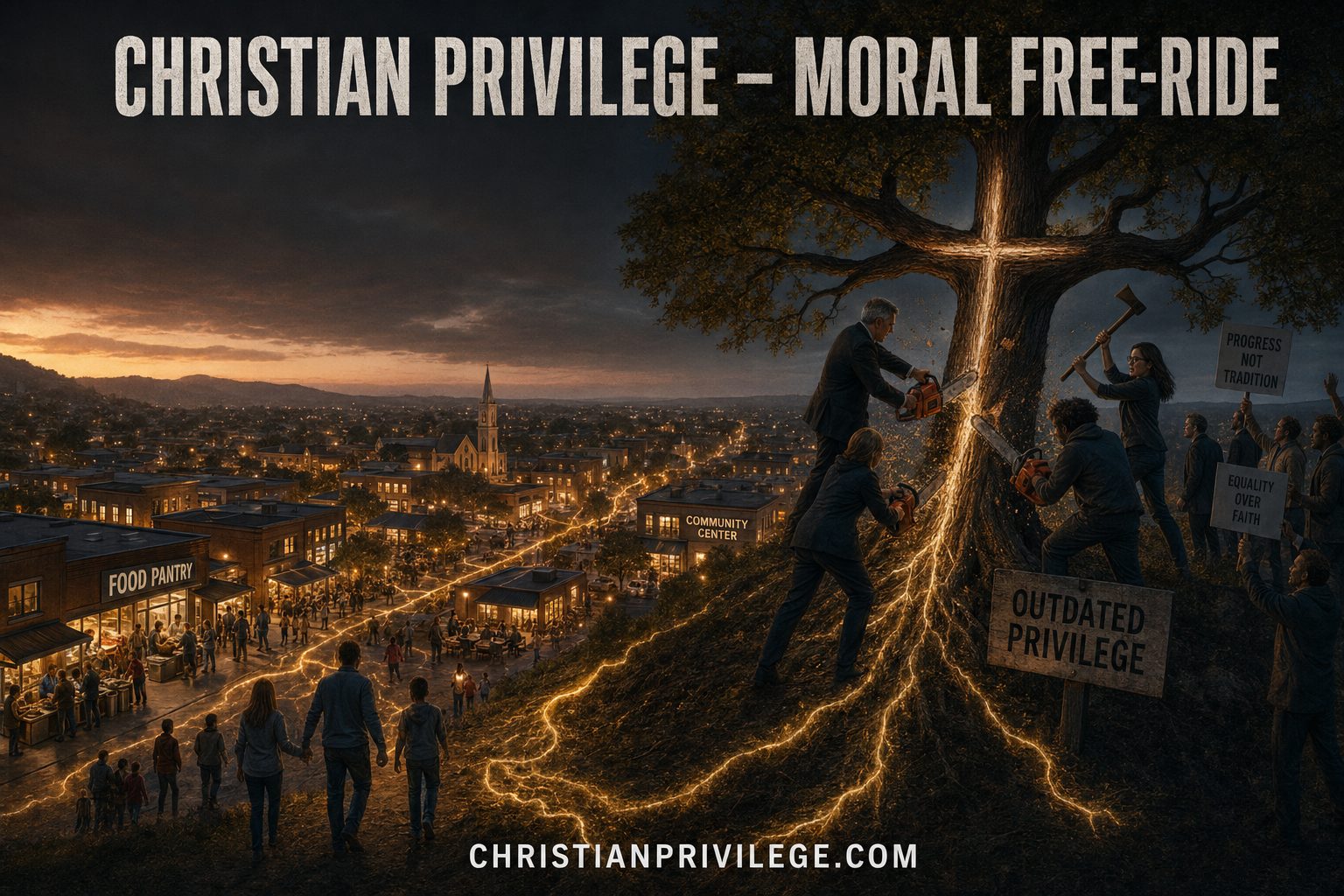
That contradiction is not minor. It sits at the center of the entire debate. Modern critics of Christian Privilege regularly appeal to universal human worth, moral equality, concern for the vulnerable, conscience rights, and the duty to challenge domination. But those are not morally self-generating ideas. They came to the modern West through a long history in which Christian teaching played an enormous role in reshaping what counted as a person, why persons mattered, and why the weak deserved protection rather than disposal.
This is the free-rider problem. The anti-Christian Privilege argument wants continued access to Christian moral capital while simultaneously insisting the source of that capital should lose legitimacy in public life. It wants the fruit while condemning the tree as a public nuisance.
Christian Privilege and the Origins of Human Dignity
The language of “human dignity” now sounds so normal that many people assume it must have always existed in roughly its modern meaning. But several historical accounts argue that the modern, egalitarian sense of dignity was profoundly shaped by Christian theology. The Center for Bioethics & Human Dignity states that the impact of Christianity on the concept is “unmistakable,” especially in transforming dignity from a comparative status possessed more fully by elites into a non-comparative dignity grounded in the idea that all humans bear the image of God.
That shift matters enormously. In older pagan frameworks, dignity was often hierarchical, attached to rank, virtue, citizenship, or honor. Christianity radicalized the concept by tying worth not to achievement or class, but to personhood itself. Church Life Journal summarized this transformation bluntly in its title: “Human Dignity Was a Rarity Before Christianity.”
A critic of Christian Privilege may not like that history, but cannot simply wave it away. If public moral discourse today depends on the equal worth of persons regardless of power, usefulness, or status, then it is already standing on ground Christianity helped build. To attack Christianity’s public legitimacy while relying on those moral conclusions is not courage. It is intellectual free-riding.
Christian Privilege and the Equality Vocabulary Critics Inherit
The same contradiction appears in the modern language of equality. Critics of Christian Privilege often speak as though Christianity is mainly a force of hierarchy and exclusion, yet multiple historical arguments trace the Western universalization of equality to biblical claims about human beings as image-bearers and to Christian social teaching about the equal standing of souls before God.
An essay in Imprimis argues that the biblical conviction that humans are equal before God helped animate the rise of abolitionism and democracy, including the belief that no person has a right to rule another without consent. Another historical summary on Christian roots of human rights notes that as Christianity spread, it “created the grounds for the development of human rights” in ways not found in classical antiquity’s understanding of dignity. These are contestable historical judgments in some respects, but they point to a reality the anti-Christian Privilege framework tries hard not to see: equality language did not descend from the clouds.
This does not mean Christians have always lived up to Christian equality. Obviously they have not. The point is more basic. The moral vocabulary used to accuse Christianity of harmful influence is itself partly Christian in origin. It is as if a generation inherited a house, denounced the builder as oppressive, and then demanded unlimited use of the plumbing, wiring, and load-bearing beams.
Christian Privilege and the Abolitionist Embarrassment
No historical example exposes this contradiction more clearly than abolition. America’s record on slavery includes appalling Christian hypocrisy and theological rationalization. But it also includes Christian resistance so morally forceful that any serious history of reform has to account for it.
NPR’s reporting on early American religion noted that “most of the anti-slavery preachers were Christians,” and highlighted Freeborn Garretson’s transformation after hearing Methodist teaching that convinced him he had “a greater right to all my fellow creatures than they had to me.” Imprimis likewise points to Quakers and other Christians as among the first to embrace abolitionism in principle by applying the biblical notion that human beings are equal in the eyes of God.
That creates a major embarrassment for the rhetoric of Christian Privilege. The framework wants Christianity to appear chiefly as inherited domination. But the abolitionist story shows Christianity repeatedly generating moral rebellion against domination. The same faith that some misused to defend slavery also gave others the language, courage, and metaphysical basis to condemn it. That is not a public record that fits neatly into the “privilege” box.
And once that fact is admitted, the anti-Christian Privilege argument begins to wobble. If Christianity has helped produce some of the very moral movements its critics admire, then eroding Christianity’s public credibility is not a clean act of liberation. It may be a way of weakening one of the traditions that has repeatedly taught people to confront injustice at its roots.
Christian Privilege and the Christian Impulse to Care for the Poor
The same pattern appears in the history of social reform and care for the poor. Critics of Christian Privilege often claim the social authority of Christianity should be reduced because Christian influence allegedly distorts public life. Yet much of America’s moral energy for serving the poor, reforming labor conditions, and confronting urban misery has flowed through explicitly Christian channels.
The National Humanities Center describes the Social Gospel as a movement in which socially aware Christians supported labor protections, opposed child labor, and called for reforms such as disability insurance for injured workers. More recent historical reflections on the movement emphasize that reformers were moved by Jesus’ concern for “the least of these” as they sought better conditions for laborers, immigrants, and the urban poor. Christianity has not only shaped individual charity; it has shaped arguments about what society owes the vulnerable.
Of course, critics can say Christians have not done enough, or that Christian movements were flawed, paternalistic, inconsistent, or selective. Some were. But that is different from pretending Christian moral influence has been mostly a public burden. The record shows something much more complicated and much more inconvenient for the Christian Privilege thesis: Christianity has repeatedly generated obligations toward the poor that secular institutions later inherited, repackaged, and treated as obvious.
Christian Privilege and the Trust Fund Analogy
The easiest way to understand the moral free-rider problem is through a trust fund analogy. Imagine heirs who live comfortably on an old family fortune while denouncing the people who built it as embarrassing relics. For a while, the lifestyle continues. The houses stay repaired. The accounts still yield returns. The furniture remains polished. It becomes easy to conclude the inheritance requires no replenishment because the inheritance is still being spent.
That is roughly how many critiques of Christian Privilege operate. They assume concepts like dignity, equality, mercy, and the moral priority of the weak are simply “there,” free-floating in the democratic air, requiring no sustaining worldview. Christianity may be mocked or minimized, but the moral language it nourished is treated as self-evident.
The trouble is that trust funds run down. Cultural capital does too. A society can spend inherited moral assumptions for generations after forgetting where they came from. But once those assumptions become detached from the beliefs that made them binding, they usually thin out. Equality becomes procedural rather than sacred. Dignity becomes conditional. Compassion becomes bureaucratic or performative. Rights remain loudly asserted, but increasingly untethered from obligations.
That is the natural disaster hidden inside the critique of Christian Privilege. If the source is steadily delegitimized, the supply does not remain infinite.
Christian Privilege and the Secularization of Borrowed Goods
The anti-Christian Privilege position often insists that secular societies can preserve all the best moral insights once associated with Christianity while discarding Christianity itself as a public authority. To a point, that is true. Ideas can survive translation. Institutions can continue functioning long after they have forgotten their original rationale. Moral habits can persist through inertia.
But persistence is not permanence. The Christian understanding of human worth rests on claims about creation, incarnation, neighbor-love, sin, moral accountability, and the image of God. Remove those claims, and human worth may still be affirmed, but it is no longer secured in the same way. It becomes vulnerable to other logics—utility, autonomy, power, preference, productivity, consensus. Once dignity loses its sacred grounding, it must constantly compete with efficiency and desire.
This is why the critique of Christian Privilege is not merely hostile but parasitic. It feeds on moral goods it did not invent while undermining the tradition that helped make those goods feel non-negotiable. It wants society to keep the vocabulary but abandon the metaphysics. That can work for a season. It cannot work indefinitely.
Christian Privilege and the Inconvenient Complexity of Christian Failure
At this point the obvious objection arises: Christians have often failed their own ideals. That is true, and any honest account must say so. Christian history contains complicity, cowardice, tribalism, injustice, and plain moral blindness. Slavery was defended by some Christians. Inequality was baptized by some Christians. Women were subordinated by some Christians. This is real history, not propaganda.
But that objection does not rescue the critique of Christian Privilege. If anything, it weakens it. Hypocrisy proves inconsistency, not uselessness. The fact that Christians betrayed Christian principles does not mean those principles contributed nothing good to public life. It often means the principles were morally serious enough to indict the betrayers. The abolitionists, reformers, and defenders of conscience did not usually win by abandoning Christian morality. They often won by appealing to it more faithfully.
That is precisely what makes the anti-Christian Privilege project so shallow. It sees Christian failure and assumes Christian influence itself is the disease. But often the deeper story is that Christianity gave society standards by which Christian failure could be exposed and resisted. A worldview that can judge its own corruption is not simply a power structure. It is a moral tradition with internal resources for reform.
Christian Privilege and the Danger of Burning Down Moral Infrastructure
If the modern critique of Christian Privilege were actually implemented in a serious way—if Christian moral authority were steadily discredited, Christian formation pushed to the margins, and Christian influence treated as a public problem—the result would not be a richer moral society. It would be a thinner one.
A society cannot endlessly shame one of its largest sources of moral language and still expect all the moral language to remain strong. If Christianity is reduced to a private hobby, then over time the public imagination loses a powerful grammar for repentance, mercy, solidarity, sacrifice, and the irreducible worth of persons. Other moral languages may step in, but they will not necessarily preserve those ideas in the same form or with the same force.
This is the danger of burning down moral infrastructure because some of the wiring was used badly. You may eliminate a source of frustration. You may also plunge the building into darkness.
Christian Privilege and the Better Answer
The better answer is not triumphalism. Christianity should not be flattered into immunity from criticism, and Christians should not pretend their history is spotless. But neither should society indulge the fantasy that it can continuously draw on Christian-shaped moral goods while treating Christianity itself as a socially embarrassing leftover.
A mature culture would acknowledge something more demanding: Christianity has been both sinner and schoolmaster in American life. It has sometimes betrayed its own teachings, and it has also supplied many of the teachings by which betrayal is recognized. It has sometimes aligned with power, and it has also inspired radical moral resistance to power.
That is why the rhetoric of Christian Privilege is so misleading. It wants a moral ledger with one column. History insists on two. And once both columns are visible, the critique starts to look not like a brave exposure of hidden dominance, but like a free-rider campaign against one of the deepest moral sources the society still depends on.