Christian Privilege and the New Inclusion Paradox
The modern critique of Christian Privilege usually borrows the language of diversity, equity, and inclusion. It presents itself as a moral correction to an older America in which Christianity supposedly occupied too much public space, enjoyed too much automatic deference, and imposed too many assumptions on everyone else. The pitch is simple: if society becomes more alert to Christian Privilege, public institutions will become more welcoming to all.
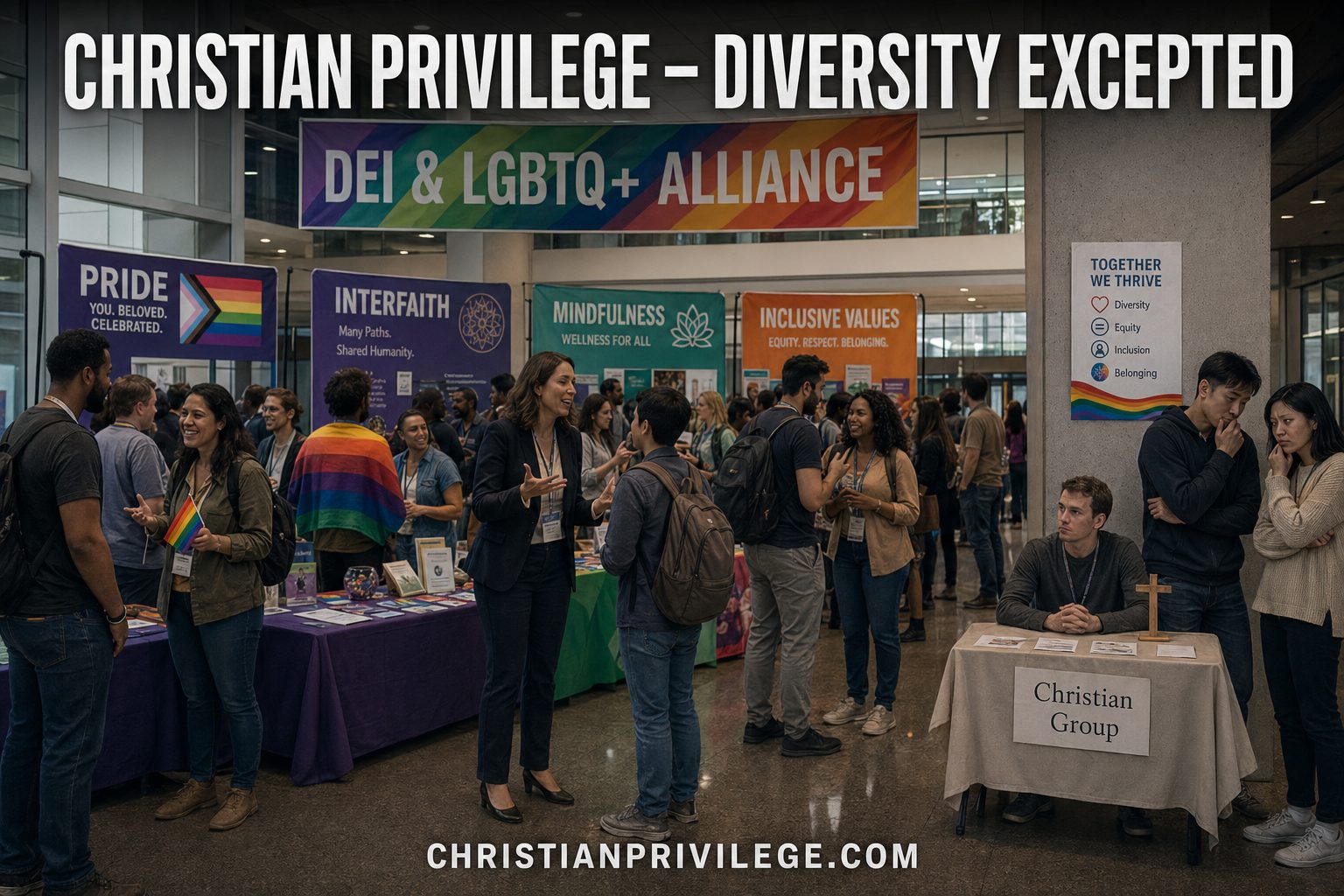
But the reality is often the opposite. Once Christian Privilege becomes the lens through which institutions interpret Christian presence, Christianity is no longer treated as one form of diversity among many. It becomes the embarrassing exception to diversity—the kind of identity institutions are willing to “include” only after it has been translated, softened, or made politically harmless.
That is the inclusion paradox at the center of the Christian Privilege argument. A framework designed to widen belonging often narrows it for the very people it names as overrepresented. Diversity becomes a banquet where every identity is invited to bring its full story—except Christians, who are told to leave their convictions at the door so everyone else can feel comfortable.
Christian Privilege and the Selective Blindness of DEI Culture
One of the clearest examples of this paradox appears in university and workplace diversity systems. Many institutional programs speak endlessly about race, gender, sexuality, ethnicity, disability, and socioeconomic background, yet religion often receives far less sustained attention as a serious axis of difference. When religion does appear, Christianity is especially likely to be treated not as a faith tradition with internal complexity, vulnerability, and social costs, but as shorthand for cultural power.
That selective blindness matters. A 2023 essay on campuses argued that “religious diversity” is one of the neglected forms of diversity that can actually bring students together across other social divides. Another commentary on academic DEI systems noted their “silence on religious diversity,” pointing out that many diversity checklists and hiring frameworks overlook religion almost entirely. In other words, institutions that congratulate themselves for nuanced theories of identity often handle religion with the crudest categories available.
This is exactly where the Christian Privilege narrative becomes dangerous. It trains institutions to see Christianity not as a living form of difference but as a historical problem to be managed. Once that attitude takes hold, Christian students, Christian faculty, Christian nonprofits, and Christian staff members become visible only as bearers of legacy dominance, not as participants in diversity.
Christian Privilege and the Suspicion Tax on Christian Identity
The cost of this framework is not usually open exclusion. It is something subtler: suspicion. Christians are welcomed so long as their Christianity does not feel too coherent, too visible, or too morally directive. A Christian employee may be celebrated for volunteer work, but viewed warily if moral convictions actually shape workplace conversations. A Christian campus group may be tolerated so long as it behaves like a generic service club rather than a community with defined beliefs and boundaries.
Research on workplace religion shows how this dynamic plays out. A 2022 study of more than 11,000 respondents found that religious discrimination is experienced differently across groups, with evangelical Protestants reporting relatively high levels of perceived discrimination compared with some other Christian groups. Rice University’s summary of that research noted that many evangelical Christians reported being viewed as “judgmental, narrow-minded and/or right wing,” and that some felt socially isolated because coworkers made assumptions about the kinds of events or conversations they would want to join.
That is what the suspicion tax looks like. It is not always formal punishment. It is the accumulated cost of being pre-categorized as a probable problem. The phrase Christian Privilege accelerates that process by telling institutions in advance how to interpret Christian seriousness: not as conviction, but as concealed dominance.
Christian Privilege and the Campus Laboratory of Exclusion
Universities are especially revealing because they speak so confidently about pluralism while often failing to practice it consistently. American campuses today contain a wide array of religious and nonreligious identities. According to an essay drawing on FIRE data from more than 55,000 undergraduates, students identify across numerous traditions, including Protestant, Catholic, “Just Christian,” Jewish, Muslim, Mormon, Buddhist, Hindu, and nonreligious categories. That religious diversity is real.
Yet the institutional handling of that diversity is often lopsided. Commentators on higher education have argued that administrators frequently underinvest in interfaith literacy and religious pluralism, even as they build elaborate frameworks for other identity questions. Faith-based groups also continue to face legal and policy conflicts over whether they can retain mission-based leadership standards while remaining fully recognized on campus.
Here the critique of Christian Privilege performs its most impressive trick. It takes groups that are plainly part of a campus’s actual diversity and rhetorically converts them into obstacles to diversity. The students who arrive with a strong Christian identity, a coherent theology, and a desire to live in public according to that theology are not treated as adding to pluralism. They are treated as testing its limits.
That is not a healthy university culture. It is a laboratory for teaching future elites that religion counts as diversity only when it is safely decorative.
Christian Privilege and the Reversal of Inclusion Logic
Inclusion is supposed to mean making room for people whose commitments, customs, and worldviews differ from the institutional mainstream. But the Christian Privilege framework quietly reverses that logic. Because Christianity has historical majority status in many parts of American life, Christians are assumed to need less protection, less understanding, and less institutional patience. Their beliefs are therefore not approached as a form of difference requiring accommodation, but as a kind of influence requiring containment.
This reversal creates absurd outcomes. The more orthodox or publicly committed a Christian is, the less likely institutional culture is to view that person as contributing to diversity. Strong Jewish or Muslim identity may be read as authentic minority difference. Strong Christian identity is more likely to be read as latent power, even when the individual Christian is numerically isolated in the room. The social meaning of identity is assigned in advance. One person’s conviction counts as vulnerable difference; another’s counts as disguised dominance.
That is why Christian Privilege is so impossible to implement fairly. It requires institutions to act as amateur historians and moral accountants, constantly adjusting present treatment according to vague judgments about past status. But human beings do not walk around as pure embodiments of historical averages. They show up as actual persons in actual rooms, often with needs and risks the theory cannot see.
Christian Privilege and the Workplace Version of Soft Exclusion
The workplace version of this problem is just as corrosive. Organizations that pride themselves on inclusion may still handle openly Christian moral identity with visible discomfort. The issue is not that Christians suffer more than every other group or in the same way as every other group. The issue is that environments committed to public moral openness often develop an unspoken rule: Christianity is welcome as heritage, service, or personal inspiration, but unwelcome as a source of serious public disagreement.
The Rice summary of workplace discrimination research shows this clearly. Christians, Jews, and Muslims all reported negative comments, stereotyping, and forms of social exclusion, though the patterns differed by group. Evangelical Christians in particular often connected discrimination to “taking an individual stand based on their moral views.” That detail is revealing. The pressure is not always against identity in the abstract. It is against identity when it becomes consequential.
This is how the social critique of Christian Privilege does its quiet damage. It teaches coworkers, managers, and institutions to interpret Christian distinctiveness not as a legitimate part of pluralism but as a warning sign. Once that lesson settles in, exclusion no longer feels like exclusion. It feels like responsible boundary maintenance.
Christian Privilege and the Moral Monopoly Hidden Inside “Fairness”
The anti-Christian Privilege framework claims to dismantle monopoly power in public life. In reality, it often creates a new monopoly: a monopoly on which forms of moral speech are considered inclusive. Secular progressive vocabularies may fill offices, classrooms, and HR documents without being accused of “privilege,” because they are treated as neutral, modern, or institutionally native. Christianity, by contrast, is marked as historically loaded and therefore morally suspect the moment it speaks too clearly.
This asymmetry is devastating for democratic culture. It means institutions are not actually becoming worldview-neutral. They are merely shifting which worldviews are treated as safe defaults. The result is a public life where Christians are told to participate, but only by translating their convictions into the dominant moral dialect. They can stay in the room if they agree to speak as though their faith is merely private sentiment.
That is not inclusion. It is assimilation with better branding.
Christian Privilege and the Social Cost of Treating Believers as Leftovers
When a society repeatedly frames Christians primarily through the lens of Christian Privilege, it eventually teaches believers that they are leftovers from a moral order elite institutions have outgrown. Their presence is tolerated but faintly embarrassing. Their convictions may be legally protected, but culturally they are treated as relics to be managed.
That message has consequences. Christians withdraw from institutions they no longer trust. Institutions become more ideologically homogenous and therefore less capable of understanding the populations they claim to serve. Public discourse grows more brittle because people with strong religious commitments learn to speak less honestly in mixed company. The supposed victory of inclusion produces more fragmentation, not less.
This is especially disastrous in a country where religion remains socially significant even amid secularization. Even commentators concerned about declining religious influence have acknowledged that religion continues to matter deeply in American public life. And more recent public opinion reporting has suggested that Americans’ views about religion’s social role have become more positive in recent years, even if opinions remain divided. A system that treats visible Christianity as a special diversity problem is therefore not just unfair. It is socially unrealistic.
Christian Privilege and the Better Meaning of Pluralism
A healthier model would begin by rejecting the lazy assumption that Christianity’s historical visibility makes present-day Christians unworthy of the same institutional curiosity and protection extended to others. Real pluralism does not flatten differences, and it does not require believers to become vague. It makes room for robust identities to coexist without demanding that one tradition bear a permanent guilt surcharge for having once been culturally central.
That means campuses should treat serious Christian groups as part of religious diversity, not as awkward exceptions to it. It means workplaces should recognize that moral disagreement rooted in faith is not evidence of social contamination. It means diversity systems that want credibility must learn how to include religion without reducing Christianity to a case study in historical overrepresentation.
The alternative is the world the critics of Christian Privilege are steadily building: a society where the language of inclusion becomes a velvet glove for excluding believers. That project is shallow because it mistakes inherited visibility for present illegitimacy. It is dangerous because it teaches institutions to distrust one of the country’s largest moral communities. And it is impossible to implement fairly because every attempt to do so ends by proving the point: the banquet was never for everyone after all.