Christian Privilege and the Pathologizing of Normal Culture
One of the most revealing weaknesses in the rhetoric around Christian Privilege is its tendency to treat ordinary cultural familiarity as if it were moral aggression. The argument often begins with a list of examples meant to prove that Christians enjoy unearned social advantages: Christmas is widely recognized, public life contains Christian symbols, strangers assume some biblical literacy, and institutions often understand Christian holidays or practices more readily than minority faith traditions.
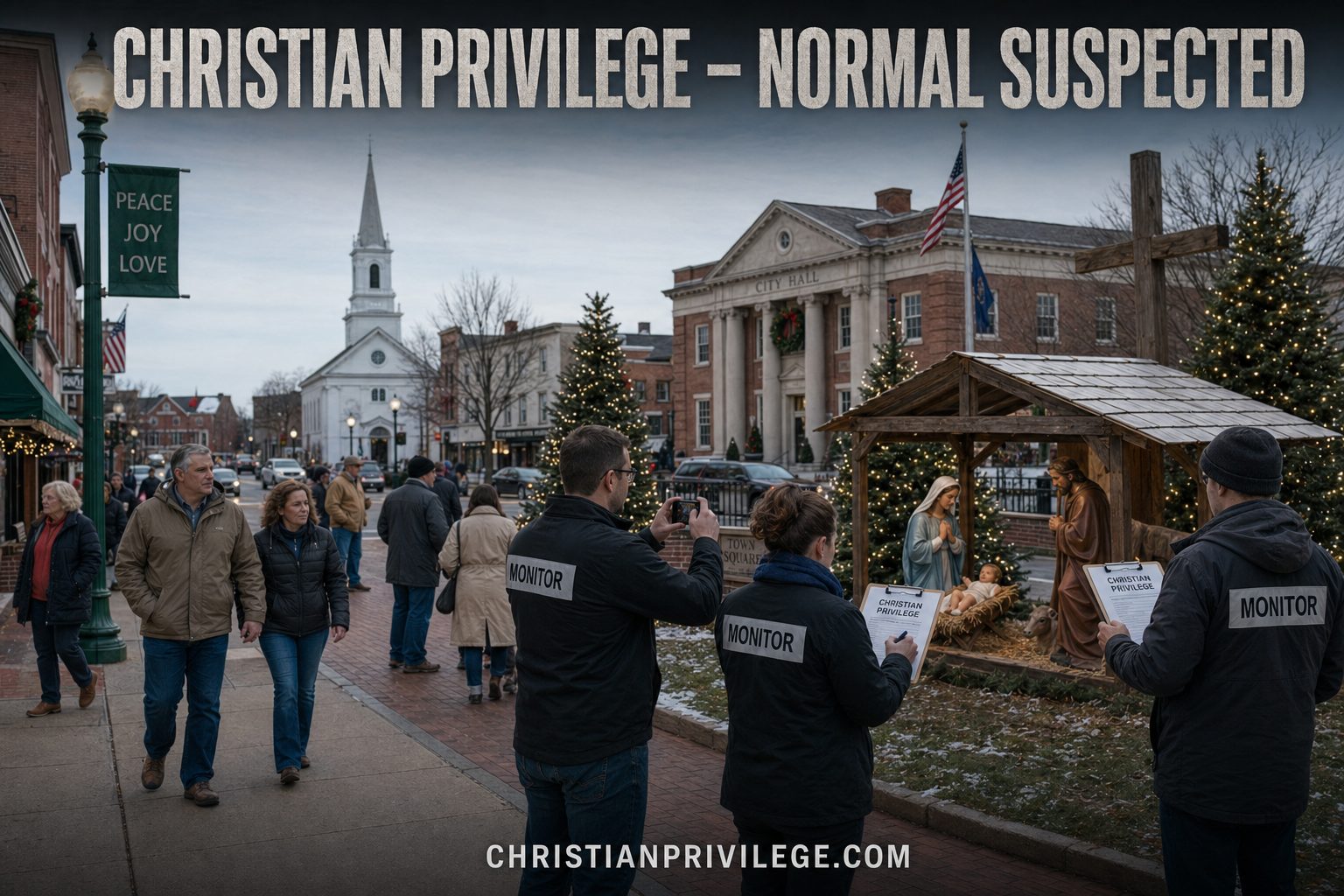
Those observations are not always false. In a country shaped for centuries by Christianity, of course Christian language and customs have been widely legible. But the anti-Christian Privilege framework makes a crucial mistake: it takes the ordinariness of a majority culture and treats that ordinariness itself as evidence of oppression. It confuses familiarity with force.
That confusion is socially poisonous. A free society needs the moral intelligence to distinguish between ordinary cultural patterns and actual coercion. When it loses that distinction, everything familiar becomes suspicious, every inherited custom looks like domination, and every trace of majority memory gets recast as a subtle act of violence. At that point, society is no longer correcting injustice. It is criminalizing normality.
Christian Privilege and the Checklist Mentality
The best-known discussions of Christian Privilege often come in the form of checklists. These lists point to things like expecting time off on Christian holidays, finding one’s holidays reflected in public decorations, assuming that most people recognize one’s sacred stories, or not being treated as threatening because of one’s religion. As descriptions of social ease, some of these points are plainly real.
The problem is not that the lists notice majority patterns. The problem is that the lists are designed to make those patterns feel morally self-condemning. A condition moves from “socially common” to “ethically suspect” simply because it advantages a majority religion in visibility or convenience. Once that framing takes hold, the very fact that Christian references are ordinary becomes the accusation.
This checklist mentality is shallow because it erases proportionality. It puts vastly different phenomena into the same rhetorical bucket: genocidal hatred and seasonal familiarity, terrorism fears and Christmas programming, employment discrimination and a coworker saying “Merry Christmas.” The category expands until it includes almost any instance in which Christian culture feels normal. And once normality itself is coded as injustice, the only cure left is disruption for its own sake.
Christian Privilege and the Gravity Problem
A useful metaphor here is gravity. Gravity is everywhere. It shapes buildings, walking, architecture, sports, and ordinary expectations. Because it is constant, people rarely notice it until something goes wrong. Now imagine a theory that treated gravity as “mass privilege” and insisted that because it benefits the heavy, society must become suspicious of every structure built with gravity in mind.
That is roughly how the Christian Privilege critique often handles majority culture. Christianity has been a major force in American history, so naturally many institutions, assumptions, and customs developed with Christian familiarity in view. The response of the checklist mentality is not to ask whether those customs are coercive, reformable, or harmless. It is to treat their ordinary presence as the problem.
But social life cannot function if all inherited normality is presumed guilty. Every society has a majority culture of some kind—linguistic, ethical, religious, regional, or historical. The mere existence of these defaults does not prove injustice. Sometimes it simply reflects demographic and historical reality. If every familiar norm is pathologized because it does not emerge from perfect procedural neutrality, then society becomes ungovernable. The accusation consumes the conditions of ordinary life.
Christian Privilege and the Inflation of Harm
This is where the rhetoric around Christian Privilege becomes not only shallow but dangerous. It inflates minor asymmetries into moral scandals while flattening the distinction between discomfort and actual repression. A society that casually recognizes Christmas may indeed be more comfortable for Christians than for others in that narrow respect. But it does not follow that such familiarity is a form of systemic abuse.
Yet the broader logic of Christian Privilege pushes relentlessly in that direction. If a public square that reflects Christian inheritance is already presumptively suspect, then ordinary experiences—holiday displays, biblical idioms, church steeples in the landscape, politicians using Christian language, schools accommodating widely observed Christian dates—can all be interpreted as proof of soft domination. The threshold for harm drops lower and lower until “I notice this tradition everywhere” becomes morally adjacent to “this tradition is oppressing me.”
That is a disastrous way to teach citizens how to live together. Pluralism requires tolerance for the fact that one will regularly encounter symbols, habits, and assumptions not one’s own. The presence of such things is not a bug in democratic life. It is what democratic life feels like when history has not been scrubbed clean.
Christian Privilege and the Panic Over Public Familiarity
The United States has long wrestled with religion in public life, and recent public opinion suggests Americans remain divided but not uniformly hostile to a visible role for religion in the public square. CNN’s summary of a recent Pew study reported that 53% of Americans expressed at least some support for cities and towns displaying religious symbols on public property, while 57% supported teacher-led prayers referencing God without specifying a religion. These are not proofs of perfect constitutional wisdom, but they do show that many Americans do not experience all public religious familiarity as oppression.
That matters because it exposes how elite critiques of Christian Privilege can be disconnected from lived social reality. Ordinary citizens often understand the difference between seeing a symbol and being coerced by it. They may disagree about where legal lines should be drawn, but they do not automatically collapse presence into persecution. The theory of Christian Privilege, by contrast, often trains people to interpret familiar Christian references as evidence that neutrality has been compromised at the deepest level.
This creates a culture of moral hypervigilance. Citizens are taught to scan ordinary public life like investigators at a crime scene, treating every inherited Christian trace as latent proof of exclusion. The result is not greater mutual understanding. It is permanent low-grade panic.
Christian Privilege and the Difference Between Majority Presence and State Imposition
The entire Christian Privilege framework becomes more persuasive than it should because it blurs two very different realities: majority presence and state imposition. Majority presence means a culture shaped by Christian history will contain Christian echoes—linguistic habits, architecture, calendar rhythms, charitable institutions, and moral references familiar to many citizens. State imposition means government compels belief, punishes dissent, or officially privileges one religion in law.
Those are not the same thing. They can overlap in some circumstances, but they must be analytically distinguished if liberty is to survive. A town with church buildings, Christmas concerts, and a population that knows Bible stories is not equivalent to a state church. A workplace that casually understands Easter is not automatically persecuting Buddhists. A public figure referencing Scripture is not the same as government mandating doctrine.
But once the Christian Privilege narrative treats cultural familiarity as presumptively suspect, these distinctions begin to erode. Normal majority presence gets narrated as soft establishment. Soft establishment gets discussed as social injury. Social injury becomes an implied justification for managerial correction. That is how a democratic culture starts drifting toward bureaucratic hostility to its own history.
Christian Privilege and the Administrative Temptation
If society takes the critique of Christian Privilege seriously enough, it will eventually try to fix the “problem” of Christian ordinariness administratively. Schools will review which holidays are highlighted and which moral vocabularies appear too frequently. Workplaces will become anxious about Christian language being too visible in seasonal events or personal expression. Civic institutions will scrub familiar references to avoid appearing unbalanced. Public speech will be monitored not for coercion, but for overfamiliarity.
This is where the natural consequences turn disastrous. To eliminate the ordinary feel of Christian culture in a historically Christian nation, institutions would have to become aggressively unnatural. They would need to suppress spontaneous customs, flatten inherited language, and correct public familiarity until the whole culture sounded as if it had been written by a committee of nervous risk managers.
The result would not be neutrality. It would be sterile artificiality. Citizens would not feel more included so much as more managed. Christians would notice that their normal presence was being treated as a problem to be solved. Non-Christians would be taught to see every cultural remnant as evidence of unfinished oppression. Everyone would become less able to distinguish real injustice from ordinary asymmetry.
Christian Privilege and the Fragility Industry
There is also a deeper psychological cost to the Christian Privilege lens. It creates what might be called a fragility industry. By framing common exposure to majority symbols as a moral injury, it encourages people to interpret ordinary cultural friction as a form of victimization. That does not build resilient citizens. It builds suspicious ones.
Every pluralistic society asks its members to endure some degree of non-centrality. People hear language they would not choose, pass symbols that do not represent them, and live among traditions not their own. The demand of citizenship is not that all such asymmetries vanish, but that no one be coerced or deprived of equal legal standing. When the rhetoric of Christian Privilege turns mere non-centrality into proof of oppression, it infantilizes public life.
And because Christianity remains historically visible, this fragility industry will always find new fuel. There will always be another hymn, holiday, idiom, monument, greeting, or assumption to pathologize. The campaign cannot end because its real target is not injustice but historical familiarity itself.
Christian Privilege and the Mistaking of Inheritance for Malice
One of the most basic moral failures in this debate is the assumption that inherited Christian visibility must reflect present Christian malice. But inheritance is not the same as intention. A country shaped by centuries of Christian influence will naturally retain Christian markings even if no one is consciously trying to dominate anyone. Holiday calendars, city names, architecture, charity networks, civic phrases, and collective memory do not vanish just because a theory finds them embarrassing.
That matters because public peace depends on reading each other with at least minimal charity. If every ordinary Christian cultural pattern is interpreted as aggressive assertion, then good-faith coexistence becomes impossible. A neighbor’s nativity display is no longer a familiar tradition; it is coded as a public micro-weapon. A mayor’s invocation is no longer an expression of inherited civic language; it is a case file. A Christmas concert is not a seasonal event but a symptom.
This is not how healthy societies behave. It is how suspicious societies decay.
Christian Privilege and the Better Path
A wiser approach would admit two truths at once. First, majority cultures do create convenience and familiarity for their own members. Second, convenience and familiarity are not the same as domination. The right response to that reality is not to criminalize ordinary Christian presence, but to protect equal liberty while cultivating enough maturity to live with asymmetry.
That means addressing real discrimination when it exists, extending reasonable accommodation to minority faiths, and maintaining constitutional limits on state establishment. It does not mean teaching the public to view every Christian trace in American life as a suspicious residue of injustice. A democratic nation does not become healthier by declaring war on whatever feels ordinary.
That is why the criticism of Christian Privilege is so often shallow, dangerous, and impossible to implement. It is shallow because it confuses normality with oppression. It is dangerous because it trains institutions to monitor inherited culture as if it were a crime scene. And it is impossible to implement without producing a brittle, artificial, perpetually offended society in which the mere fact that Christianity once shaped the country becomes a standing accusation.