Christian Privilege and the Fantasy of Cultural Self-Creation
But that promise rests on a fantasy—the fantasy that a civilization can amputate its own roots and remain standing. No country invents itself from scratch. Every nation inherits language, moral instincts, rituals, institutions, and assumptions from the people who built it. In the American case, those inheritances came from many streams, but Christianity was not a minor tributary hidden at the edge of the map. It was one of the main rivers that fed the whole landscape.
That does not mean America was a theocracy, nor does it mean every founder was orthodox, saintly, or consistent. It means something much simpler and harder to deny: Christianity helped shape the moral grammar of the country. And once that fact is admitted, the attack on Christian Privilege starts to look less like reform and more like civilizational vandalism.
Christian Privilege and the Difference Between Heritage and Oppression
One of the shallowest moves in the rhetoric around Christian Privilege is the refusal to distinguish between cultural inheritance and unjust coercion. Critics point to Christian holidays, biblical references in public speech, Christian influence on reform movements, or the long Christian imprint on law and education, then treat the mere visibility of that inheritance as proof of oppression.
But a society cannot be understood that way. If a majority tradition leaves fingerprints on the calendar, the architecture, the metaphors of political speech, the founding debates, and the moral vocabulary of reform, that is not automatically evidence of tyranny. It is often just evidence of history. To call every inherited Christian pattern “privilege” is like calling English grammar a conspiracy because most Americans speak it. The word mistake becomes the theory.
This is where the critique of Christian Privilege becomes not only shallow but dangerous. Once every trace of Christian inheritance is reframed as morally illegitimate, the only acceptable future is one in which the inheritance itself is treated like contamination. What begins as social criticism quickly turns into a purge.
Christian Privilege and the Architecture Beneath the House
America’s civic house rests on beams that were shaped, in part, by Christian ideas about personhood, conscience, sin, equality, duty, and moral law. Even historians and museum interpreters emphasizing diversity and pluralism in early America still describe a nation whose religious life was central to its formation, not incidental to it.
The Smithsonian’s account of early America traces religious diversity, yes, but also shows how deeply faith traditions structured the young nation’s imagination, disputes, and institutions. NPR’s summary of that same historical work makes the point even more plainly: “We can’t tell the story of America without telling the story of religion.”
That line matters because it exposes the weakness of the Christian Privilege framework. The framework assumes Christian influence is an optional coating that can be scraped off. History says otherwise. Christianity in America is not wallpaper. It is closer to framing lumber. You can remove it if you insist—but once you start prying it out, the cracks spread farther than you expected.
Christian Privilege and the Inheritance of Human Dignity
The strongest critics of Christian Privilege often rely on moral assumptions that Christianity helped normalize in the first place. Appeals to universal human worth, the equal dignity of persons, the moral limits of state power, the duty to protect conscience, and the obligation to care for the weak did not emerge from nowhere.
Of course, those ideas can now be defended in secular language, and in a pluralistic society they often are. But translation is not origin. A moral idea can survive after being detached from its source for a time, just as cut flowers can remain bright in a vase for a few days. That does not mean roots are irrelevant. It means stored beauty is being spent.
This is one of the great contradictions in anti-Christian Privilege rhetoric. It wants the fruit of Christian moral formation without admitting the importance of the tree. It wants the language of dignity without the worldview that made dignity sacred rather than negotiable. It wants the reforming energy of Christian ethics without the faith that generated the reformers.
Christian Privilege and the Historical Record of Reform
The same history often cited to embarrass Christianity also reveals how often Christian conviction fueled American reform. NPR’s account of early American religion notes that the drive to abolish slavery was led largely by Christian preachers, and it recounts how religious conviction moved figures like Freeborn Garretson toward emancipation.
That does not erase the sins committed by Christians, nor does it excuse hypocrisy. It does something more important: it prevents historical dishonesty. A serious account must say both that Christian belief was sometimes misused and that Christian belief was also one of the forces used to fight abuse. The history is morally complicated, but it is not morally blank.
The Christian Privilege narrative is often too brittle to handle that complexity. It prefers a simpler script in which Christianity is mostly a dominant residue to be managed, apologized for, and gradually displaced. But when a tradition has helped produce abolitionist energy, conscience rights, charitable institutions, literacy movements, and enduring ideas of equality, dismissing it as mere dominance is not analysis. It is ideological editing.
Christian Privilege and the Impossible Purge
Suppose the critics of Christian Privilege got exactly what they wanted. Suppose the country undertook a serious campaign to remove Christian influence from the public square wherever it appeared inherited, normal, or institutionally significant. What would follow?
Christian references in public discourse would be treated as suspect not because they are coercive, but because they are Christian. Educational institutions would feel pressure to present Christianity primarily as a problem to be managed rather than a force that shaped the civilization students inhabit. Social service groups with overtly Christian identities would be tolerated only if they behaved as though their faith were incidental to their mission. Public memory would be rewritten to emphasize the harms of Christianity while minimizing the ways it formed the nation’s moral and legal imagination.
This is why the project is impossible to implement honestly. Christianity’s imprint on America is too deep, too layered, and too woven into the country’s symbols, institutions, and assumptions to be cleanly extracted. The only way forward would be either selective amnesia or active suppression. In practice, the purge would not end with church-state boundaries. It would move into education, philanthropy, speech, art, and civic participation. The campaign would begin by condemning privilege and end by criminalizing inheritance.
Christian Privilege and the Logic of Uprooting
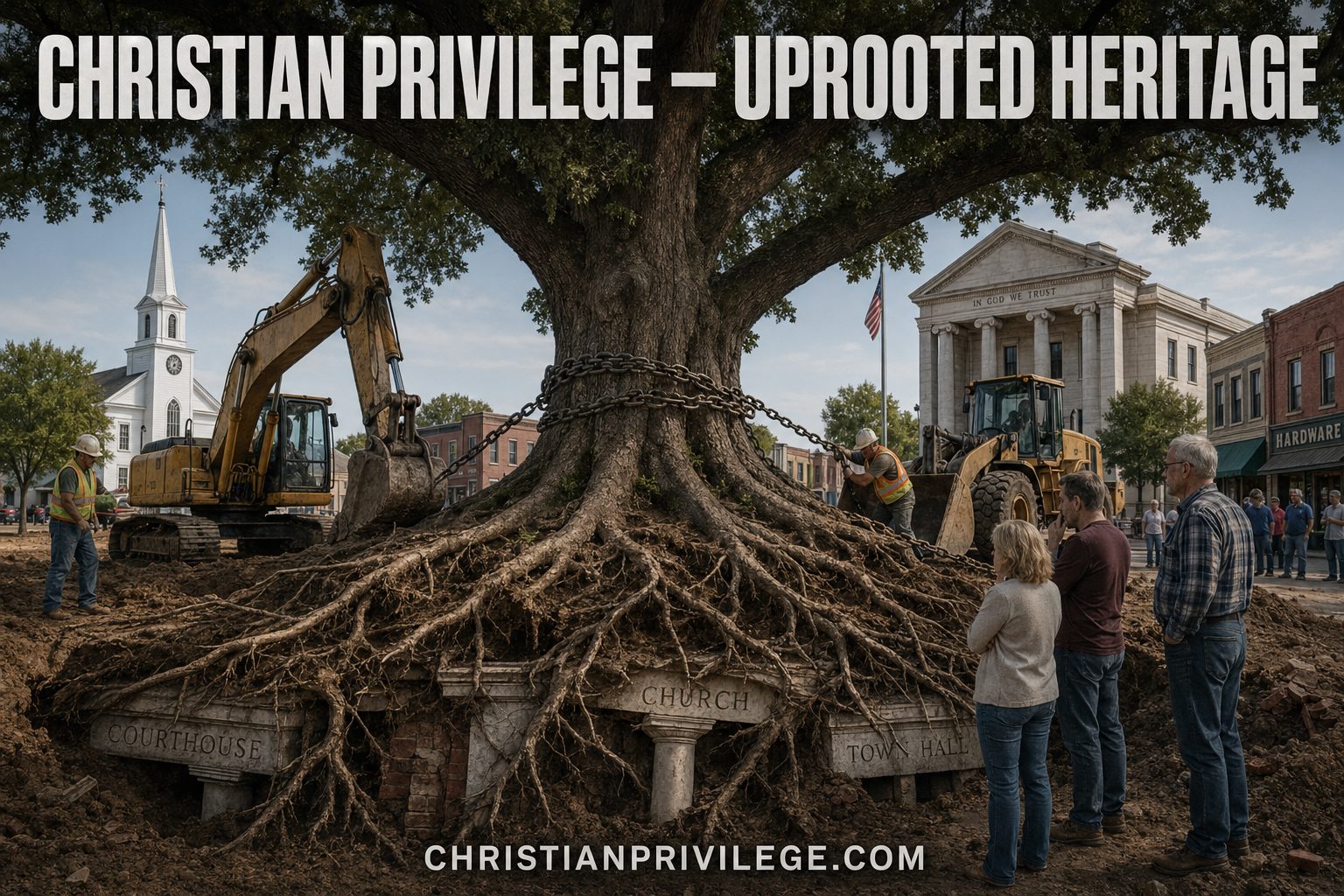
The best metaphor for this project is not reform but uprooting. Imagine a town angry at a vast old tree because its branches are everywhere—over streets, homes, playgrounds, and public buildings. The tree drops leaves in the gutters. Its roots distort sidewalks. It shapes the whole appearance of the place. So the town council decides the tree has too much “privilege.”
There are real inconveniences, so the complaint sounds plausible at first. But once the tree is removed, the summer shade disappears, the soil loosens, birds vanish, erosion worsens, and the town discovers that much of what felt ordinary was quietly being held together by the very thing it resented.
That is the anti-Christian Privilege project in civilizational form. It notices only the spread, not the support. It sees the reach of Christianity in American life and mistakes that reach for illegitimacy. It confuses pervasiveness with oppression. And because it lacks gratitude for inherited goods, it cannot see how many of those goods are attached to the thing it wants removed.
Christian Privilege and the New Official Memory
A society that accepts the strongest critique of Christian Privilege must eventually rewrite its own public memory. Schoolchildren would still be taught that religion mattered, but increasingly in the tone used for explaining a troublesome historical weather pattern—something pervasive, regrettable, and better left behind. Christian influence would be narrated mostly as a cautionary tale.
That distortion would not merely be inaccurate; it would be socially corrosive. A people taught to despise the moral sources of their own civilization become easy prey for cynicism. If the inherited language of duty, repentance, forgiveness, equality, and conscience is presented only as a mask for domination, then future generations will not refine that inheritance. They will mock it, hollow it out, and eventually replace it with whatever ideology is loudest at the moment.
Civilizations can survive criticism. They cannot survive permanent contempt for their own foundations.
Christian Privilege and the Secular Dependence Problem
There is another problem hiding inside the critique of Christian Privilege: its advocates often depend on the moral stability produced by Christian inheritance even while arguing for its removal. They assume a culture can keep the habits of mercy after severing them from the story that made mercy binding. They assume a nation can keep talking about human worth as though worth were self-evident, even after dismantling the metaphysical architecture that made persons more than useful animals.
That may work for a while. Inherited moral capital can be spent long after it stops being replenished. But it cannot be spent forever. A society that steadily evacuates Christianity from its public self-understanding may continue using Christian-shaped language for a generation or two, just as a wealthy family can live lavishly on an old trust fund. Eventually, though, the account runs thin. When that happens, words like equality and dignity remain in circulation, but they become softer, thinner, and more negotiable.
That is one of the most disastrous likely outcomes if the Christian Privilege project succeeded. It would not produce a nobler America. It would produce a morally confused America—one still mouthing the conclusions of Christian civilization while forgetting why anyone should believe them.
Christian Privilege and the Better American Response
The wiser response is not denial. Christianity did shape America, and at times Christians used power badly. But the answer is not to declare Christian inheritance itself illegitimate. The answer is to preserve the American balance: no established church, no coerced conscience, and no cultural cleansing campaign against the faith that helped form the nation.
That balance is what made religious freedom and diversity flourish in early America rather than collapse it. As one summary of the Smithsonian exhibit put it, the creation of religious freedom did not weaken religion as a cultural or moral force; it led to “explosive growth” in religious denominations. In other words, American liberty did not require uprooting Christianity. It required limiting government while allowing beliefs to contend openly in society.
That model remains wiser than the thin and dangerous rhetoric of Christian Privilege. A free people do not become more just by pretending they have no roots. They become more mature by understanding those roots honestly—pruning what is diseased, preserving what still gives life, and refusing the seductive folly of chopping down the tree that still holds the ground together.